Centered fixed width test
Brian Burnell's nuclear weapons history site under construction.
|
Latest update 19 March 2025.
Optimised for Chrome browsers
Functions with Internet Explorer, but not tested in other browsers.
Coming soon is a further section on the complex logistic supply chain for the naval WE.177A weapon.
|
The format is alphabetical, an A-Z of projects. These are projects coded V to W.
|
|
Vampire
Under construction.
|

|
|
Variant A
Under construction.
|
|
|
Violet Club
|
|
|
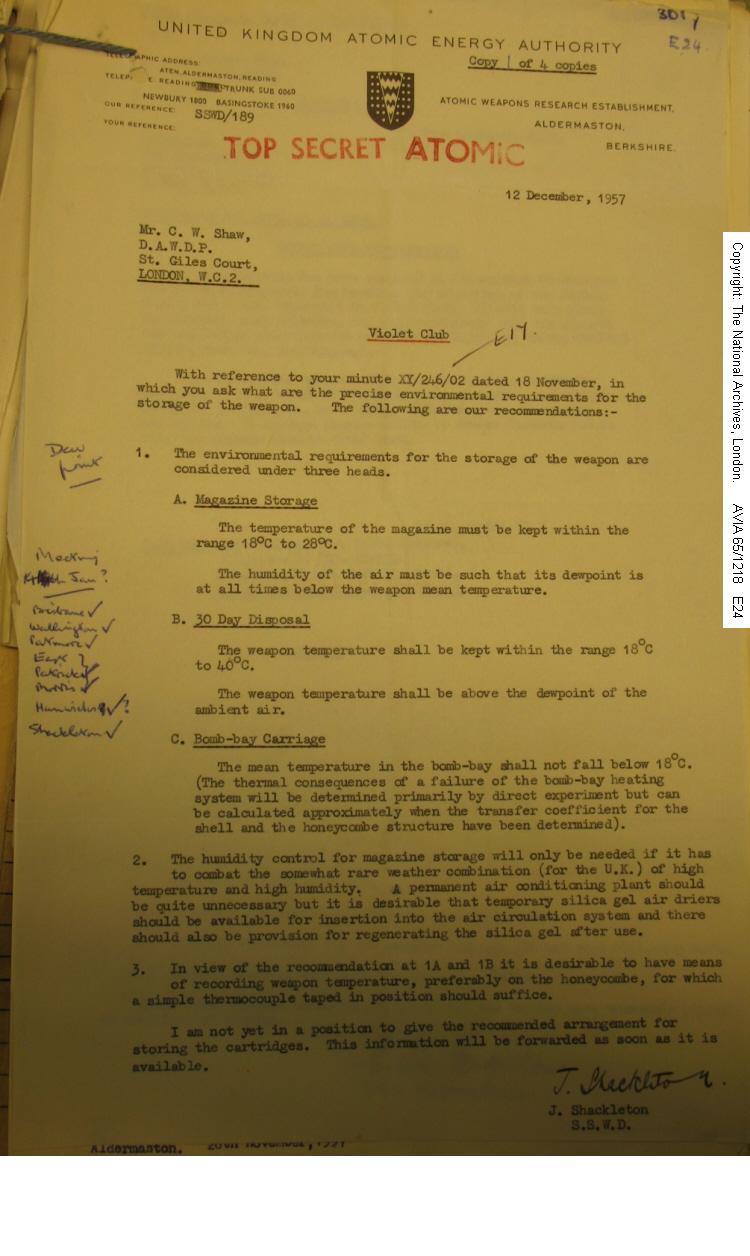
Violet Club was the first high yield weapon deployed by the British, and was intended to provide an emergency capability until a thermonuclear weapon could be developed from the
Christmas Island thermonuclear tests known as Operation Grapple. After the Americans tested a thermonuclear weapon in 1952, followed by the Soviets with Joe 4, and before the UK
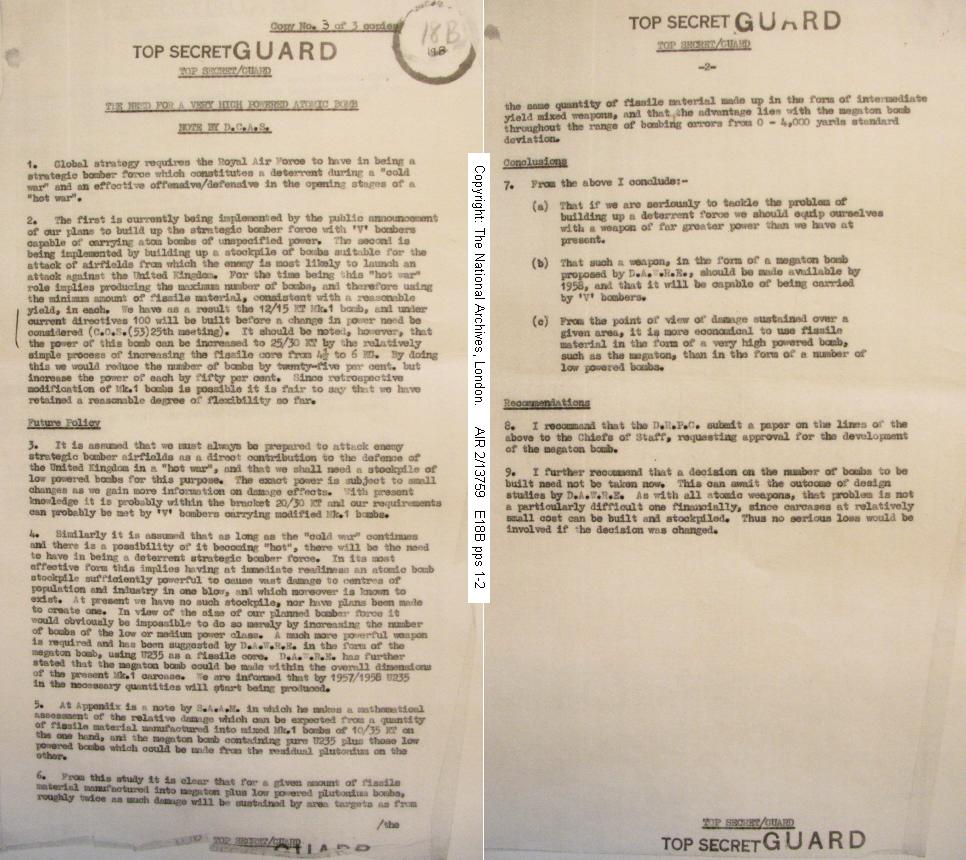
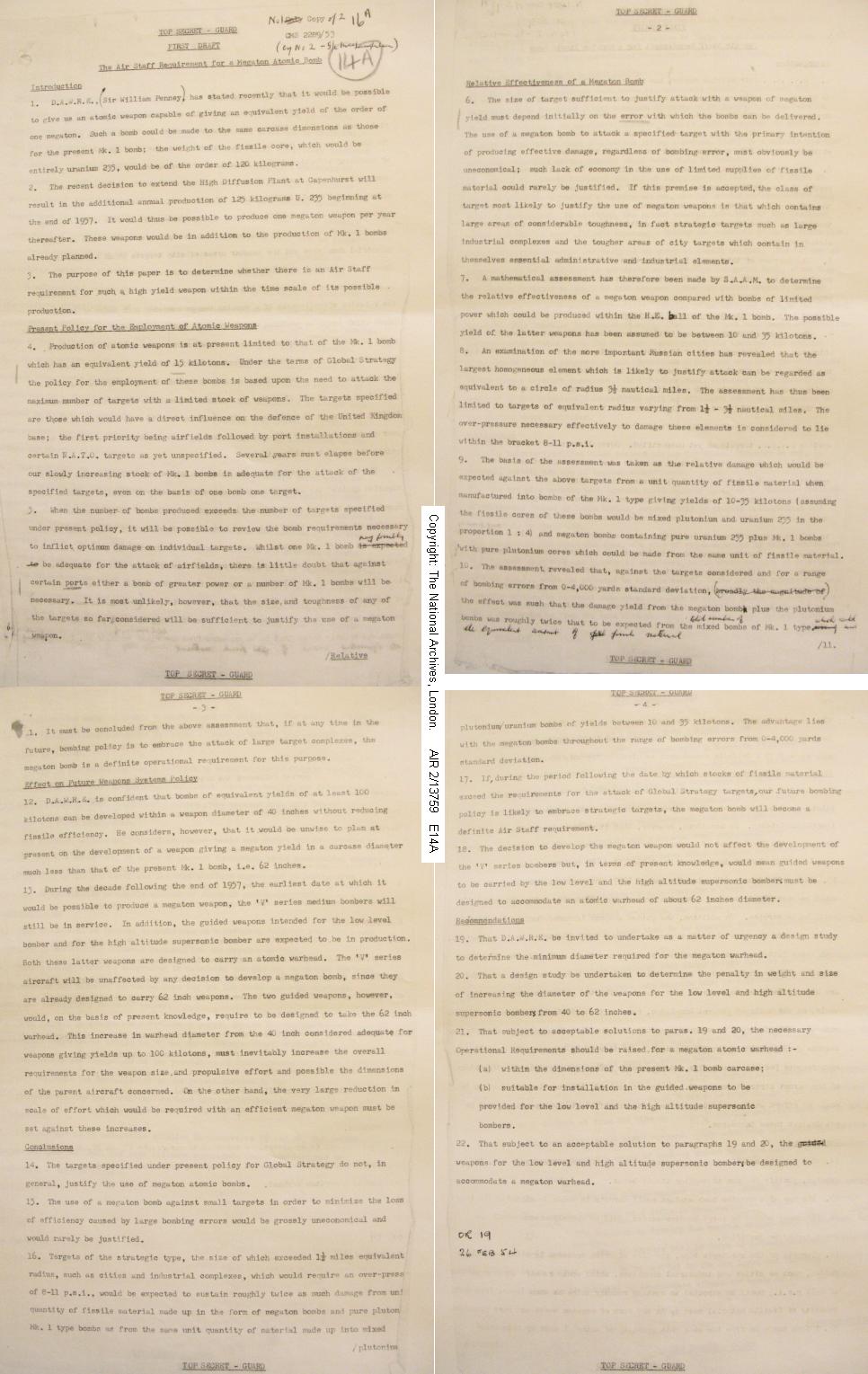
government took a decision in July 1954 to develop a thermonuclear weapon, AWRE Aldermaston were asked in 1953 about the possibilities for a very large pure fission bomb yielding one
megaton. AWRE's response referred to the Zodiak Mk.3 bomb, but progressed no further than a rudimentary study.
(1)
At this time studies were also started
(2)
that ultimately led to a decision in 1954 to develop a thermonuclear weapon, and the design studies were split into two tracks, the Thermonuclear Bomb Type A, a hybrid type, really a very
large boosted fission device, no longer regarded as a thermonuclear weapon, and the Type B, a device that derives a significant amount of energy from fusion.
(3)
The British at that time had not yet discovered the Teller-Ulam technique necessary to initiate fusion, and the Type B was still beyond their capabilities. The intermediate devices proposed,
the Type A hybrids, were similar in concept to the Alarm Clock and Joe-4 layer cake hybrid designs of other nuclear powers. Although these Type A intermediate devices used small quantities
of fusion fuel in their fissile cores to provide a supply of energetic, fast neutrons to boost the efficiency of the fission reaction, they did not derive a measurable amount of energy output from
fusion.
The Violet Club warhead, known variously as Green Grass, Knobkerry, and the Interim Megaton Weapon was a pure, unboosted fission device derived from the two British Type A
weapons, stripped of their fusion boosting elements. It was the largest pure fission weapon deployed by any nuclear power.

|
|
|
|
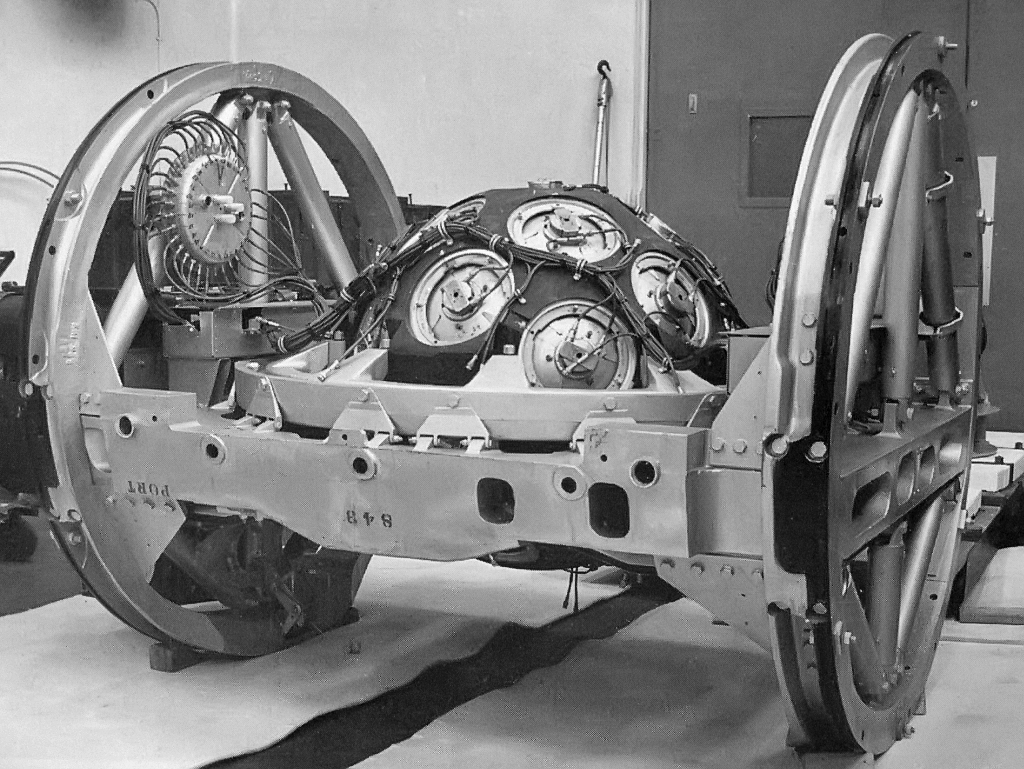
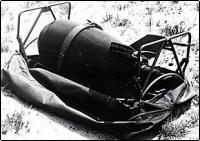
An Orange Herald spherical warhead installed in the centre section frame of a Blue Danube casing prior to the Operation Grapple tests at Christmas Island. Although smaller at approx
36 inches diameter than the Green Grass warhead of Violet Club at 45 inches, the Green Grass warhead would appear to be very similar. A notable difference would be the 72-lenses of the
Green Grass implosion system, derived from the Green Bamboo design, unlike this photograph showing 32 lenses and detonators. The Blue Danube derived firing switch (the large circular
item attached to the frame at top left) is clearly seen, with the firing cables leading to each detonator also clearly visible. Because the timing of the firing signal was so important, each cable
was of exactly identical length, with duplicated cables to the nearest detonators having to be coiled. The nose and tail units of the casing fix to the large circular frame of the modified Blue
Danube casing. Photo: MoD.
|
Genesis
The British Type A hybrid weapon was known as Green Bamboo, weighed approx 4,500 lb (2,045 kg)
(4)
and its spherical shape measured approx 45 inches diameter, with a 72-point implosion system. Green Bamboo was intended as the warhead for all projected British strategic delivery
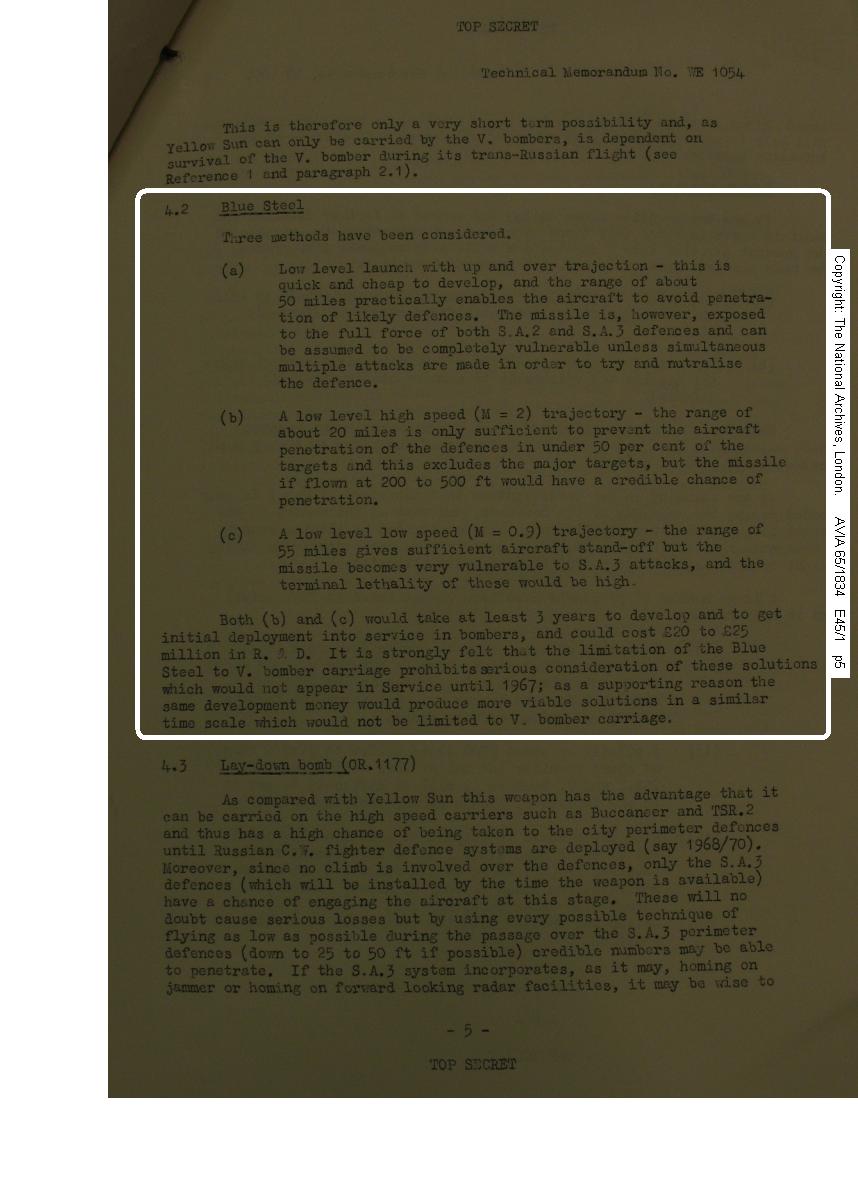
systems of the period; Yellow Sun Stage 1, a free-fall bomb for the V-bombers; Blue Steel an air-launched stand-off missile, also deployed aboard the V-bombers; and Blue Streak, a
silo-based medium-range ballistic missile. Various other proposed delivery systems would also use this standardised warhead. The large girth of both Yellow Sun and Blue Steel was
necessary to accomodate the large spherical implosion system of Green Bamboo.
(5)
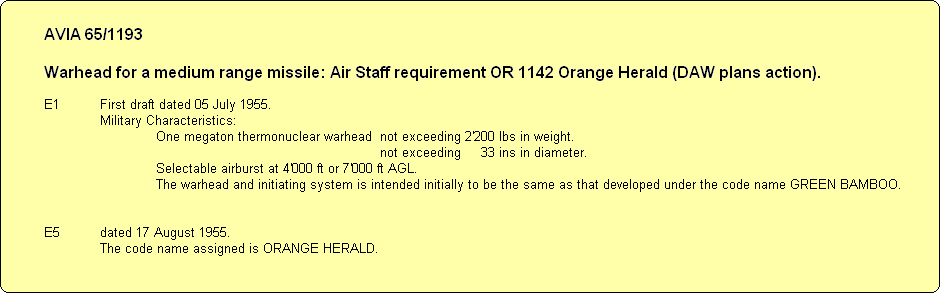
A variant with a smaller implosion sphere, fewer explosive lenses, and some other changes was substituted for Green Bamboo when it was realised that the Blue Streak ballistic missile
would be unable to accommodate the weight of Green Bamboo without appreciable loss of range performance. This Type A hybrid variant was codenamed Orange Herald,
(6)
and its reduced size and weight was achieved by reducing the size of the surrounding explosive layers
(7)
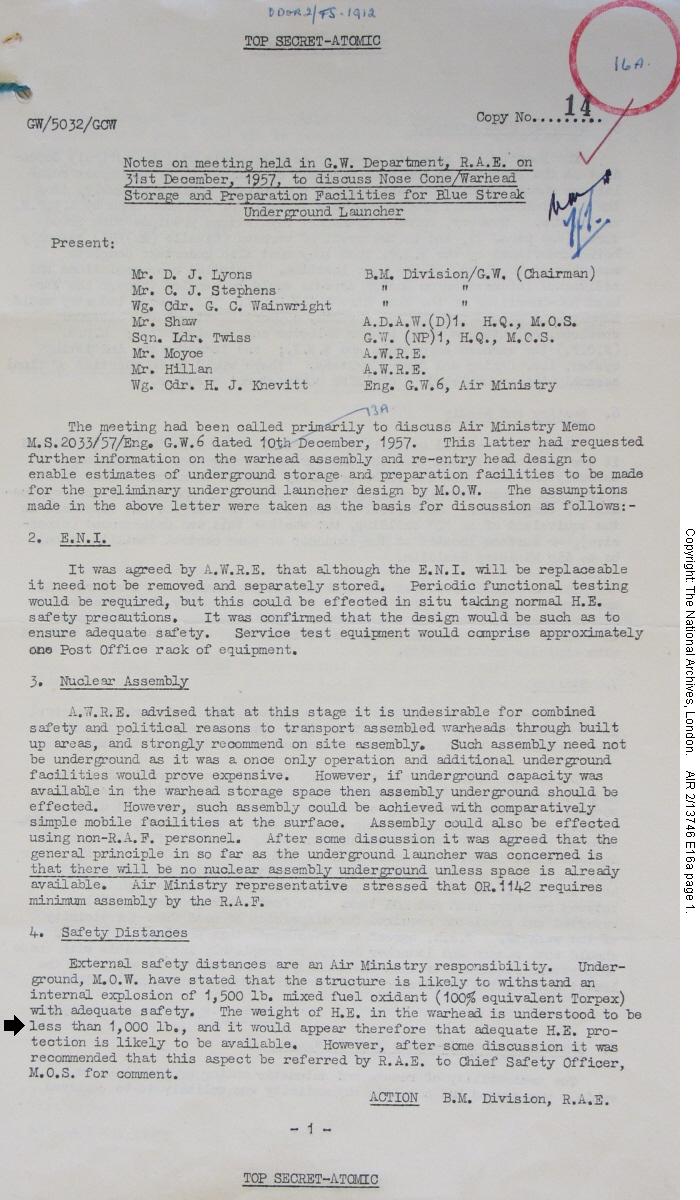
to under 1'000 lbs (454 kg)
(8)
and this would result in less compression at the fissile core when detonated, and a reduced nuclear efficiency and yield. Less fissile material is consumed as a consequence of lower
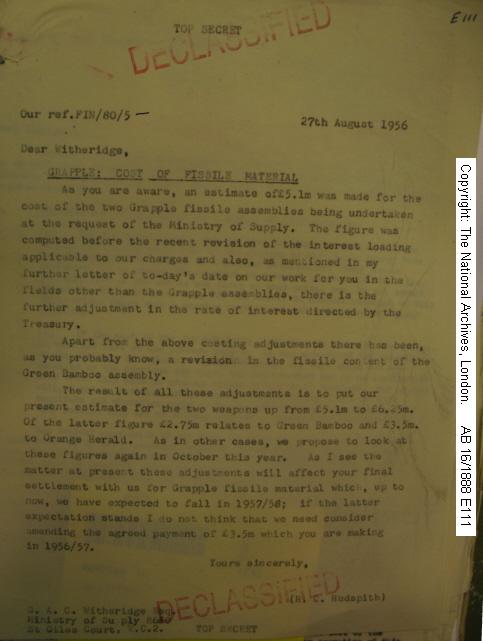
compression before fission ends as the core expands and blows itself apart. To counter this and maintain yield at the desired level of 1 MT the fissile core of Orange Herald was enlarged,
and this in turn made excessive demands on scarce and expensive fissile material. Estimates computed from reliable declassified official sources of actual core cost
(9)
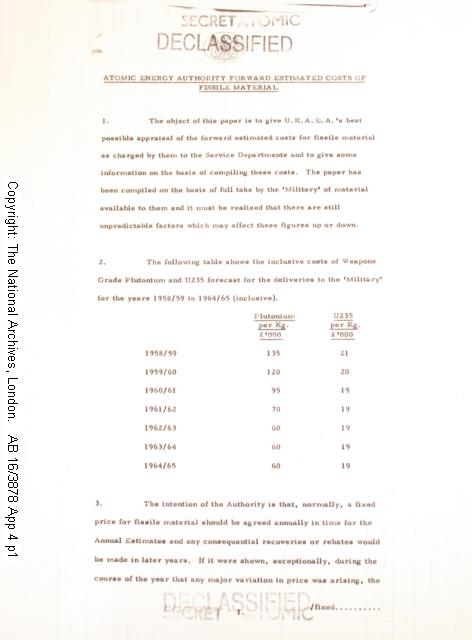
and cost per kilogram of HEU
(10)
put the core sizes of Green Bamboo and Orange Herald as 98 kg and 125 kg respectively, although some other published (and unverified) sources claim lower figures of 87 kg and 117 kg
respectively. A useful benchmark is the declassified document written by Sir William Penney in 1953, that estimated 120 kg of HEU was required for the 1 MT Zodiak Mk.3 unboosted fission warhead.
(11)
This Orange Herald hybrid boosted fission design was tested at Christmas Island in 1957, yielding 720 kt,
(12)
although AWRE scientists considered that the boosting elements failed to work, and that it functioned as a pure fission device.
(13)
Estimates of the quantity of HEU used in this device and in the Green Grass pure fission warhead of Violet Club should be interpreted in this light, although there is no declassified hard
evidence on this point and all published figures are speculative.
These two weapons, Green Bamboo and Orange Herald were intended as the two hybrid weapon predecessors of the first British thermonuclear weapons, based on the Granite design
series that began with Short Granite, Purple Granite, Grapple X, Grapple Y, Flagpole and Halliard at Grapple Z.
|
Emergency Capability Weapon
Delays and failures in the Granite programme and the abandonment of Green Bamboo without a test, left a gap in the programme, and an emergency capability weapon to fill that gap
was devised from elements of both Green Bamboo and Orange Herald; being known as Knobkerry,
(14)
or Green Grass, and the Interim Megaton Weapon.
(15)
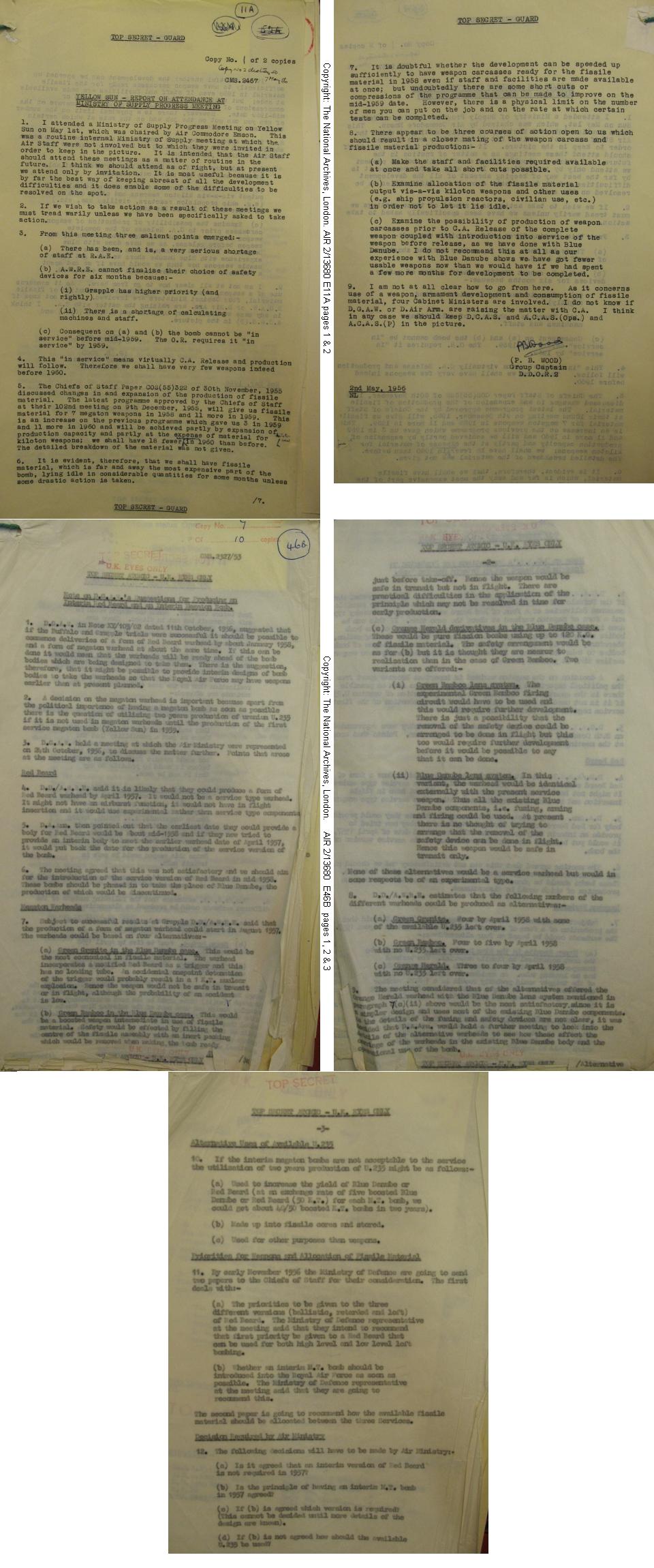
There were also other factors involved in the decision to build an Interim Megaton Weapon. One being that the British production programme was by 1957 producing quantities of HEU for
which there was no immediate need; and the Chiefs of Staff were reluctant to see it continue to languish in stores, unused for weapons, when it was being produced at great cost.
(16)
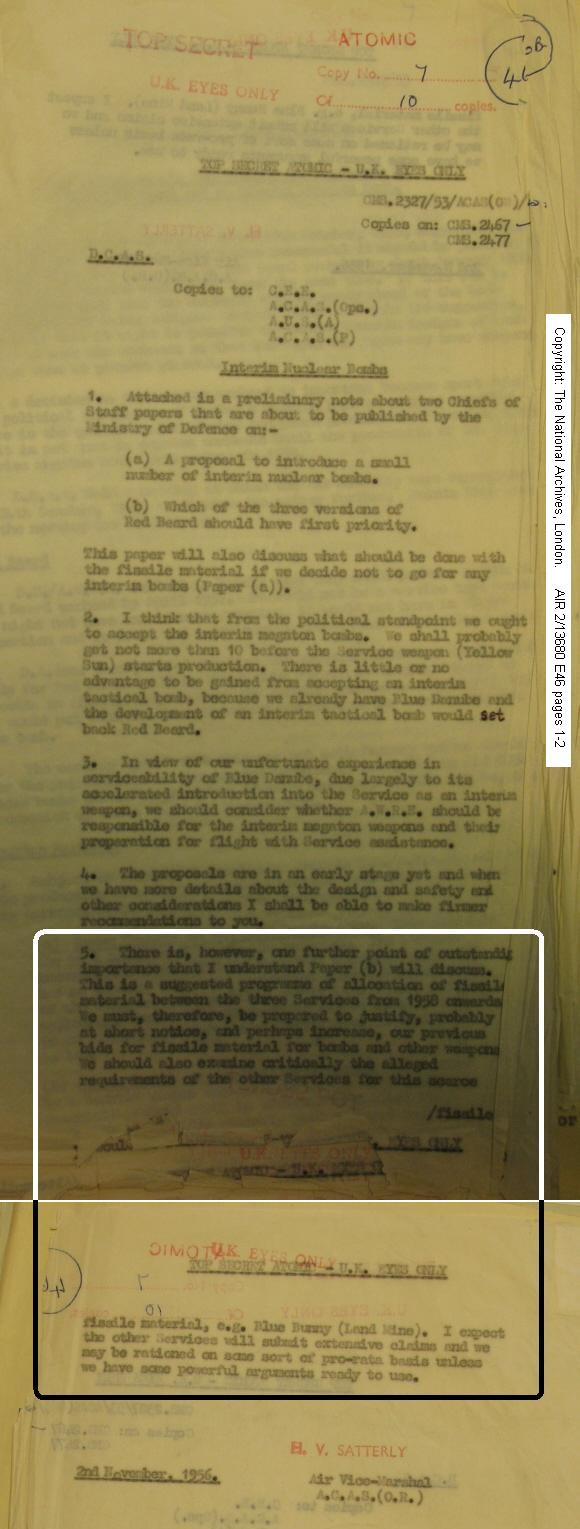
The Air Staff wanted the Interim Megaton Weapon to hoover-up the HEU allocated to them for strategic weapons but not yet used because of delays in development of thermonuclear
weapons. The Air Staff view was that if the stored HEU were not used, they may lose it to the other Services.
(17)
The Army wanted nuclear landmines, and the Navy required HEU for a nuclear submarine reactor development programme, and 60 kg to fuel HMS Dreadnought, the Navy's first
nuclear-powered submarine.
Although there are no reliable or declassified sources for this amount, and one declassified source states the core size as "up to 120 kg"
(18)
the Green Grass warhead containing perhaps 60–86 kg of HEU was hurriedly produced and installed in a modified Blue Danube casing, to be known as Violet Club, until a better weapon
based on a later Yellow Sun casing and the Green Grass warhead could be produced. This later, fully developed weapon, engineered to robust Service standards, was to incorporate better
safety devices with in-flight removal of the nuclear safety device. The earlier Violet Club weapon was expected to be short-lived. A lower standard of safety and robustness was accepted for Violet Club,
(19)
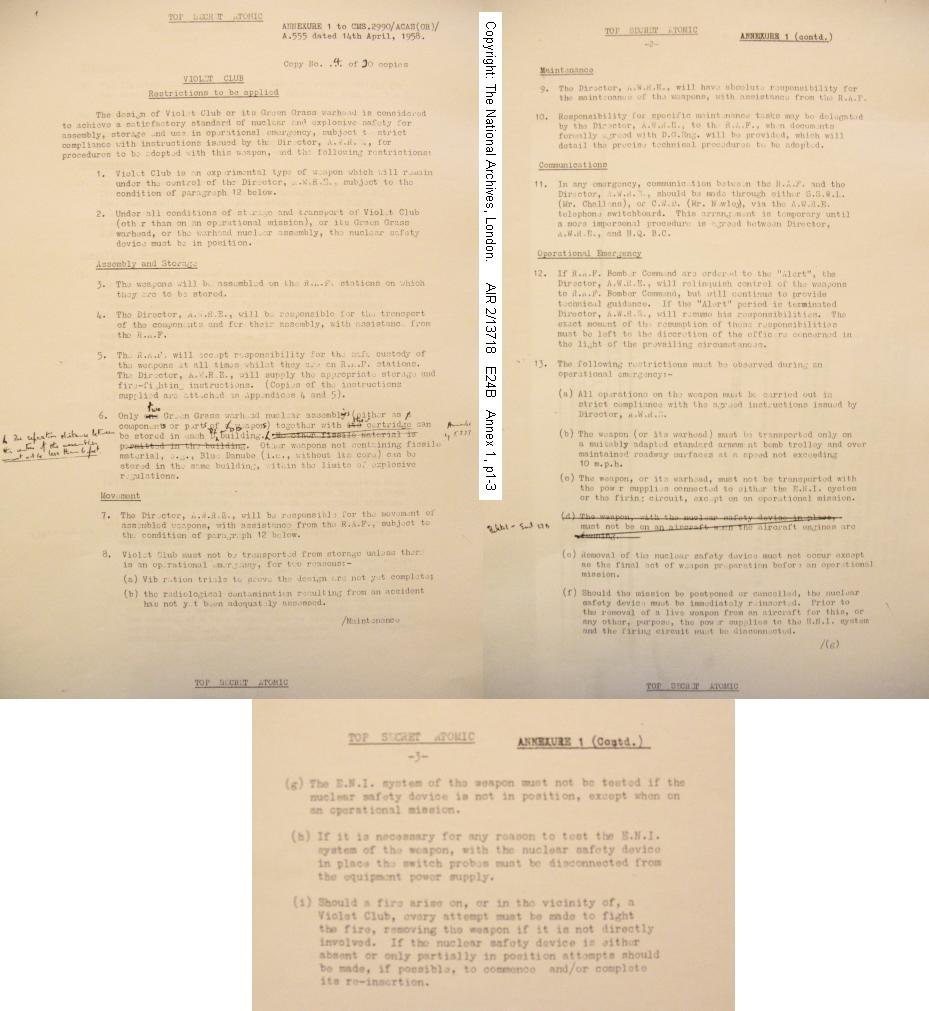
and the nuclear safety device was removed on the ground after loading into the aircraft. At take-off Violet Club was armed and live. Because it was thought too dangerous to fly with it except
in an operational emergency, and too dangerous to attempt a landing at base, no training, exercise or other peacetime flights were ever permitted. Nor was it permitted to be transported by
road to the remote V-bomber dispersal bases around the UK, where the bombers would routinely disperse to at periods of heightened international tension. It had to be stored assembled at
the assigned bomber bases, since transport on public roads from nearby specialist weapon storage facilities was forbidden.
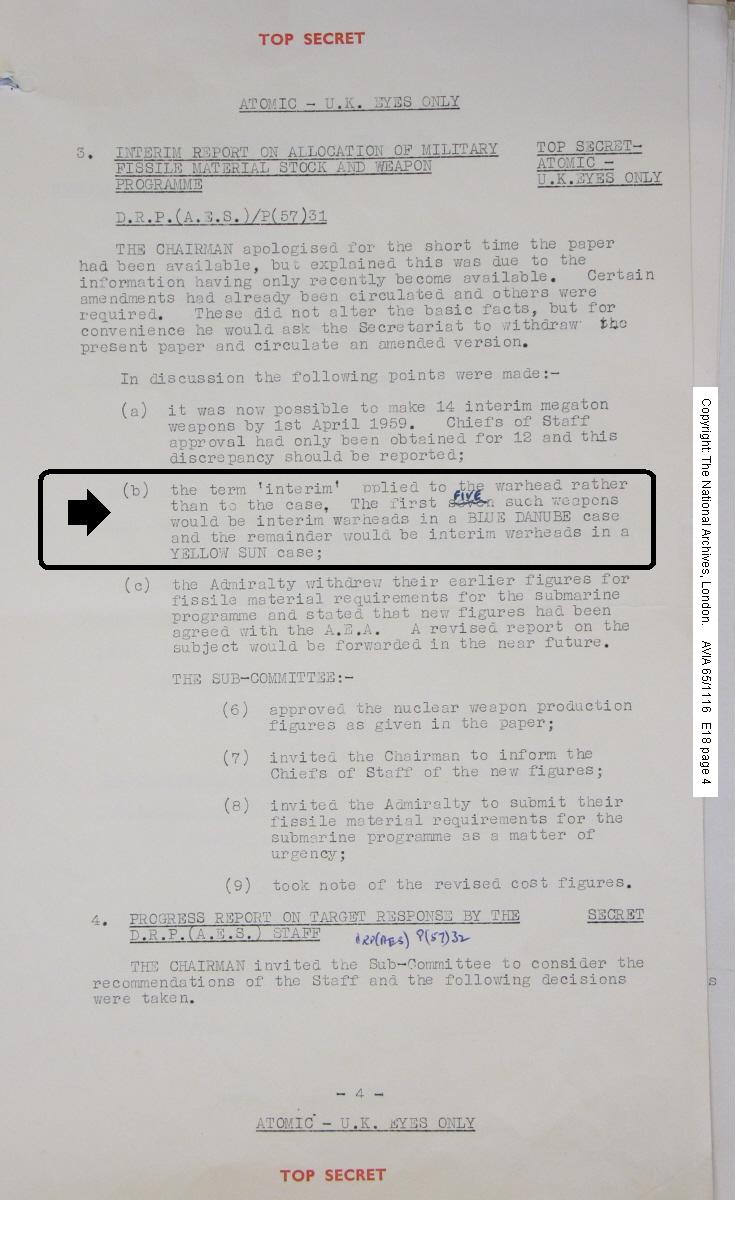
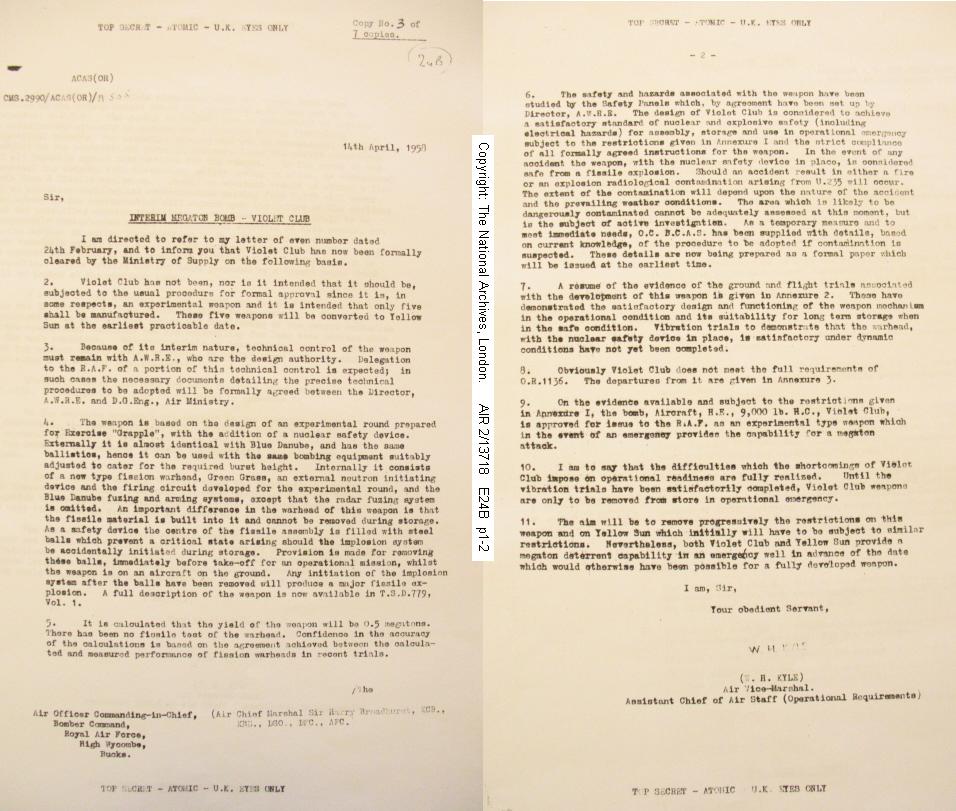
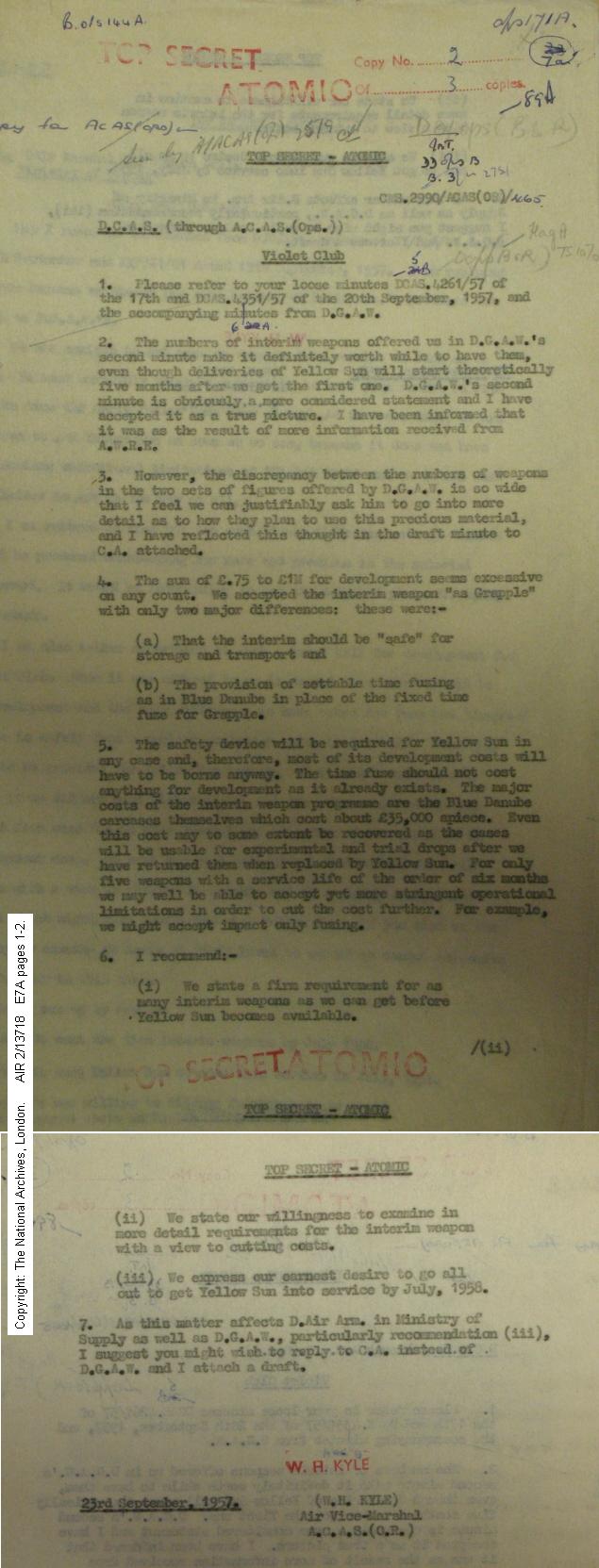
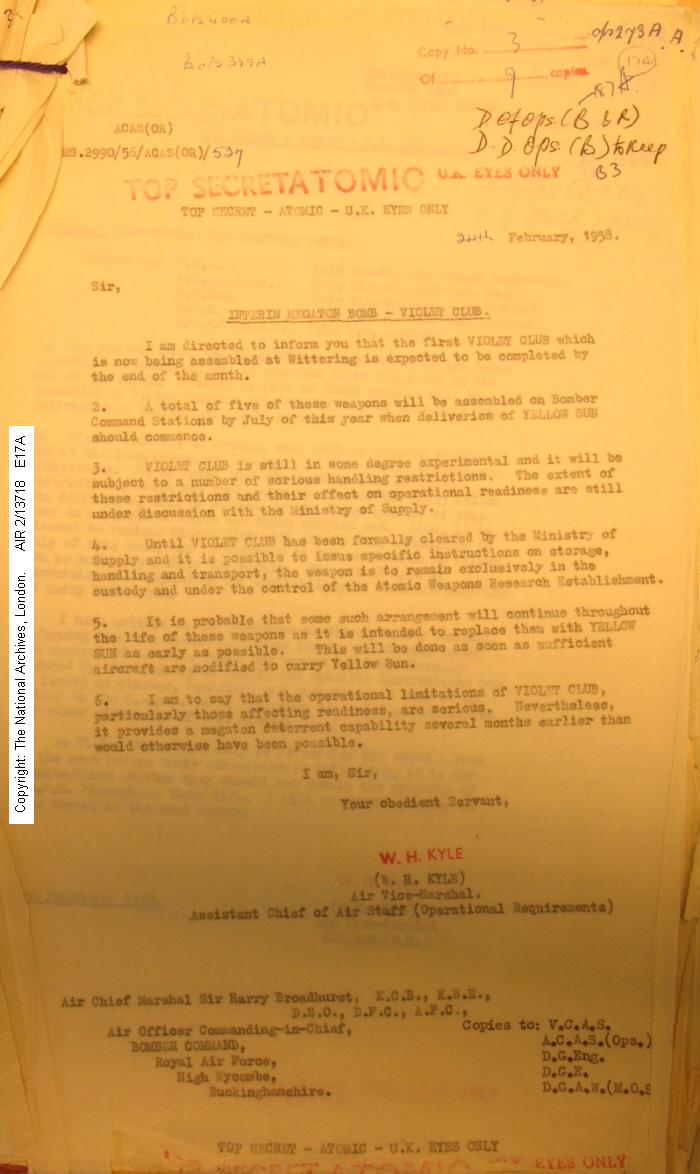
Plans for twelve Violet Club weapons were approved by the Chiefs of Staff for carriage in Vulcan and Victor aircraft, but in the event production was curtailed early, with only five produced,
(20)
carried by Vulcan aircraft only, and known by the RAF description of Bomb, Aircraft, HE 9'000 lb HC,
(21)
and their Green Grass warheads were removed for transfer to Yellow Sun casings when these became available. None were ever under RAF operational control during their short lives.
Because of their complexity, and the fact that they were rushed into service as an emergency capability weapon, and that they were never proof-tested in a full nuclear test, nor been through
the normal rigorous pre-Service testing process conducted by agencies independent of the designers and manufacturers, they were never formally accepted into service, or approved for
Service use. Instead, the weapons were in the custody of AWRE staff at RAF bases, to be released to the RAF in the event of a national emergency being declared by the relevant authority.
(22)
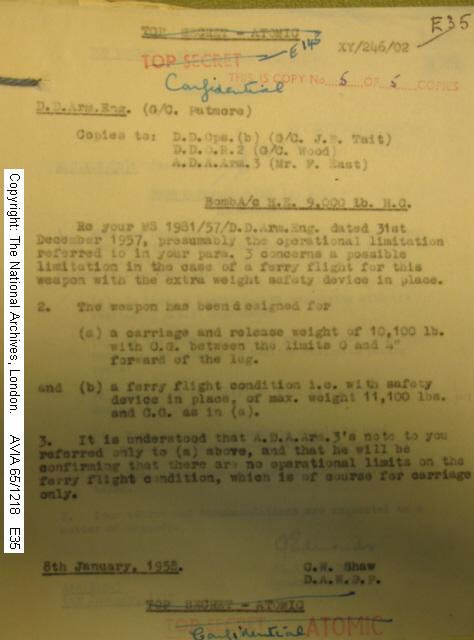
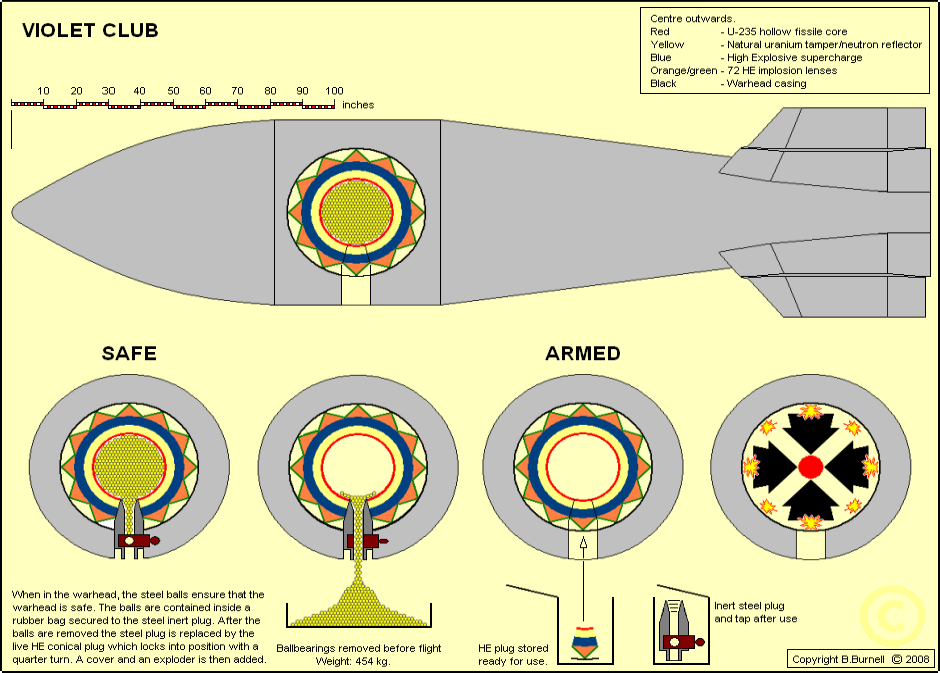
Although Violet Club was known by the Service designation Bomb, Aircraft, HE 9'000 lb HC, this was a notional weight only. Actual weight was different. To make use of the existing Blue
Danube casing without costly and time-consuming further tests, conditions that determined the known ballistic properties of the casing were replicated in Violet Club, with ballast carried to
match Blue Danube's weight of 10'250 lbs and centre of gravity. The added weight of the ballbearing safety device increased total weight to 11'250 lbs (5'114 kg) when loaded into an aircraft
for a 30-day readiness period,
(23)
although the aircraft release mechanism was limited to 11'100 lbs for a ferry flight.
(24)
Dispersal to remote airfields with the safety device in place was therefore not possible.
|
|
Design defects
Violet Club and Green Grass were not considered satisfactory designs and suffered from numerous design defects, some, in the case of Violet Club's casing, being inherited from the
Blue Danube casing that had itself suffered from numerous defects. Many of these were attributable to it being the first British nuclear bomb, and it being the first bomb to be designed for
release from aircraft flying at the great heights and speeds envisaged; and there was no experience of bomb release at more than twice the height and speed of the previous generation of
medium bombers.
The Blue Danube casing also suffered from being the first bomb casing designed with a large di-electric plastic nose. There was little previous manufacturing experience of these very
large plastic mouldings, with only two manufacturers in the UK able to work to the demanding standards required, and these mouldings were the cause of much frustration with operation of the
radar fuzes in Blue Danube. These fuzes, based on radar altimeter technology, were omitted from Violet Club, and replaced with off-the-shelf clockwork timers backed-up with barometric
fuzes. Without the requirement for radar transparency, the plastic nose was replaced with a less troublesome metallic nose in Violet Club.
The barometric fuzes themselves were an issue, because the aerodynamic design of the casing was very 'slippery' with a terminal velocity greater than Mach 2 when released from great
heights and speeds. At this time, no aircraft could reach those speeds, and few could exceed Mach 1 except in a dive. Indeed, prior to the delivery of the first V-bomber in 1954, the RAF had
no means of carrying the Blue Danube casing to the heights, or at the speeds required for test flights. At the high terminal speeds reached by the casing, the barometric sensing devices were
prone to errors unless located where transonic shockwaves could not effect accuracy, but there was little understanding or experience to draw upon. In essence, the barometric fuzes were
used in Blue Danube as 'gates' to switch on the power supply to the radar (altimeter) fuzes. This technique permitted the radar fuzes to be used sparingly, in the last few seconds before
detonation at a measured height above ground, and being switched on only briefly, it was hoped that the radar fuzes would then be immune to enemy jamming. The barometric fuzes alone
could not acheive the accuracy demanded without calibration to local air pressure. In Violet Club, this complex system was discarded, and a simple clockwork timer was activated at bomb
release, that could be set using the casing's known measured ballistic performance data. The clockwork fuze was then backed-up with a barometric fuze and an impact fuze to ensure
detonation in the event of a failed clockwork and barometic fuze.
A major defect was the reliance on batteries for all electrical power after release from the aircraft. The batteries used were 6v lead acid accumulators, - commercial motorcycle
batteries, that were kept fully-charged and inserted into the weapon on the ground immediately before flight. In Violet Club they were used to charge large capacitors in the warhead firing
circuits and provide power to the Blue Stone ENI (External Neutron Initiator). Both were essential components of the firing circuits. Storing the batteries outside the weapon while on the ground
was thought a necessary safety break between the power supply and the firing circuits, but contributed to lengthy delays while the batteries were inserted at the last minute before flight. Later
generations of weapons used ram-air-driven generators that provided no power prior to release, or thermal batteries that could be safely stored in the weapon for lengthy periods without
maintenance, and the necessary safety break was provided by other means, eg speed detectors activated only by bomb release.
Other design flaws, the rushed Service entry and uncertainty about shelf-life of the weapon led to a requirement for a complete strip-down and inspection at six-monthly intervals. Each
taking three weeks per weapon using AWRE civilian staff. The unstable nature of the weapon, with the fissile core being greater than one uncompressed critical mass, required that the work
being done in-situ at RAF bases, causing considerable disruption to operational duties. Three principal reasons for the strip-downs were deterioration of the rubber bag lining the inside
of the hollow spherical core, that was in intimate contact with the steel balls, corrosion of the steel ballbearings, which exacerbated rubber bag deterioration, and deterioration of the HE,
which was prone to cracking. Replacement of the HE would cost RAF budgets in excess of £92'000 adjusted to 2007 prices.
(25)
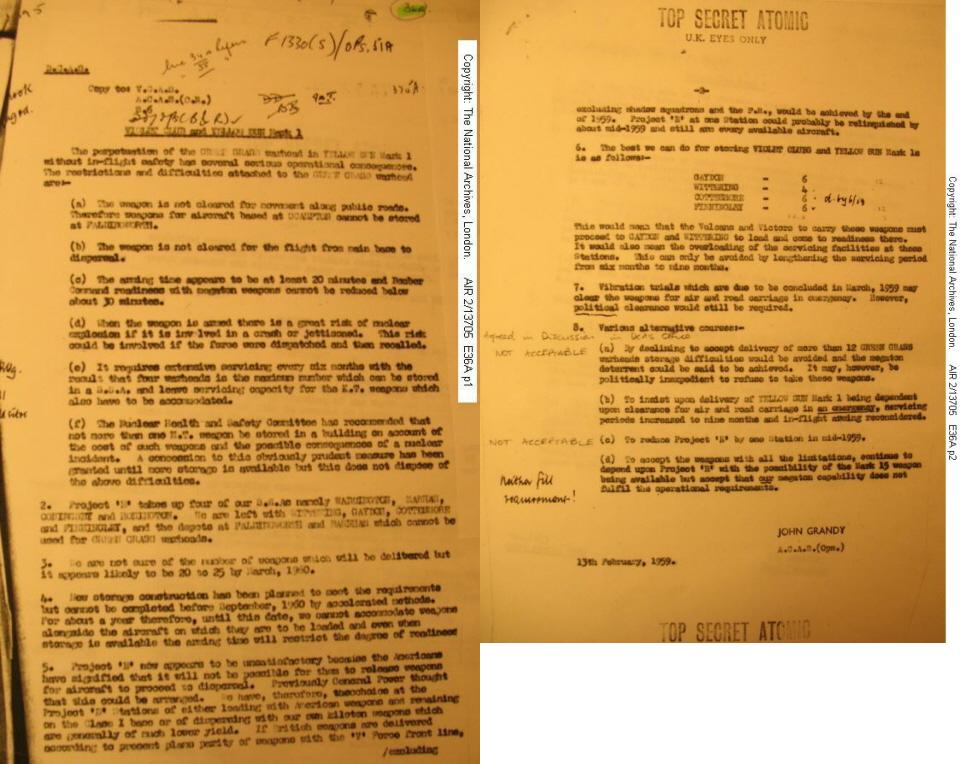
The RAF were under considerable pressure to find adequate storage for the weapons at operational bases, because the weapon was too unstable to be transported by road to suitable
specialist weapon storage facilities, or to be stored in close proximity to other similar weapons. One weapon per storage building was the rule. Strip-down inspections were a further hindrance
to their operational duties, seriously jeopardising essential safety and servicing work on tactical nuclear weapons.
(26)
|
Green Grass warhead
The Green Grass warhead of Violet Club was a hollow spherical implosion design; a fissile core of HEU (Highly Enriched Uranium, weapons or military grade U-235) surrounded by an
explosive supercharge and a 72-lens implosion system. The HEU core brought together into one solid piece was greater than one uncompressed critical mass. To prevent spontaneous
fission and keep it sub-critical the HEU was fabricated into a hollow thin-walled sphere of approximately 22 in (560mm) internal diameter and approximately 0.126 in (3.21mm) thick,
although there is as yet, no declassified hard evidence to support these figures computed from other declassified data.. When triggered, the HE implosion system collapsed the core inwards
into a solid sphere of approx 7 in (180 mm) diameter at normal density, continuing to crush it yet smaller. The hollow core also benefited from what is referred to as levitation, where the
airspace within the hollow sphere permits the collapsing shell to gather speed before impacting at the centre. This process has been described as 'hammering' the core as in driving a nail
using the kinetic energy of a swinging hammer, as distinct from placing the hammerhead on a nail and pushing. Although it is not clear that British designers were aware of the benefits of a
levitated design at this stage.
The Green Grass warhead contained perhaps 60–86 kg of HEU (although there are no declassified direct sources for this figure). The most reliable figure so far obtained is 58.9 kg,
computed from declassified figures of amounts of material recovered and recycled after Green Grass was withdrawn from service. Declassified records show that in total there were
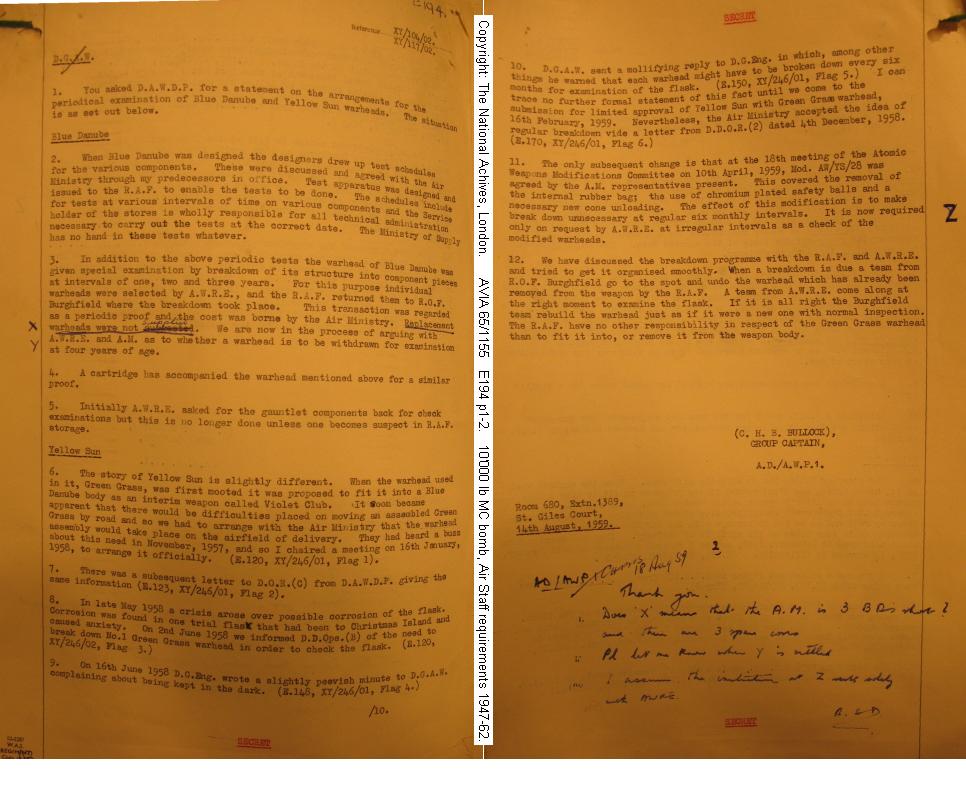
thirtyseven Green Grass warheads manufactured. Five were installed in Violet Club casings initially, before being transferred to newer Yellow Sun Mk.1 casings to join thirtytwo others installed
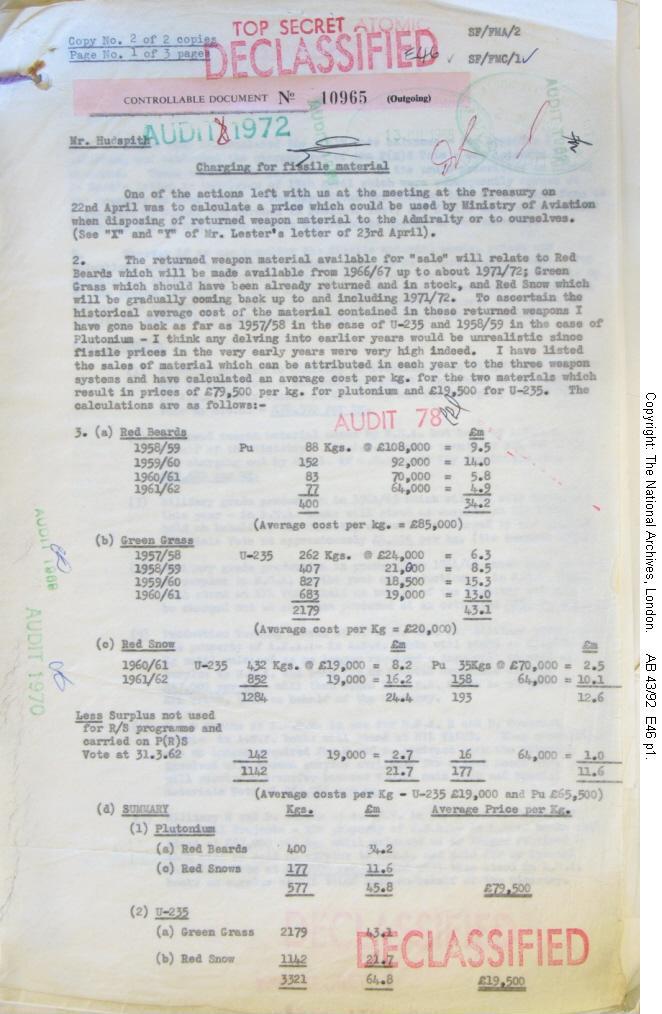
in Yellow Sun Mk.1 casings; thirtyseven Green Grass warheads in total. 2179 kg of U-235 was recovered
(27)
from these thirtyseven warheads, and the arithmetic shows an unexpectedly low figure of 58.9 kg per warhead. Although more than an uncompressed bare (unreflected) spherical critical mass of 52 kg,
(28)
this is a quantity of U-235 considerably less than the 64 kg
(29)
that was used in Little Boy used at Hiroshima. Nevertheless, the RAF were nervous of the weapon.
The hollow spherical core was entirely supported by a tamper (believed to be tuballoy, or natural uranium) and the HE supercharge and lenses. These in turn were supported inside a cast
magnesium 'honeycomb' or matrix to aid structural strength.
(30)
The honeycomb can be visualised as similar in concept to an eggbox supporting an egg, with holes piercing it to permit wiring and other services to pass.
Knobkerry, or Green Grass was the first deployed British warhead to dispense with the crude crush-type polonium-210 and beryllium neutron generators used to initiate fission with a
burst of neutrons. These were used in all earlier weapon designs, including Little Boy, Fat Man, Blue Danube and Red Beard, and were a great inconvenience with their short shelf-life of
around six to nine months before requiring replacement. The logistical difficulties were enormous. Instead, Green Grass used an Electronic Neutron Generator or ENI codenamed Blue
Stone, also referred to as Unit 386D, which had the virtue of being located outside the implosion sphere and was adjustable, allowing the neutron burst to be triggered at precisely
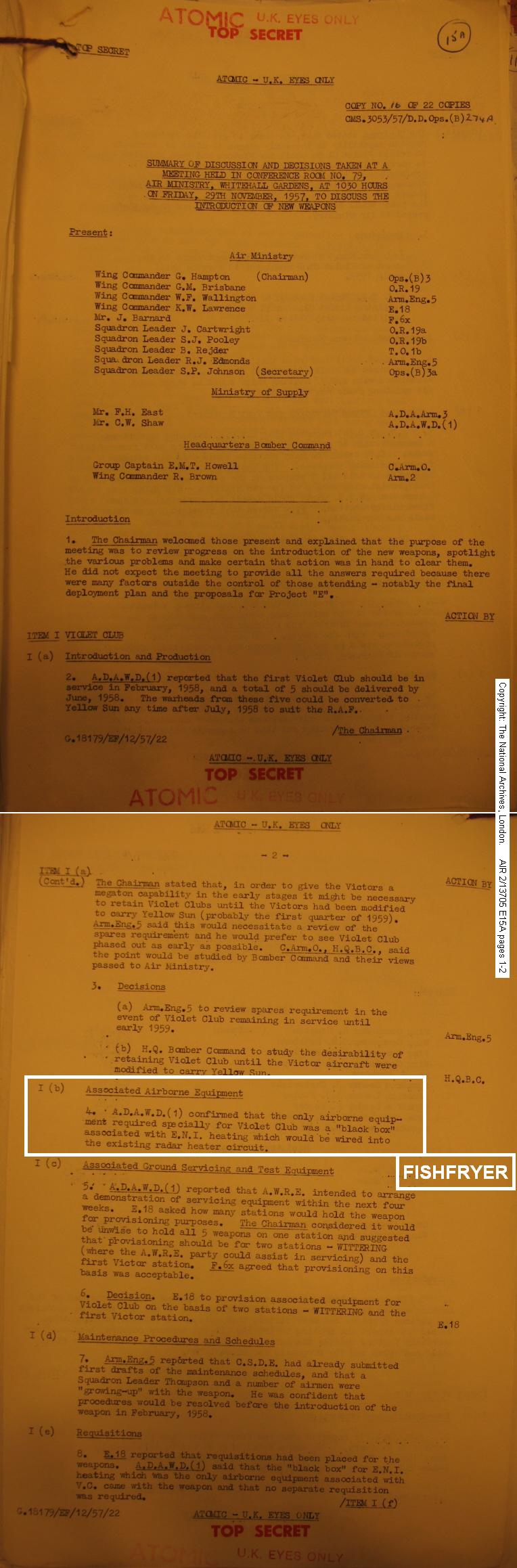
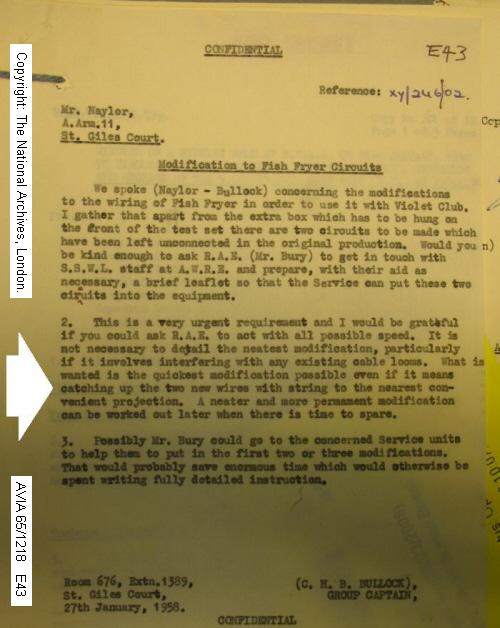
the right moment to maximise yield. Prior to release, the Blue Stone ENI drew electrical power from the aircraft via an improvised device known by the codeword Fishfryer, which
supplied power to warm-up the ENI and charge capacitors.
(31)
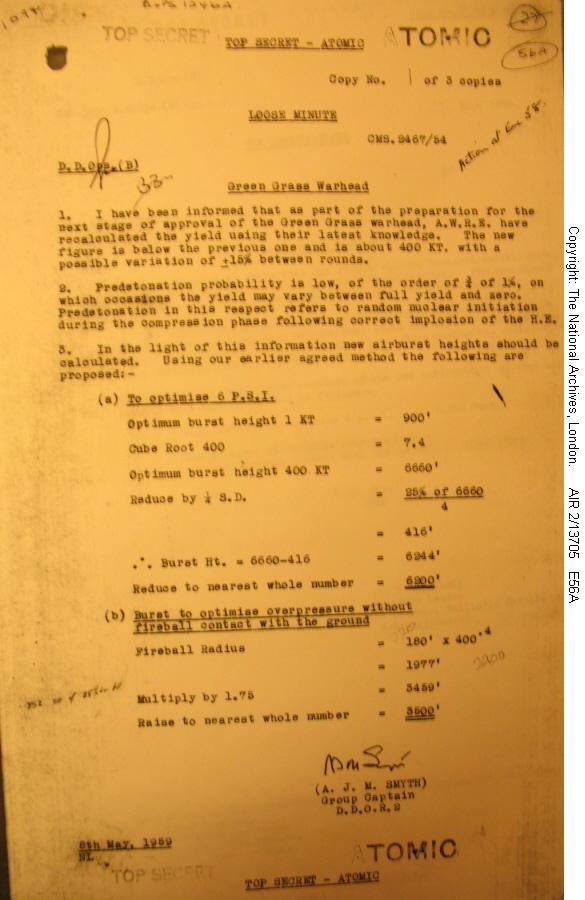
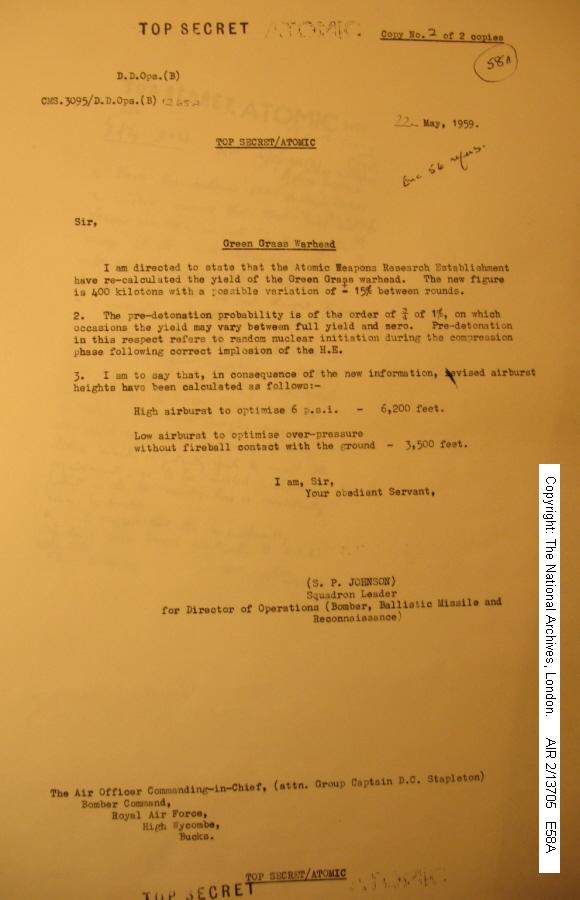
Burst heights of 3'500 ft and 6200 ft AGL (above ground level)
(32)
were chosen to maximise ground overpressure at 6psi, or to maximise overpressure without fireball ground contact, using a barometric fuze with a clockwork timer backup.
(33)
Impact and graze fuzes provided an assured detonation. With the exception of the clockwork timer, these fuzing items were inherited with the Blue Danube casing. The radar altimeter fuzes
were omitted, and the radar-transparent thermoplastic nosecone was replaced with a metal nose.
(34)
|
|
Safety and arming
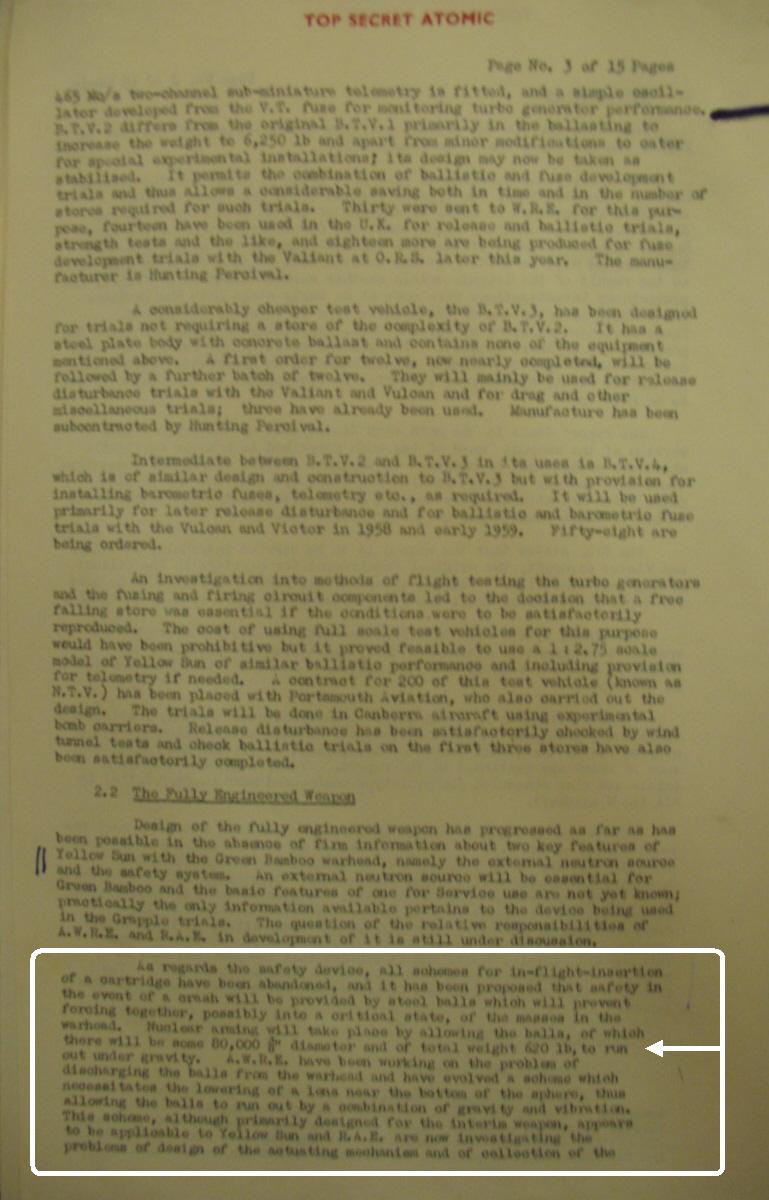
The safety system used was inherited from the Green Bamboo design, which also had a core fabricated as a hollow spherical shell,
although smaller than Green Grass, required fewer steel balls to fill it, and that weighed considerably less at 620 lbs (282 kg).
(35)
The weight of the safety system balls in Green Grass at 1'040 lbs (473 kg)
(36)
suggests a much larger diameter for the fissile core's spherical shell , although there is as yet no declassified hard evidence.
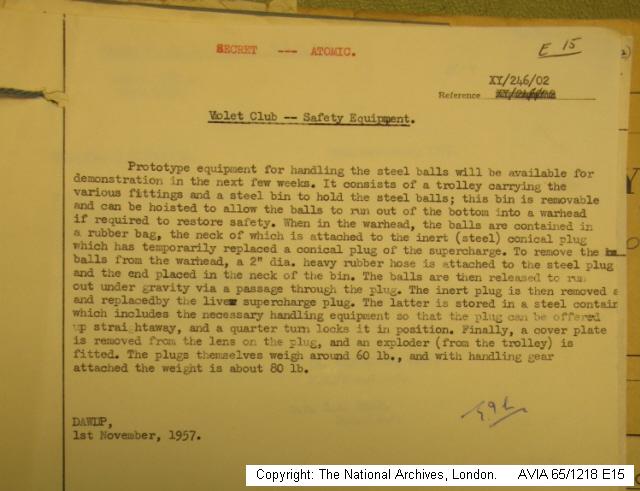
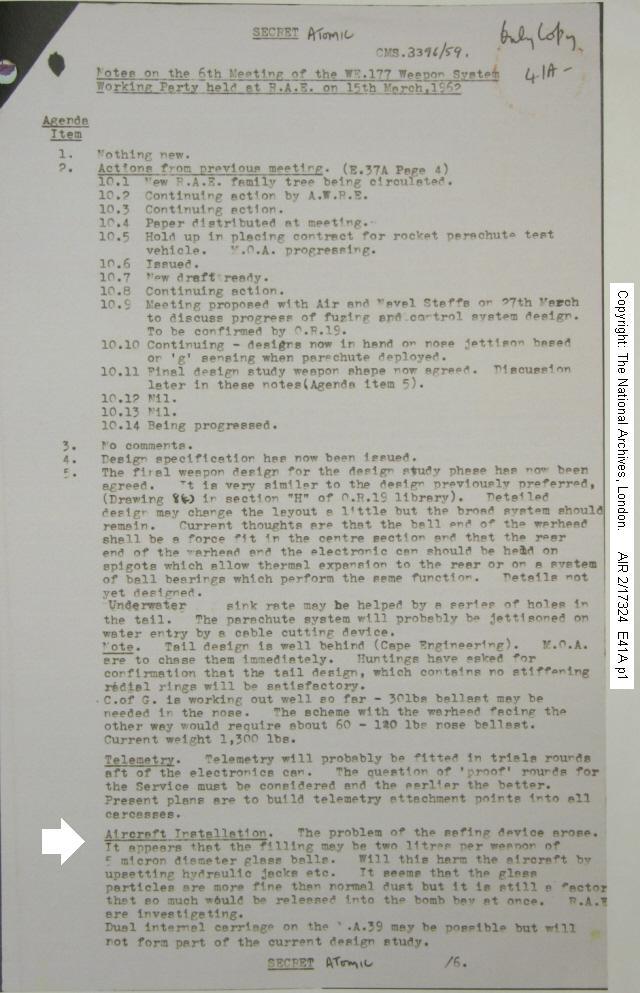
A fire in a bomb store or a traffic collision on an airfield could result in a partial crushing or collapse of the non-removable HEU core, and in turn a spontaneous nuclear chain reaction. AWRE
responded by inserting a rubber bag, rather akin to an outsize female condom, though a hole in the core, and filled this with 6'500
(37)
steel ball bearings weighing 1'040 lbs (473 kg).
(34)
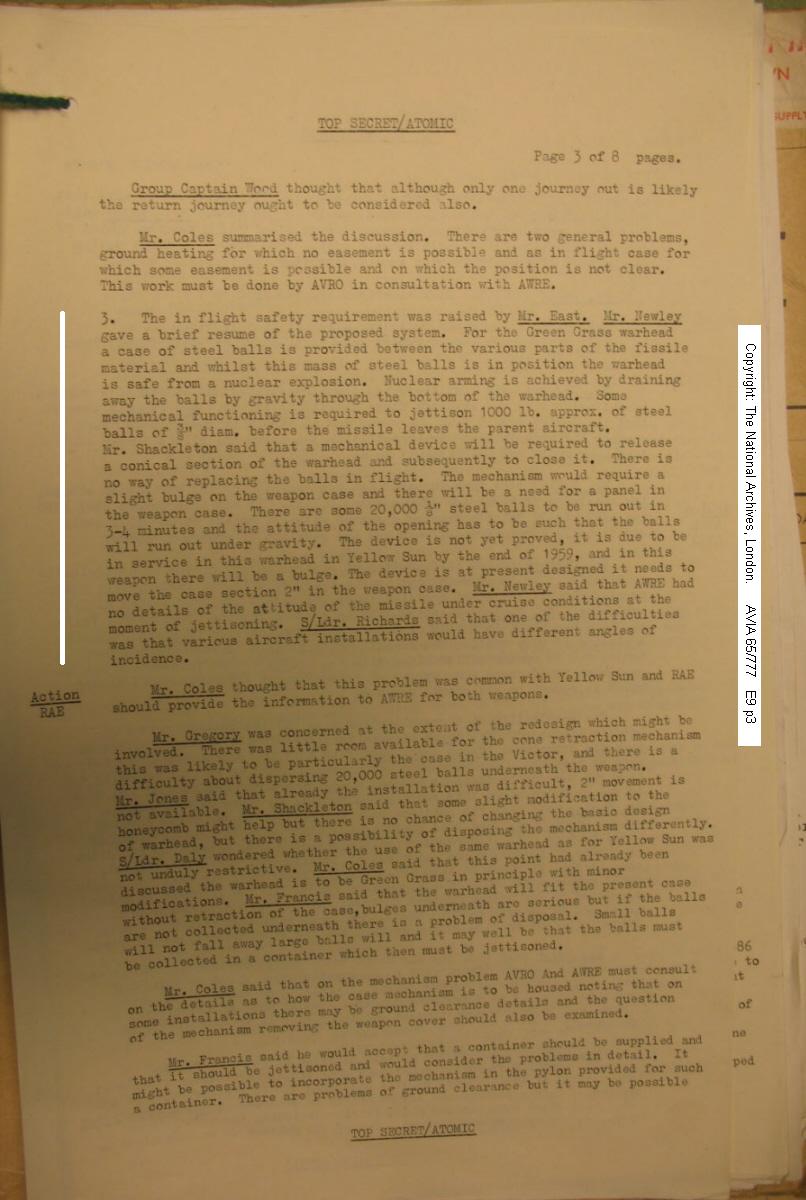
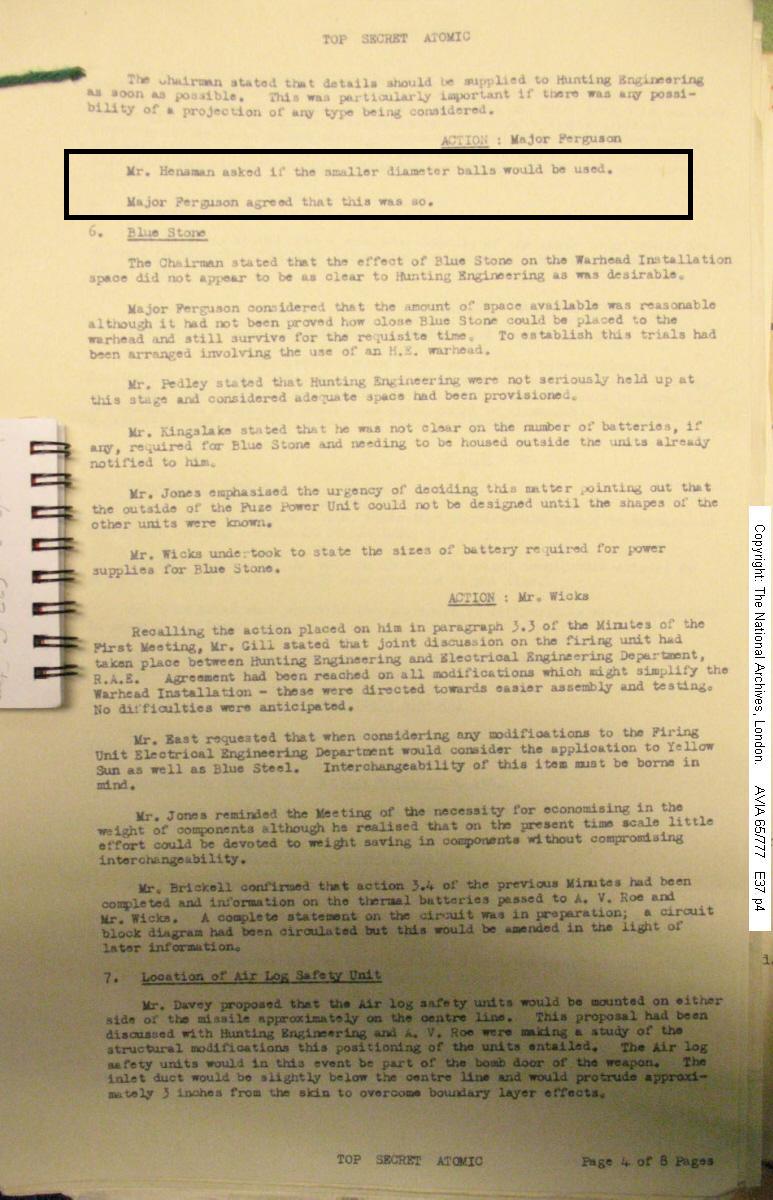
That computes to balls of one inch diameter. When Green Grass warheads installed in Violet Club were later transferred to a more modern bomb casing, Yellow Sun Mk.1, the quantity of
these steel balls was increased to 120,000 with a reduction in size to 0.375 in diameter (9.5 mm) to make removal easier,
(38)
and there is a claim elsewhere in a book commissioned by the MoD that the quantity was increased yet further to 133'000,
(39)
which suggests that the ball diameter was reduced further to approximately 9mm. The balls were retained in the device by sealing the hole with a bung.
(40)
The steel balls were intended to prevent a nuclear detonation even if the explosives fired accidentally, or in any conceivable accident. The ball bearings had to be removed through the hole in
the bomb casing during flight preparation, after the bomb was winched into the aircraft. The ball bearings then had to be re-inserted into the lowered and upturned bomb before transport back
to the bomb store. The batteries were also installed before flight, and the neutron generator enabled, and without the final safety device of the ball bearings installed, these weapons
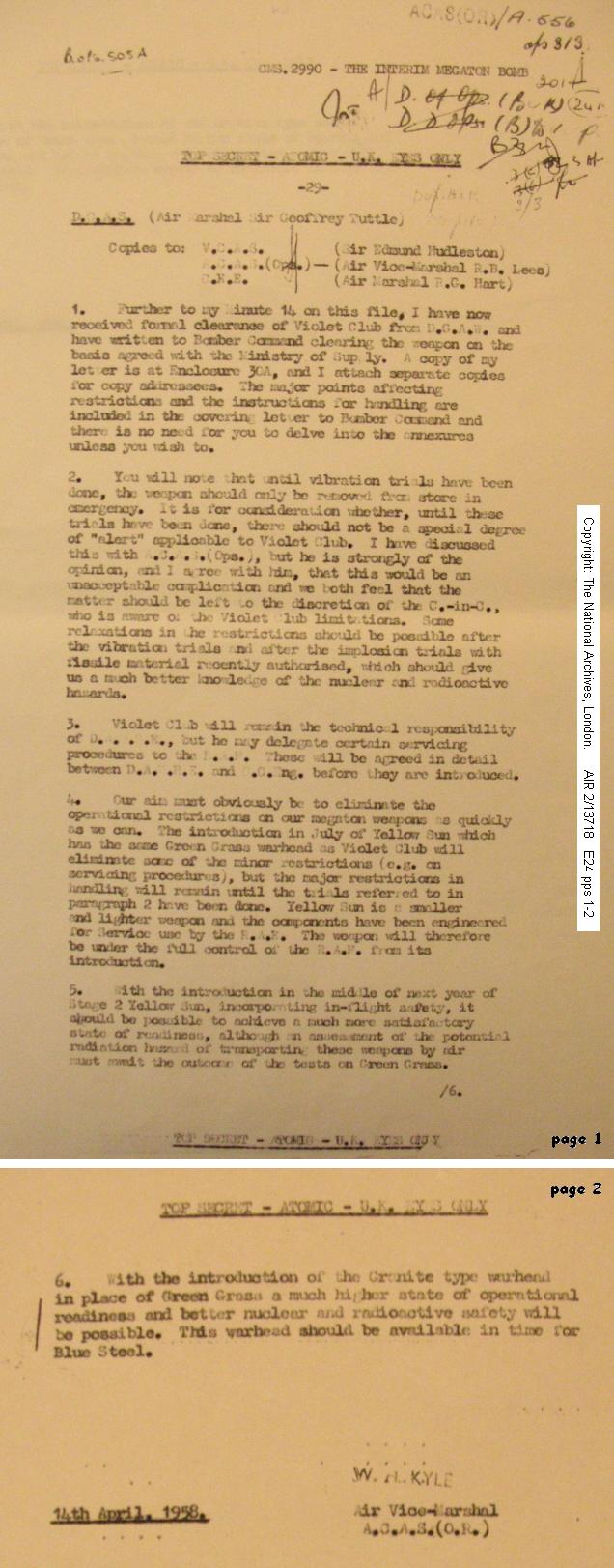
were armed and live, and the RAF view was that they were too dangerous to be flown on exercises. Bomber Command exercises demonstrated that flight preparation followed by a scramble
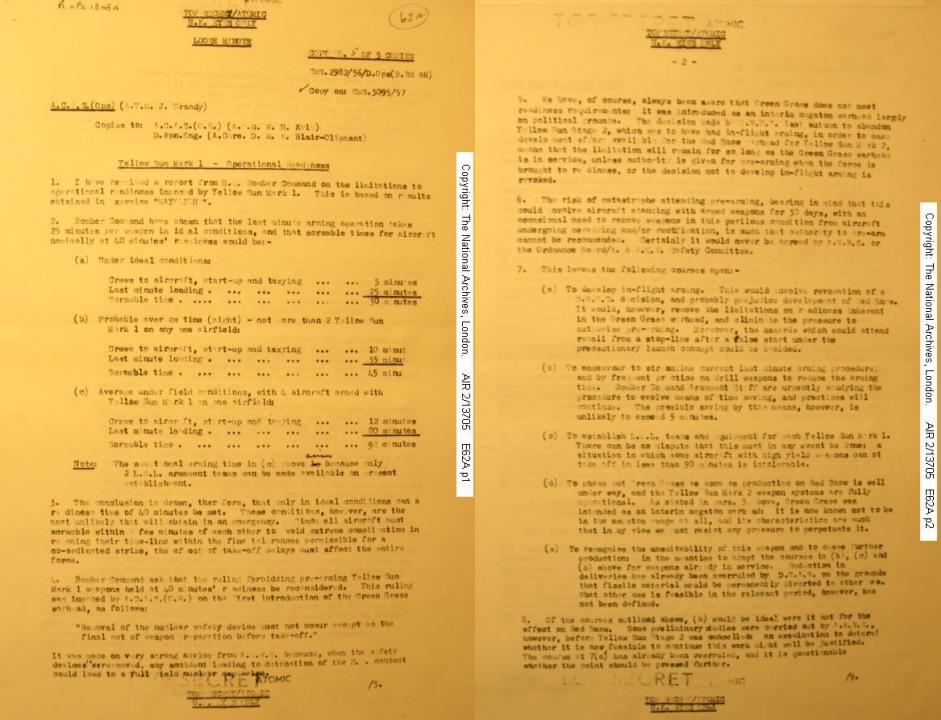
take-off could not be reduced below thirty minutes with the Green Grass warhead fitted into the improved Yellow Sun casing,
(41)
and on exercises in bad weather and at night, a ninety minute scramble was the norm.
(42)
An accident was reported in the autumn-winter-spring of 1958-59 when the steel ball retaining bung was inadvertently removed and 6'500 one inch diameter steel ball bearings the size of
gobstoppers exited onto the floor,
(43)
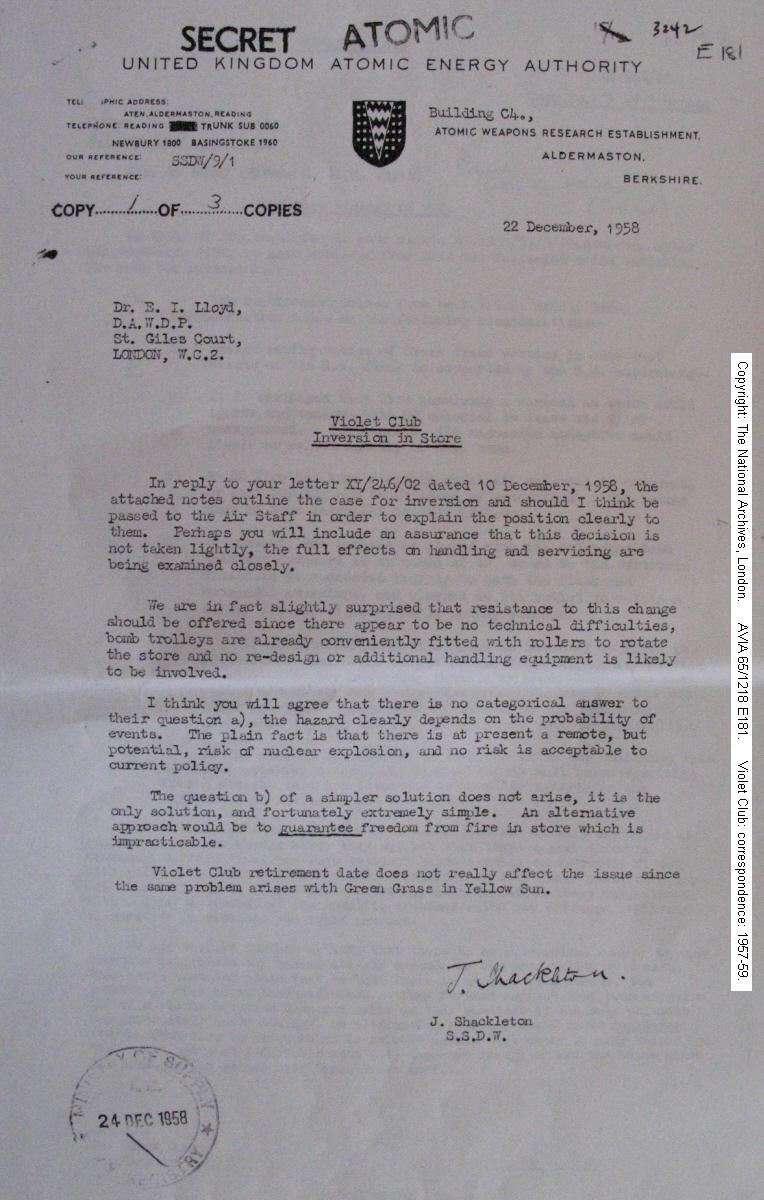
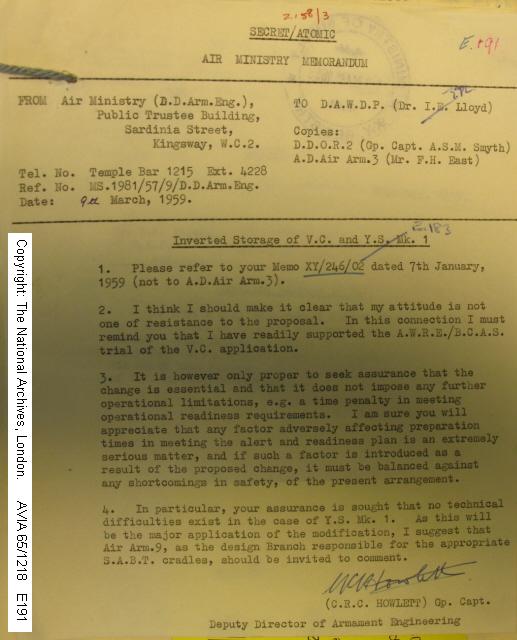
leaving the bomb armed and vulnerable, and the Royal Air Force were so nervous of the outcome of a fire in storage, that permission was sought to store the bombs inverted, so that a loss of
the bung could not end with the steel balls on the floor, and the HEU unprotected against a subsequent
explosion.(44)
Even without the partial nuclear detonation feared by the RAF, there was "a risk of catastrophe".
(45)
|

|
|
Deployment and carriage
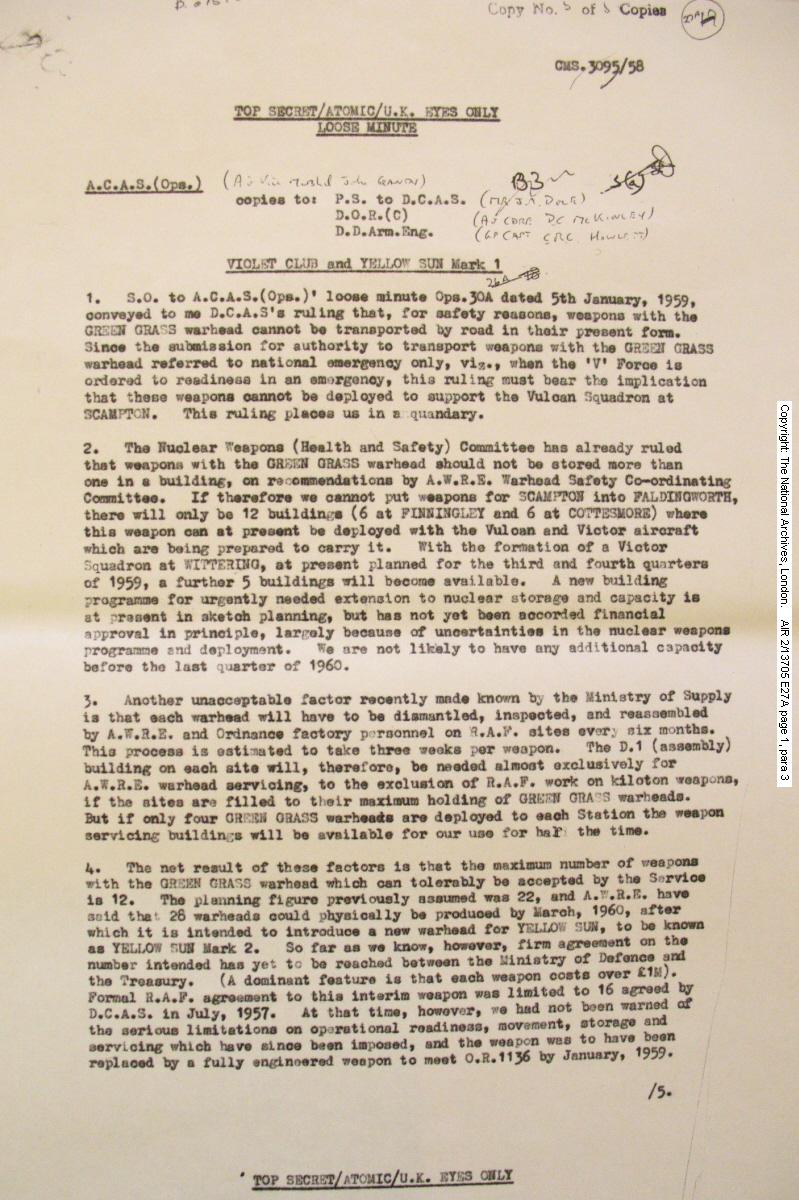
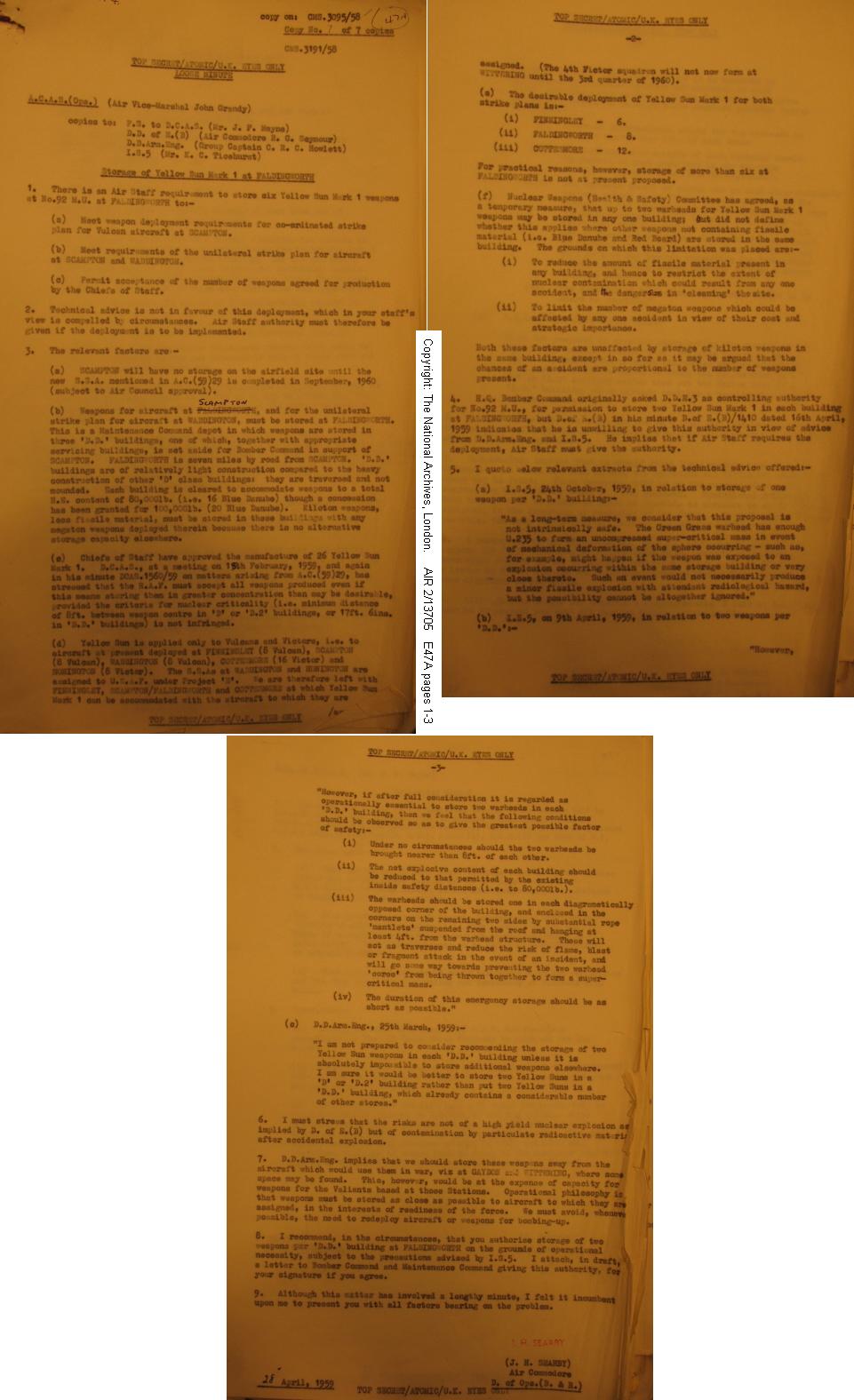
Deployment was to be at RAF Wittering and Vulcan squadrons at RAF Finningley and Scampton, although at Scampton a problem arose because there were no suitable storage and
workshop facilities on base at Scampton. The weapon was to be stored nearby at Scampton's off-base specialist weapon storage and maintenance facility at RAF Faldingworth, seven miles
away. The embargo on transport of assembled Violet Club weapons on public roads was a subject of much head-scratching, and there are declassified files that show that an exception was
made for this site.
(46)
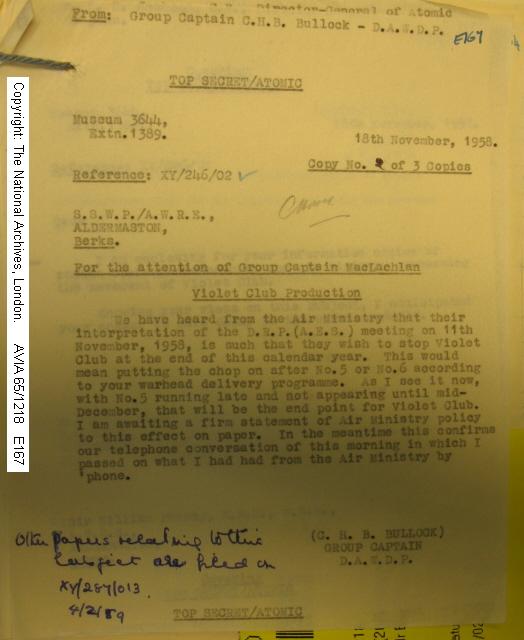
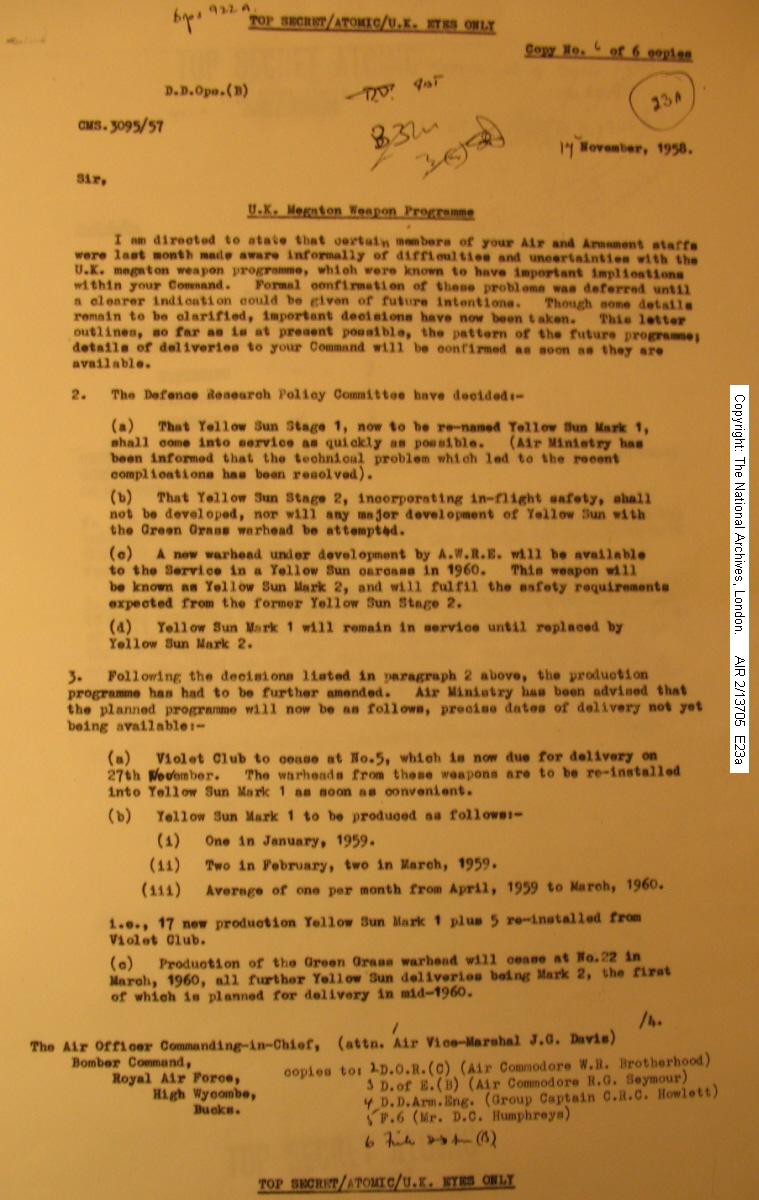
The first weapon was delivered in April 1958, and the fifth and last was due for delivery on 27 November 1958,
(47)
although there are suggestions that this date may have slipped to May 1959, just in time to be retired from service.
(48)
Carriage was by Vulcan medium bombers only, the Victor being later into service, with release at high altitude only, using the same techiques as adopted for Blue Danube. The Violet
Club casing had identical ballistic properties to Blue Danube to minimise development time and cost.
|
|
RAF dissatisfaction
Violet Club/Green Grass struggled to meet the Chiefs of Staff requirement for a high yield Interim Megaton Weapon as specified with a megaton range yield. It was a cobbling together of
elements of at least two other designs, Green Bamboo and Orange Herald, both inherently unstable designs, each with fissile cores that were greater than one uncompressed critical mass. A
hastily devised nuclear safety mechanism added to overcome the warhead's inherent instability was less than adequate to ensure safety in several scenarios identified by the RAF. One such
scenario was that of an aircraft fire while a Violet Club bomb was loaded in the aircraft with the safety balls removed. The best advice AWRE could offer was to drench the area with fire
retardant while lowering the weapon to the ground for a quick getaway. Or lowering the weapon to re-insert the steel balls.
(49)
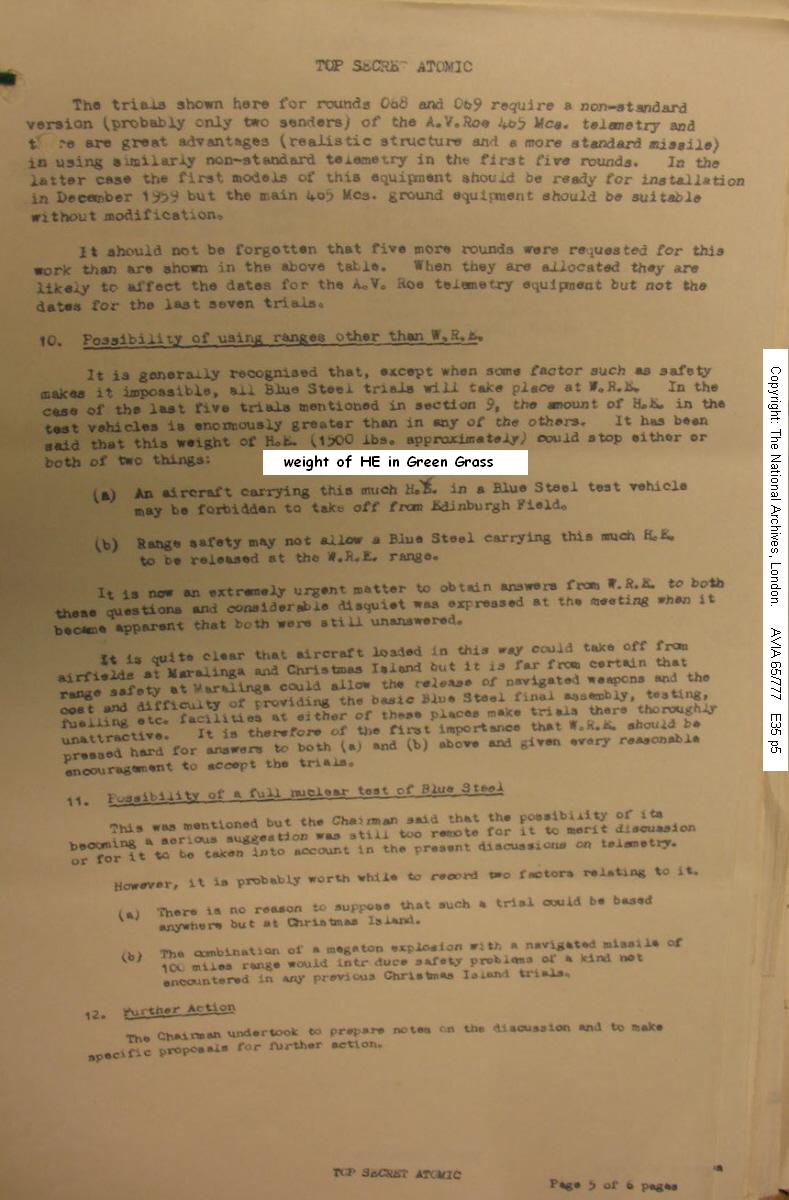
Without the steel balls inserted, a road traffic accident on the airfield that crushed or deformed the hollow spherical fissile core was sufficient to initiate uncontrolled fission. With 1'500 lbs
(689 kg) of HE in the bomb,
(50)
a large 'dirty bomb' was a real possibility, and contributed to the restrictions on road movement on and off base.
Violet Club had to be armed before flight and take-off was likely to be hazardous, and therefore the weapon couldn't be used on an airborne alert,
(51)
and couldn't be jettisoned when armed. Landing on return to base with an armed bomb was too hazardous to contemplate. The aircraft's bomb release mechanism's ferry flight weight limit of
11'100 lbs was inadequate for the bomb with the ballbearing safety device installed,
(52)
so Violet Club couldn't be flown to a remote dispersal base in accordance with RAF strategy planned for periods of heightened international tension,
(53)
and that was a source of great disatisfaction for the RAF, because the dispersal plan was central to RAF strategy. Strategic Air Command bomber bases were mostly located deep within the
North American landmass, and had considerable warning time before short-range missiles launched from off-shore could reach their bases, and had adequate time to scramble their aircraft.
Unlike SAC, all ten RAF Bomber Command main bases were within range of short-range missiles launched from off-shore or Eastern Europe, and had only minutes after receipt of warning in
which to scramble their aircraft. The ten main bases were therefore supplemented by twenty-six dispersal airfields, located from Kent, close to the English Channel, to Cornwall, Wales and
Ulster in the west, to the north east and the Western Isles of Scotland. At times of international tension, bombers were to disperse with their weapons around these distant airfields. Violet
Club, being unmovable by road when assembled, unarmed, and not able to be flown unarmed to the bomber's disperal airfield, effectively wrecked RAF strategic dispersal plans. The RAF
were aware of these shortcomings when they agreed to accept Violet Club as an emergency capability weapon for a short period, with the proviso that after approximately one year a more
developed variant of the Green Grass warhead fitted into a better, modern casing, Yellow Sun, would be introduced. It would have in-flight arming with a mechanism to jettison the steel ball
safety device only if the bombers were ordered beyond their fail-safe point. RAF chagrin was in large part because that improved weapon was never produced, and the Green Grass
ground-armed warhead installed in Yellow Sun casings soldiered on for four years, until 1963, after the Cuban Missile Crisis, with the RAF unable to disperse its bombers.
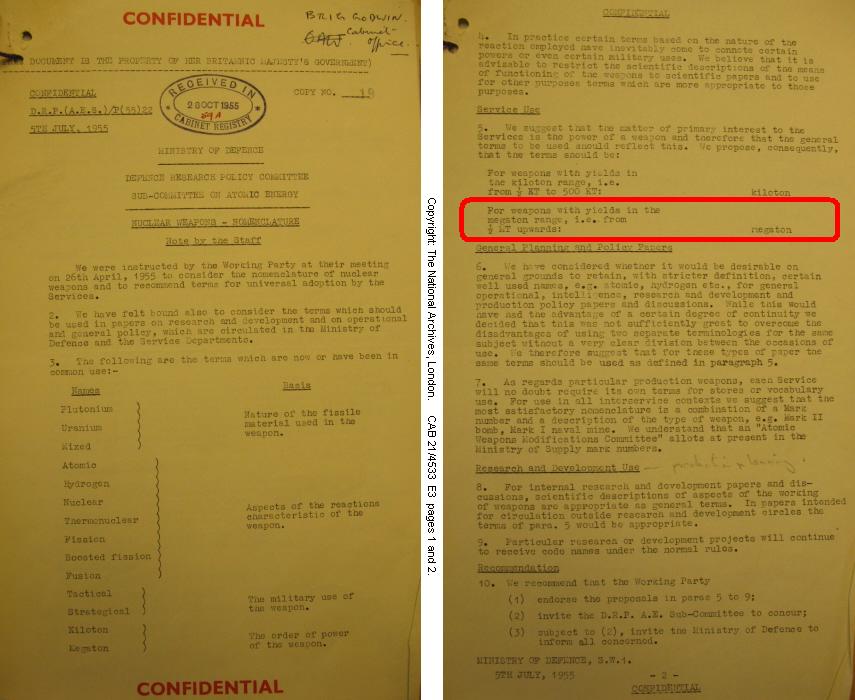
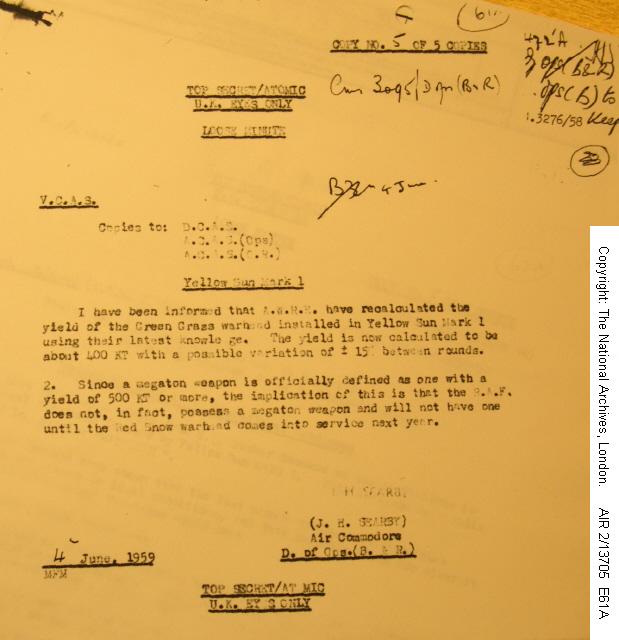
The warhead installed in Violet Club was never proof-tested, and AWRE estimated its yield at 500 kilotons, based on the Christmas Island test of Orange Herald. Mr W.J.Challens of
AWRE who later became the Director of AWRE claimed to the Air Staff that it met the specification because
" A weapon of one half megaton is considered to be in the megaton range."
(54)
A statement that returned to haunt AWRE when later estimates revised the yield downwards to 400 kt.
(55)
Challens also stated to the Air Staff on behalf of AWRE that
" AWRE were almost completely sure that a nuclear explosion would not occur if the balls are in -
but in the absence of trial-proof he could not guarantee it."
(56)
It is hardly surprising that his qualification of 'almost' did not instil confidence in the Service users, and the non-nuclear elements of the weapon were not adequately tested
either, as this RAF Bomber Command instruction indicates.
" Aircraft engines must not be run with Violet Club loaded on the aircraft with the safety
device [ of steel balls ] in place. The engines must not be started until the weapon is prepared
for an actual operational sortie." (57)
[ to prevent the balls vibrating like a bag of jellybeans. ]
" ... uncertainty exists about the effects of movement with the balls
inserted." (58)
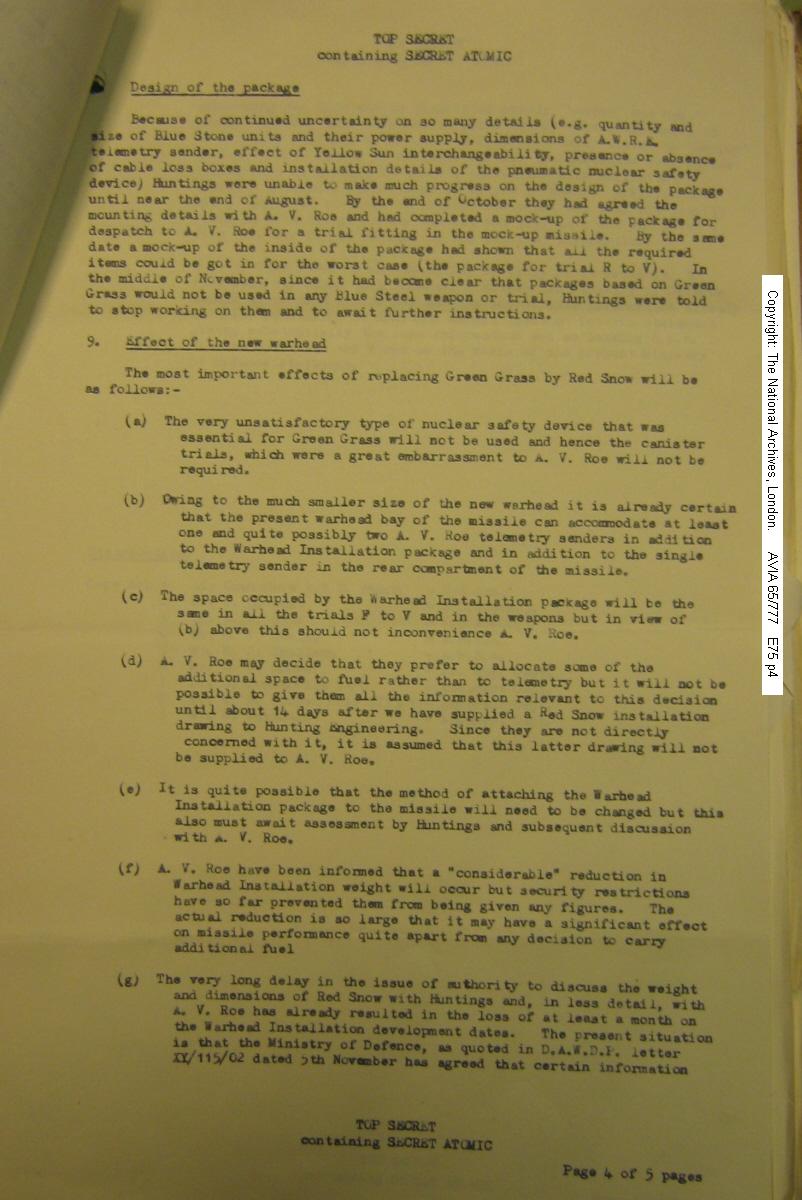
Other engineering specialists were also unimpressed with the warhead. Dr S.Jones, writing on behalf of the Armaments Dept at the Royal Aircraft Establishment at Farnbourgh described the
nuclear safety device as a:
" very unsatisfactory type of nuclear safety device that was essential for
Green Grass ... " (59)
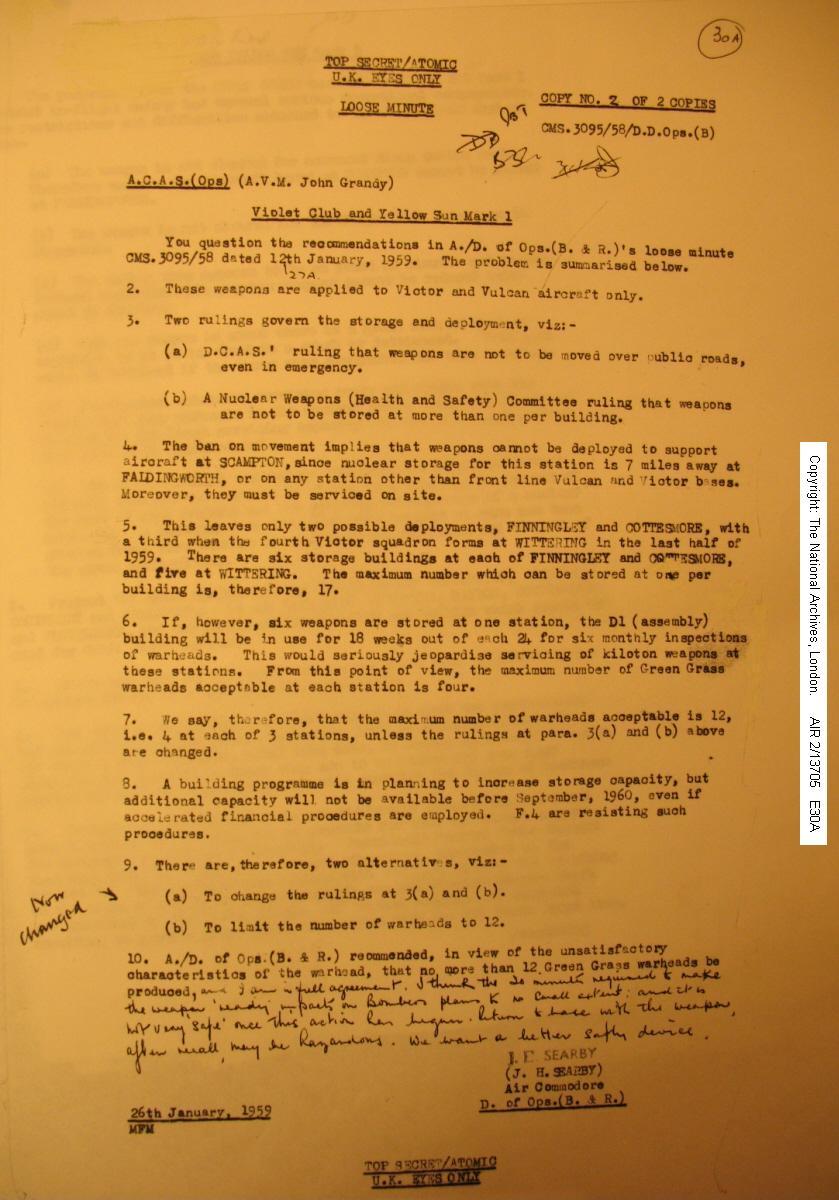
A senior officer, an Air Commodore, the Director of Operations at Bomber Command, writing on 26 Jan 1959, referring to the flight preparation time and recall after take-off said:
" I think the twenty minutes required to make the weapon 'ready' [for take-off] impacts on Bomber
Command's plans to no small extent: and it is
not very 'safe' once this action has commenced.
Return to base after recall, may be hazardous. We want a better safety device." (60)
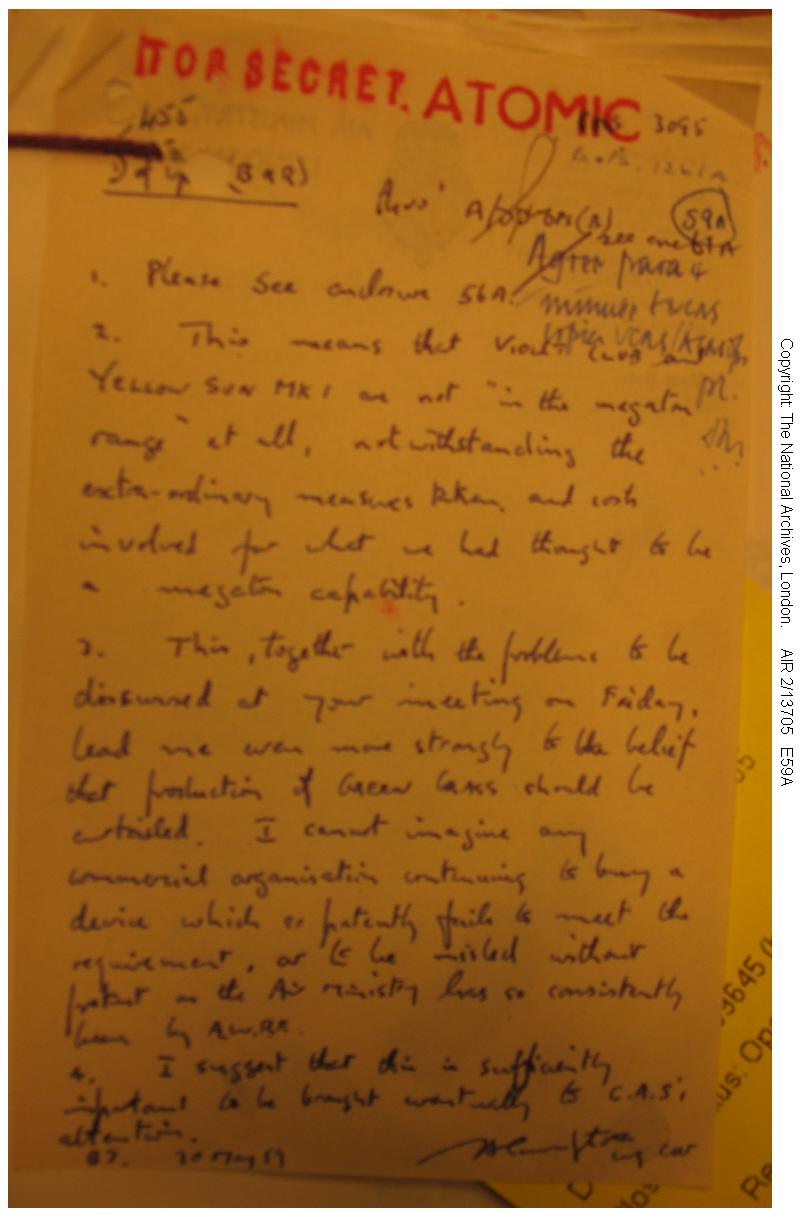
A Wing Commander at RAF Bomber Command, a Bomber Operations staff officer, minuted his senior, the Air Commodore quoted above with this comment, dated May 1959:
" This minute means that Violet Club and Yellow Sun [both with the Green Grass warhead]
are not "in the megaton range" at all, notwithstanding the extraordinary measures taken
and costs involved for what we thought to be a megaton capability. This ... leads me to the
belief that production of Green Grass be curtailed. I cannot imagine any commercial
organisation continuing to buy a device that so patently fails to meet the requirement,
or to be misled without protest as the Air Ministry has so consistently been by
AWRE." (61)
|
|
Storage, maintenance and servicing
The complete weapon was not of the modern variety of nuclear weapon that is not normally servicable by the armed forces in the frontline, and returned at intervals to the manufacturer for
service. Violet Club, like Blue Danube before it, was intended to be serviced by the user, the RAF, at air bases, without assistance from the civilian manufacturers. However, the RAF had little
experience of nuclear weapons, security was very restrictive, and few people outside AWRE had a firm understanding of nuclear technology, or the associated fuzing and firing technologies.
The weapon was not supplied to the RAF whole, fully assembled, ready for use, but as a series of parts, some major sub-assemblies, eg. the nose section, the tail section, the centre section,
and the warhead. Unlike the earlier Blue Danube weapon, the fissile core of Green Grass was an integral part of the warhead and could not be removed without a complete strip-down of the
warhead. The unstable nature of the warhead, with its fissile core greater than one uncompressed criticial mass, precluded it being assembled before delivery, and so was assembled on
each airbase by a team of civilian staff from AWRE, with some assistance from RAF technicians.
(62)
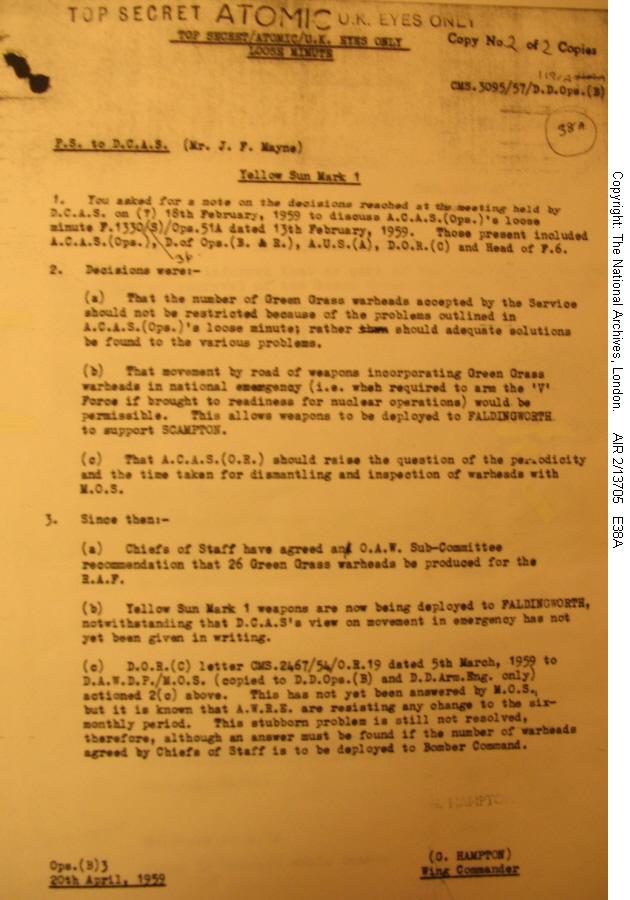
AWRE stipulated that each Green Grass warhead must be stripped-down at six-monthly intervals
(63)
for a thorough inspection, taking three weeks per weapon, and done by AWRE civilian staff at RAF air bases, with some help from the RAF. A further impediment was the restriction placed on
locating more than two weapons in the same maintenance and storage building, and not closer together than six feet.
(64)
A great strain was placed on the RAF's other operational requirement to service Blue Danube weapons in the available facilities. The RAF were unhappy with these arrangements, and the
poor standard of design of Green Grass that had led to that situation.
AWRE were concerned to restrict knowledge of the inner workings of the weapon to as few people outside AWRE as possible.
(65)
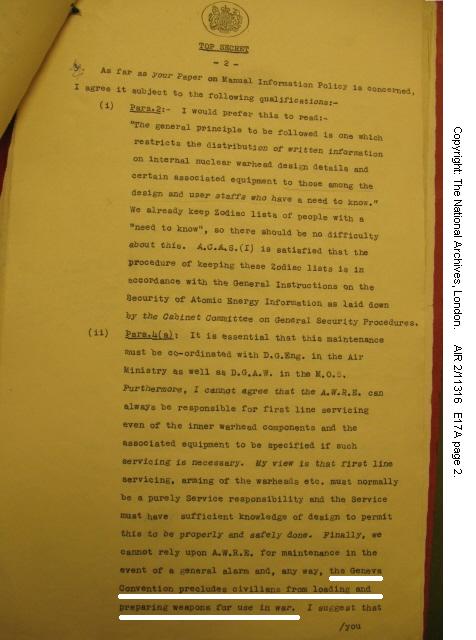
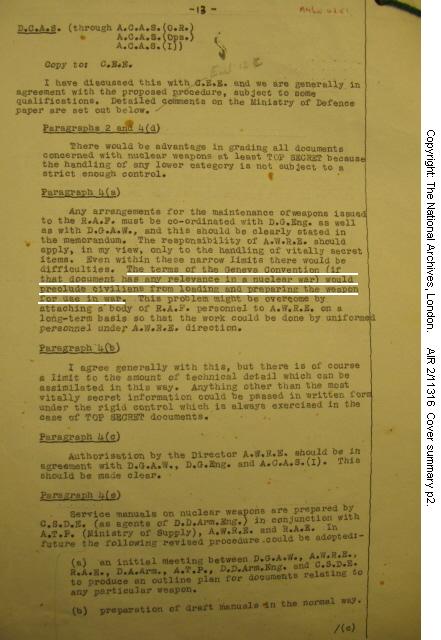
Their civilian staff were doing the routine maintenance work at airbases that senior RAF staff officers considered should be done by uniformed personnel in order to comply with the Geneva
Convention, which forbade civilian workers being used in the front line preparing weapons for use.
(66)
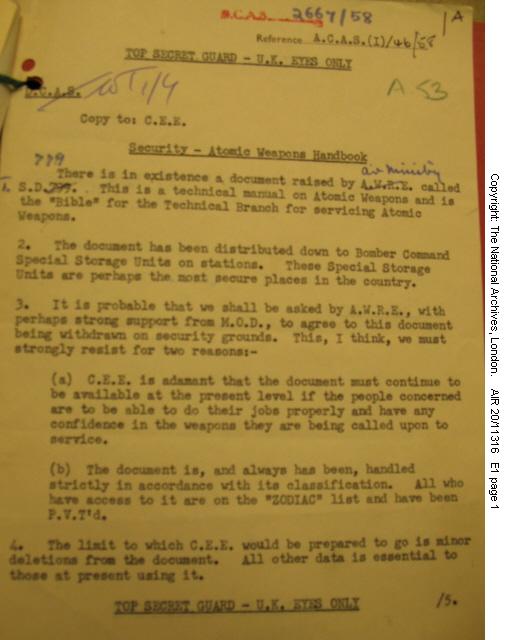
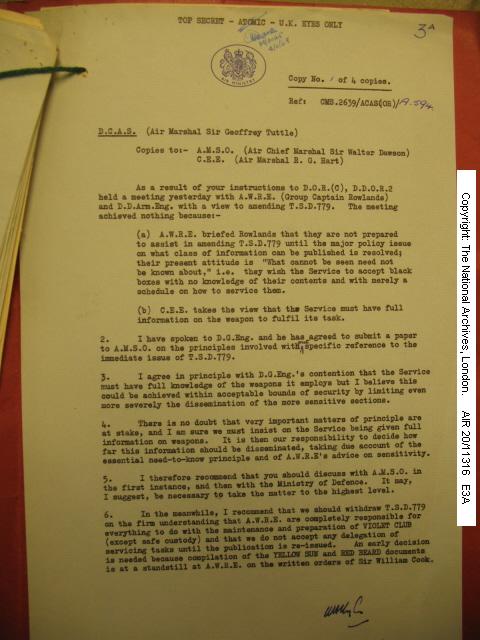
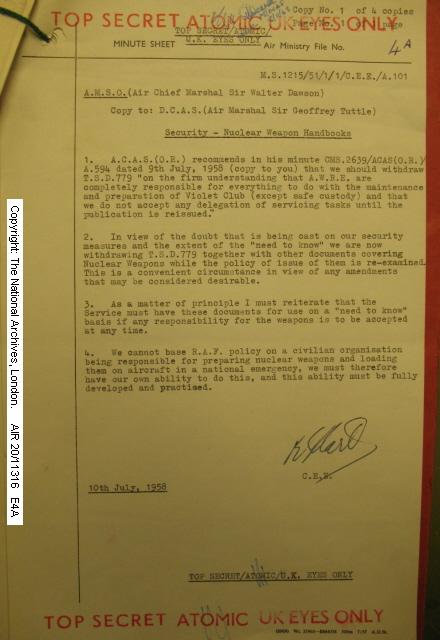
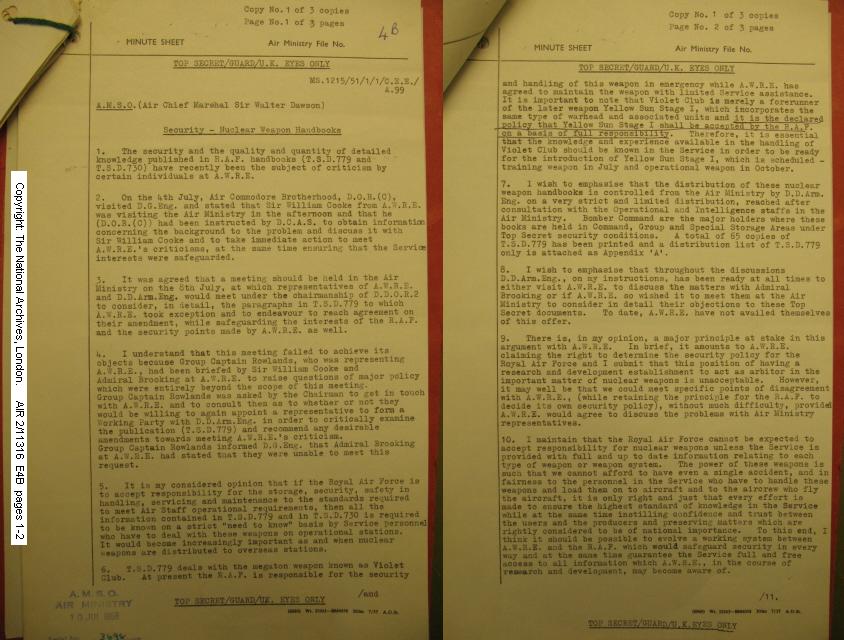
Attempts by the RAF and Air Ministry to produce a service manual TSD.779 vol 1
(67)
for uniformed servicemen met with determined opposition from AWRE at the highest level,
(68)
which at one stage refused to co-operate with production of a maintainer's manual, claiming that the manual jeopardised security, and that RAF maintainers had no need to know what was
inside the weapon, and what uniformed service personnel could not see, they did not need to know of.
(69)
RAF staff officers and the Air Ministry asserted their right to determine the security procedures with the Service, and that their servicing policy would not be determined by an external, civilian
research establishment,
(70)
if the RAF were to assume full responsibility for storage, maintenance and security of the weapon. The RAF asserted that some knowledge of the inner workings and content of the warhead
was essential to Service morale and efficiency.
(71)
Without the limited knowledge contained within a service manual, their servicing personnel would not be able to carry out the servicing task,
(72)
morale would decline, and safety would be compromised. RAF engineering staff officers recommended that the RAF should only accept responsibility for the safe custody of Violet Club, with
AWRE completely responsible for everything concerning maintenance and preparation, and that the RAF should not accept any delegation of servicing tasks until a servicing manual was
issued to RAF engineering personnel.
(73)
Storage temperature limitations were exacting.
(74)
The limits specified were principally aimed at maintaining the HE implosion material in good condition, controlling differential rates of thermal expansion and contraction between the HE and
other components, and prevention of cracking and distortion of the HE. Short-term temperature limits set for an operational mission were less restrictive initially at 5°C - 40°C, but later raised
to 18°C - 40°C, while in the aircraft's heated bomb bay. Long-term ground storage temperature limits were more rigorous at 18°C - 28°C in heated and air-conditioned magazines. Weapons
held at immediate readiness for 30 days alongside the aircraft on the airfield, were stored inside a heated pantechnican parked alongside each aircraft, and temperature limits were as for
the heated aircraft bomb bay, with some parts of the weapon kept warm using an electric blanket.
The large amount of high explosive (approx 1'500 lbs or 682 kg) contained in each weapon was as great a concern as radioactive components, and the number permitted in each storage
building was strictly limited to two, and not closer together than six feet.
|
|
Variants
There were no variants or derivatives of Violet Club, although the warhead itself, Green Grass, was used in a later weapon, Yellow Sun Mk.1, and there were plans to install Green Grass in the
Avro Blue Steel Mk.1 stand-off bomb carried by Vulcan and Victor medium bombers. These plans were cancelled when a better warhead was made available after the 1958 US-UK Mutual
Defence Agreement, often referred to informally as the 1958 Bi-Lateral.
|
|
Further development
There was no further development of Violet Club. It was a one-off design, with no development potential, and was succeeded by a radically different concept, the fission-fusion-fission type
of thermonuclear warhead, referred to above as the Type B.
The Interim Megaton Weapon, alias Knobkerry, alias Green Grass, that wasn't really of megaton yield, used in Violet Club and Yellow Sun Mk.1 had another distinction. It was the last entirely British nuclear weapon deployed with the RAF. All later weapons were of entirely American design, or had significant amounts of American design know-how incorporated in their design following the 1958 Bi-Lateral. The RAF never deployed a thermonuclear weapon of wholly home-grown design. Although lessons were undoubtedly learned from them, and some features incorporated into later warheads, the thermonuclear devices tested in the atmosphere at Christmas Island in Operation Grapple were all abandoned, because AWRE no longer had any need for them. They were all experimental devices that required further work, time, and considerable amounts of money to develop them into reliable weapons able to withstand the rough-and-tumble of Service life. The American designs offered in late 1958 were fully tested and Service-engineered, and cheap to produce.
(75)
They were manufactured in Britain from British materials (athough many non-nuclear components were purchased in the United States)
(76)
from American-supplied blueprints.
(77)
They were British property, and there were no American political constraints on their independent use. For the Treasury, the deal must have appeared truly wonderful. Violet Club and Yellow
Sun Mk.1 bridged the gap for a few short years until these American designed warheads became available.
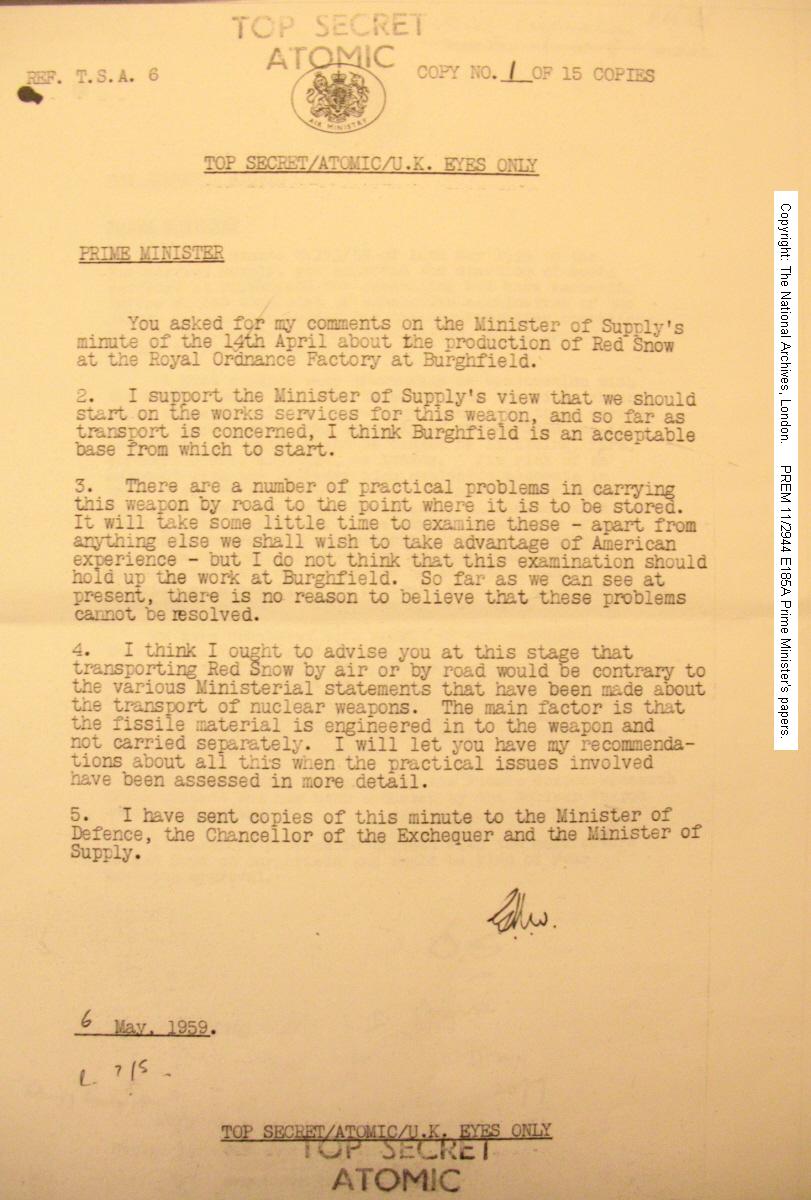
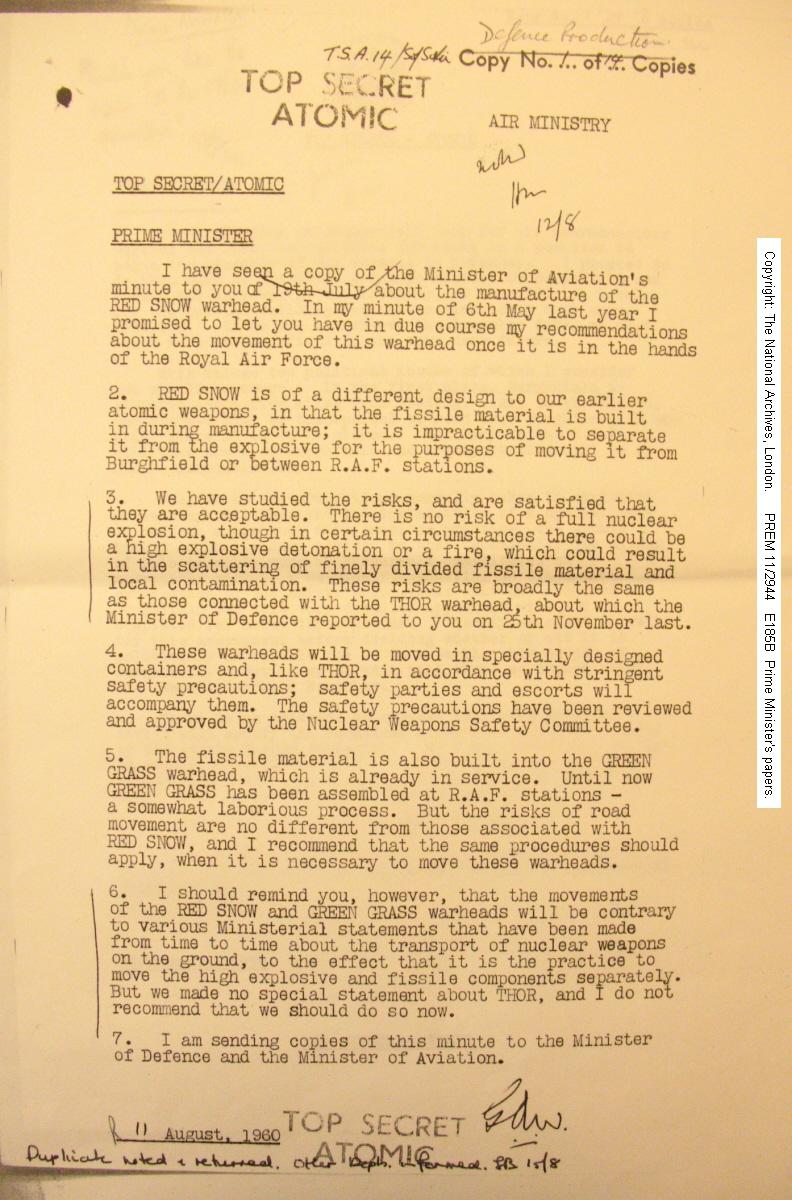
Unlike the earlier weapons deployed with the RAF, Blue Danube and Red Beard, the fissile material for Violet Club was embedded in the implosion sphere
(78)
and could not be removed and stored separately. Also, unlike the earlier weapons, they did not use a plutonium fissile core, instead using HEU for the reasons stated above. They were very
large and 'dirty' fission weapons; the largest pure or unboosted fission bombs deployed by any nuclear power before or since.
Although a fission warhead of any given yield would use more HEU
(79)
(and be less expensive) than a warhead with an all-plutonium fissile core, a fission weapon of Violet Club size was simply impossible to construct with a plutonium core with the technology
available, because the problems associated with predetonation, caused by Pu-240 impurities in reactor-produced Pu-239 were insurmountable, at that time, and with this design. With the
technology of the period, HEU was the only possible usable fissile material for an unboosted fission weapon of this large size. Consequently, the fissile core of Violet Club was considerably
cheaper built from HEU than plutonium because the industrial costs of producing the two fissile materials was widely different, with plutonium being over 640% more costly than HEU.
(80)
An added bonus for the UK Treasury was that the United States was supplying the UK with their lower cost HEU, while the UK were able to sell their expensive and surplus military grade
plutonium to the United States, which must have cheered the Treasury somewhat. A further bonus was that US produced HEU was priced at less than one third of the British cost of HEU
production, at 1958 prices.
(81)
In this period, the UK purchased over seven tons of US produced HEU, much of it finding its way into the Interim Megaton Weapon. Seven (short US) tons of HEU was enough to produce
approximately 110 Violet Club bombs.
|
|
|
Retirement
All five Violet Club weapons were retired by the end of May 1959.
(82)
The warheads were removed and retrofitted to the new Yellow Sun Mk.1 casings, where they were to be adapted for in-flight removal of the steel ballbearing nuclear safety device, using the
smaller balls. These plans for in-flight arming were never implemented, the equipment was never deployed, and the Green Grass warheads from Violet Club were transferred to Yellow Sun
Mk1 casings intact. The failure of AWRE and RAE at Farnborough to implement the in-flight arming plans was a source of much of the dissatisfaction expressed by senior RAF staff officers,
partly because of safety concerns; partly because of servicing issues; but mainly because the RAF Bomber Command dispersal plan was unusable.
The casings were scrapped, and none survive in museums. The five Green Grass warheads from Violet Club with a further thirtytwo warheads built for Yellow Sun Mk.1 survived until 1963
when all were replaced by thermonuclear warheads of American design.
|
|
Where can I see one?
There are no surviving examples of either Violet Club, the Green Grass warhead alias Knobkerry, the Interim Megaton Weapon. Only one similar bomb carcass, an example of Blue
Danube, survives in the AWE Historical Collection. This collection is kept on a secure site at AWE Aldermaston, which is closed to the general public. Only in exceptional circumstances will
AWE and the MoD invite bona-fide researchers to view the collection.
|
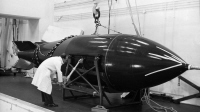
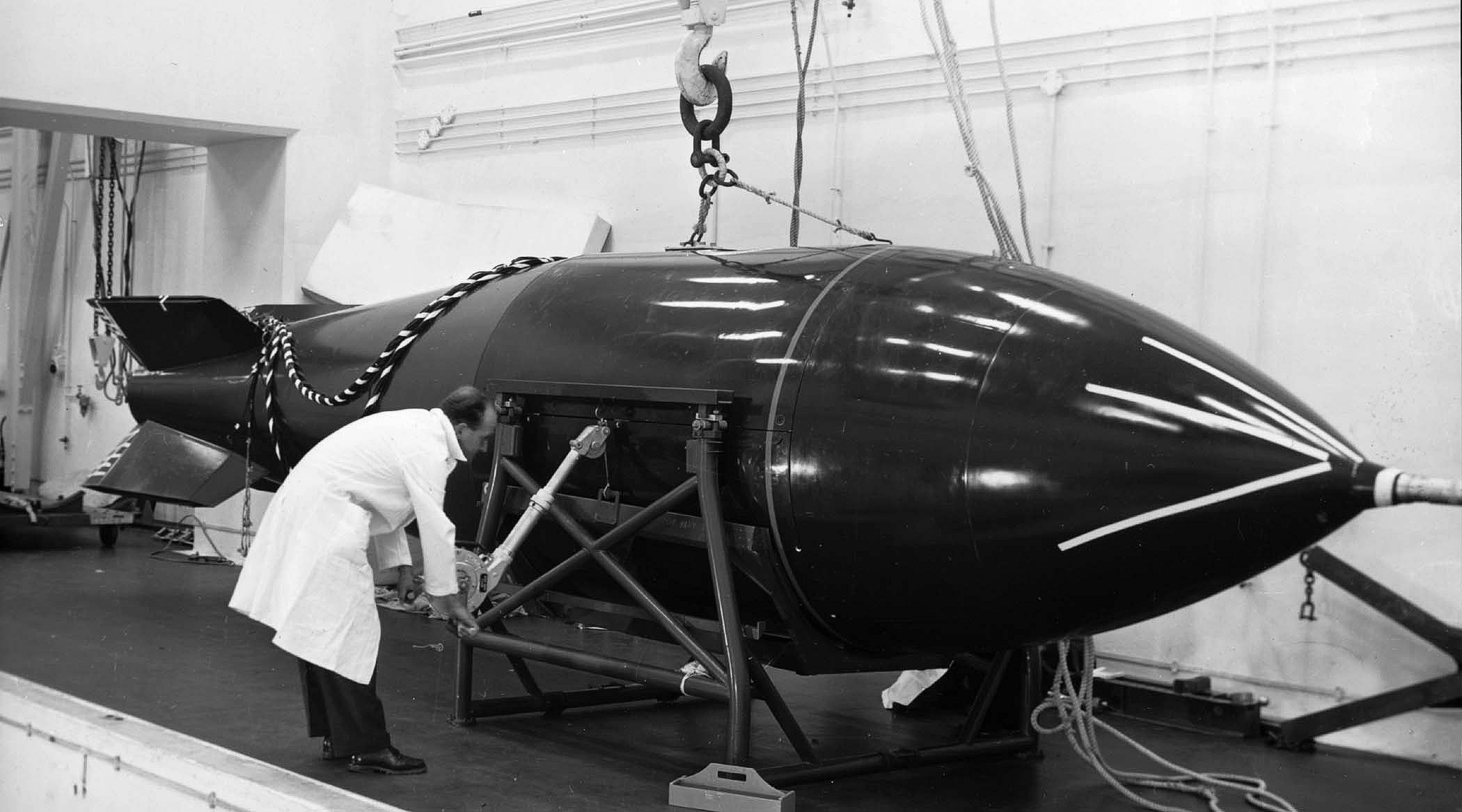
A Blue Danube casing, externally identical to the casing used for Violet Club.
|
|
Writer's Personal Note
The carcases (bomb casings) for Violet Club were of the Blue Danube bomb casing design with some minor internal changes to the nose and centre sections. The tails were identical. All
were manufactured by Hudswell Clarke & Co Ltd at their Roundhay Road plant in Leeds, Yorkshire, formerly used by Blackburn Aircraft to manufacture Fairy Swordfish and Barracuda torpedo
bombers, the Supermarine Sea Otter air-sea rescue flying boat, the Blackburn Firebrand naval fighter and torpedo bomber, and other naval aircraft of WW2.
(83)
This writer was employed there as a (very) junior design engineer, initially charged with making tea and being a 'gofor' (translates colloquially as in "go for some fish and chips"). Over several years from 1955 I
worked on Violet Club, Blue Danube, Red Beard, all the Maralinga and Christmas Island airdrop test casings, and numerous other less well documented projects, both in the design offices,
workshops and assembly areas, with access to every aspect of the weapons. At the end of 1958, shortly before I moved on to work on new projects, Chief Designer Shaw and the Production
Manager (a higher form of gofor) received their reward, in the form of a gong, (a medal to my non-British foreign readers) an award of a MBE each in the New Year Honours List, making both of them Members of the British Empire. Presumably awarded on behalf of us lesser mortals who did the actual hard graft behind a drawing board. There were no computers then, at least not for lowly engineering staff! Not even a pocket calculator had been invented. The best we had was a set of log tables and a slide rule. But we managed OK I believe; without any terrible accidents.
|
Footnotes

- back TNA AIR 2/13759 E18B Megaton bomb (Zodiac Mk 3).1953-1954.
- back TNA AIR 2/13759 E14A p1 Megaton bomb (Zodiac Mk 3).1953-1954.
back TNA AIR 2/13759 E18B Megaton bomb (Zodiac Mk 3).1953-1954.
- back Lorna Arnold Britain and the H-Bomb p61-62 66 84
Published MacMillan-Palgrave, London 2001. ISBN 0-333-94742-8. Copyright: MoD.
- back Dr Richard Moore The Real Meaning of the Words: a Pedantic Glossary of British Nuclear Weapons.
Nuclear History Working Paper No 1. First published by the Mountbatten Centre for International Studies, University of Southampton. Dr Moore is a Visiting Research Fellow at the Centre for Science and Security Studies at King's College, London, the Official Historian at AWE Aldermaston, and formerly a Visiting Research Fellow at the Mountbatten School of International Studies at the University of Southampton.
- back Humphrey Wynn. RAF Strategic Nuclear Forces: their origins, roles and deployment 1946-69, p193.
Pub:1994 HMSO. ISBN 0-1177-2833-0. Copyright: MoD.
- back TNA AVIA 65/1193 E1 E5 Warhead for a medium range missile. [Blue Streak] 1955-1958.
- back Lorna Arnold Britain and the H-Bomb p87
Published MacMillan-Palgrave, London 2001. ISBN 0-333-94742-8. Copyright: MoD.
- back TNA AIR 2/13746 E16A p1 Warhead for medium range ballistic missile Blue Streak (OR 1139 and 1142) 1955-1960.
- back TNA AB 16/1888 E111 Grapple 1 and Green Bamboo weapon tests; finance.1956-1958.
- back TNA AB 16/3878 Appendix 4 Forward prices of fissile materials. 1957-1961.
- back TNA AIR 2/13759 E18B Megaton bomb (Zodiac Mk 3).1953-1954.
- back TNA AIR 2/13759 E18B Megaton bomb (Zodiac Mk 3).1953-1954.
back Lorna Arnold Britain and the H-Bomb p147 236 Published MacMillan-Palgrave, London 2001. ISBN 0-333-94742-8. Copyright: MoD.
- back Lorna Arnold Britain and the H-Bomb p147
Published MacMillan-Palgrave, London 2001. ISBN 0-333-94742-8. Copyright: MoD.
- back Dr Richard Moore The Real Meaning of the Words: a Pedantic Glossary of British Nuclear Weapons.
Nuclear History Working Paper No 1. First published by the Mountbatten Centre for International Studies, University of Southampton. Dr Moore is a Visiting Research Fellow at the Centre for Science and Security Studies at King's College, London, the Official Historian at AWE Aldermaston, and formerly a Visiting Research Fellow at the Mountbatten School of International Studies at the University of Southampton.
- back TNA AIR 2/13680 E11A E46B Megaton bomb (OR 1136). 1954-1956.
back TNA AIR 2/13680 E46B Megaton bomb (OR 1136). 1954-1956.
back TNA AVIA 65/1116 E18 p4 MoD Defence Research Policy Cttee: Atomic Energy Sub-Cttee; agenda & minutes.1957-1960.
- back TNA AIR 2/13680 E46B p1 Megaton bomb (OR 1136). 1954-1956.
- back TNA AIR 2/13680 E11A Megaton bomb (OR 1136). 1954-1956.
back TNA AIR 2/13680 E46B p1-2 ¶5 Megaton bomb (OR 1136). 1954-1956.
- back TNA AIR 2/13680 E46B p2(c) Megaton bomb (OR 1136). 1954-1956.
- back TNA AIR 2/13718 E24 p1-2 Violet Club: policy. 1957-1958.
Letter from ACAS (OR) to DCAS notifying him 14 April 1958, of formal clearance for Service use of Violet Club received from DGAW and transmitted to C-in-C Bomber Command 11 April 1958.
- back TNA AVIA 65/1218 E167 Violet Club correspondence. 1957-1959.
- back TNA AIR 2/13718 E24B Violet Club: policy. 1957-1958. Letter from ACAS (OR) to CinC Bomber Command 11 April 1958
back TNA AIR 2/13718 E24B Annex 1 Violet Club: policy. 1957-1958. Annex to ACAS letter to C-in-C Bomber Command, 11 April 1958
- back TNA AIR 2/13718 E24B Violet Club: policy. 1957-1958. Letter from ACAS (OR) to CinC Bomber Command 11 April 1958
- back TNA AVIA 65/1218 E38 Violet Club correspondence. 1957-1959.
- back TNA AVIA 65/1218 E35 Violet Club correspondence. 1957-1959.
- back TNA AVIA 65/1155 E194 ¶11 10'000 lb HE MC bomb: ASRs 1947-1962.
- back TNA AIR 2/13705 E27A Yellow Sun: policy. 1957-1966.
- back TNA AB 43/92 E46 p1 Fissile material costs. 1963-1965.
- back nuclearweaponarchive.org Library/Fission
- back English Wikipedia Little Boy basic weapon design.
- back TNA AVIA 65/1218 E183(a) Violet Club correspondence.1957-1959.
- back TNA AIR 2/13705 E15A p2 ¶1 Yellow Sun: policy. 1957-1966.
back TNA AVIA 65/1218 E43 Violet Club correspondence. 1957-1959.
- back TNA AIR 2/13705 E56A Yellow Sun: policy. 1957-1966.
back TNA AIR 2/13705 E58A Yellow Sun: policy. 1957-1966.
- back TNA AIR 2/13718 E7A (4) Violet Club: policy. 1957-1958.
- back TNA AIR 2/13718 E24B p1 ¶4 Violet Club: policy. 1957-1958. Letter from ACAS (OR) to CinC Bomber Command 11 April 1958
back TNA AIR 2/13718 E21A p1 ¶3 Violet Club: policy. 1957-1958. Statement by W.J.Challens on behalf of AWRE. Minutes of a conference at the Air Ministry to discuss RAF acceptance of Violet Club.
- back TNA AIR 2/13681 E17A p3 ¶2.2 Megaton bomb (OR 1136). 1957.
- back TNA AVIA 65/777 E2 Blue Steel warhead: installation. 1957-1959.
- back RAF Historical Society Journal. Issue No.26 (2001) p96, p147 ISSN 1361 4231.
RAF experience of nuclear weapons: An account by a nuclear weapons specialist engineer officer Air Commodore Owen Truelove.
- back TNA AVIA 65/777 E9 p3 Blue Steel warhead: installation. 1957-1959.
back TNA AVIA 65/777 E37 p4 Blue Steel warhead: installation. 1957-1959.
- back David J.Hawkins. Keeping the Peace, the Aldermaston Story. p52 ¶3.
Published Pen and Sword Books in association with AWE plc Media and publishing group. 2000. ISBN 0-85052-775-9. Crown Copyright 2000. An account commissioned by the MoD written by a former Manager of Corporate Communications at AWE. Although useful in parts it should not be overlooked that this is essentially an exercise in propaganda written by a former PR officer at AWE, tasked with producing an account for AWE's public relations group.
- back TNA AVIA 65/1218 E15 Violet Club correspondence. 1957-1959.
- back TNA AIR 2/13705 E62A Yellow Sun: policy. 1957-1966.
- back TNA AIR 2/13705 E62A Yellow Sun: policy. 1957-1966.
- back RAF Historical Society Journal. Issue No.26 (2001) p96, p147 ISSN 1361 4231.
RAF experience of nuclear weapons: An account by a nuclear weapons specialist engineer officer Air Commodore Owen Truelove.
- back TNA AIR 2/13705 E36A Yellow Sun: policy. 1957-1966.
back TNA AVIA 65/1218 E181 Violet Club: correspondence. 1957-1959.
back TNA AVIA 65/1218 E183 Violet Club: correspondence. 1957-1959.
back TNA AVIA 65/1218 E191 Violet Club: correspondence. 1957-1959.
- back TNA AIR 2/13705 E47A p3 Yellow Sun: policy. 1957-1966.
back TNA AIR 2/13705 E62A p2 Yellow Sun: policy.1957-1966.
back TNA AIR 2/13718 E24B p1-2 Violet Club: policy. 1957-1958.
back TNA AIR 2/13718 E24B Violet Club: policy. 1957-1958. Letter from ACAS (OR) to CinC Bomber Command 11 April 1958
- back TNA AIR 2/13705 E25A Yellow Sun: policy. 1957-1966.
back TNA AIR 2/13705 p36 Yellow Sun: policy. 1957-1966.
back TNA AIR 2/13718 E38A Yellow Sun: policy. 1957-1966.
- back TNA AIR 2/13705 E23A Yellow Sun: policy. 1957-1966.
- back TNA AVIA 65/1116 E20 MoD Defence Research Policy Cttee: Atomic Energy Sub-Cttee; agenda & minutes. 1957-1960.
- back TNA AIR 2/13718 E17A (c) Violet Club: policy. 1957-1958.
back TNA AIR 2/13718 E24B Anx1 p3 Violet Club: policy. 1957-1958.Annex to letter from ACAS (OR) to CinC Bomber Command 11 April 1958
- back TNA AVIA 65/777 E35 p5 Blue Steel warhead: installation. 1957-1959.
- back TNA AIR 2/13718 E24B Anx1 p2 Violet Club: policy. 1957-1958.
Annex to letter from ACAS (OR) to CinC Bomber Command 11 April 1958
- back TNA AVIA 65/1218 E35 Violet Club correspondence. 1957-1959.
- back Humphrey Wynn. RAF Strategic Nuclear Forces: their origins, roles & deployment 1946-69. Dispersal Map. p448.
Pub:1994 HMSO. ISBN 0-1177-2833-0. Copyright: MoD.
- back TNA AIR 2/13718 E21A p2 ¶8 Violet Club: policy. 1957-1958.
Statement by W.J.Challens on behalf of AWRE. Minutes of a conference at the Air Ministry to discuss RAF acceptance of Violet Club.
back TNA CAB 21/4533 E3 p2 Cabinet papers: nuclear weapons nomenclature: policy. 1955.
- back TNA AIR 2/13705 E56A Yellow Sun: policy. 1957-1966.
back TNA AIR 2/13705 E58A Yellow Sun: policy. 1957-1966.
back TNA AIR 2/13705 E61A Yellow Sun: policy. 1957-1966.
- back TNA AIR 2/13718 E21A p2 ¶8 Violet Club: policy. 1957-1958.
Statement by W.J.Challens on behalf of AWRE. Minutes of a conference at the Air Ministry to discuss RAF acceptance of Violet Club.
back TNA CAB 21/4533 E3 p2 Cabinet papers: nuclear weapons nomenclature: policy. 1955.
- back TNA AIR 2/13718 E15A (3) (d) Violet Club: policy. 1957-1958.
- back TNA AIR 2/13718 E21A p2 ¶7-8 Violet Club: policy. 1957-1958.
- back TNA AVIA 65/777 E75 p4(9)(a) Blue Steel warhead: installation. 1957-1959.
- back TNA AIR 2/13705 E30A Yellow Sun: policy. 1957-1966. Handwitten addendum.
- back TNA AIR 2/13705 E59A Yellow Sun: policy. 1957-1966.
- back TNA AIR 2/13718 E24B p1 ¶3 Violet Club: policy. 1957-1958. Letter from ACAS (OR) to CinC Bomber Command 11 April 1958.
back TNA AIR 2/13718 E24B Anx 1 Violet Club: policy. 1957-1958. Annex to letter from ACAS (OR) to CinC Bomber Command 11 April 1958.
- back TNA AIR 2/13705 E27A p1 ¶3
Yellow Sun: policy. 1957-1966.
- back TNA AIR 2/13718 E24B Anx1 p1 Violet Club: policy. 1957-1958. Letter from ACAS (OR) to CinC Bomber Command 11 April 1958.
- back TNA AIR 20/11316 E12B p1(a) Nuclear weapons service manuals: policy. 1958.
- back TNA AIR 20/11316 E17A p2 ¶4a Nuclear weapons service manuals: policy. 1958.
back TNA AIR 20/11316 sumy p2 ¶4a Nuclear weapons service manuals: policy. 1958.
- back TNA AIR 20/11316 E1A p1 Nuclear weapons service manuals: policy. 1958.
back TNA AIR 2/13718 E24B p1 ¶4 Violet Club: policy. 1957-1958. Letter from ACAS (OR) to CinC Bomber Command 11 April 1958.
- back TNA AIR 20/11316 E3A p1¶6 Nuclear weapons service manuals: policy. 1958.
- back TNA AIR 20/11316 E3A p1¶1a Nuclear weapons service manuals: policy. 1958.
- back TNA AIR 20/11316 E4A ¶4 Nuclear weapons service manuals: policy. 1958.
back TNA AIR 20/11316 E4B p2 ¶9/10 Nuclear weapons service manuals: policy. 1958.
- back TNA AIR 20/11316 E1A p1¶3(a) Nuclear weapons service manuals: policy. 1958.
- back TNA AIR 20/11316 E3A p1 Nuclear weapons service manuals: policy. 1958.
- back TNA AIR 20/11316 E3A p1¶6 Nuclear weapons service manuals: policy. 1958.
back TNA AIR 20/11316 E4B p1¶5/9/10 Nuclear weapons service manuals: policy. 1958.
- back TNA AVIA 65/1218 E24 Violet Club correspondence. 1957-1959.
- back TNA AVIA 65/1771 E24 p1 ¶3 Defence Committee on Nuclear Requirements. 1959-1963.
- back TNA AVIA 65/1064 E74 p1 & 2. Inspection of atomic weapons. 1958-1960.
Twenty items and sub-assemblies purchased in the US for Red Snow production in the UK.
- back Lorna Arnold Britain and the H-Bomb p214
Published MacMillan-Palgrave, London 2001. ISBN 0-333-94742-8. Copyright: MoD.
back Lorna Arnold Britain and the H-Bomb p213Published MacMillan-Palgrave, London 2001. ISBN 0-333-94742-8. Copyright: MoD.
- back TNA PREM 11/2944 E185A Prime Minister's papers.
Red Snow thermonuclear warhead manufacture at Burghfield: transportation issues. 1959-1960.
back TNA PREM 11/2944 E185B Prime Minister's papers.Red Snow thermonuclear warhead manufacture at Burghfield: transportation issues. 1959-1960.
- back Charles S.Grace. Nuclear Weapons: Principles, Effects and Survivability.
Pub: Royal College of Military Science, Shrivenham, Wiltshire. ISBN 0-0804-0992-X
- back TNA AB 16/3878 Appendix 4 p1 Forward prices of fissile materials. 1957-1961. Letter of 7 March 1959 UKAEA to DAWRE.
- back TNA AB 16/3878 Appendix 4 Forward prices of fissile materials. 1957-1961.
Attached handwritten note identifies the US price of HEU @ £6'000/kg at 1958/59 prices, and the cost to the RAF from UK production as £21'000/kg at 1958/59 prices. Cost of Pu-239 to the RAF from UK production was £135'000/kg at 1958/59 prices.
- back TNA AVIA 65/1116 E20. MoD Defence Research Policy Cttee: Atomic Energy Sub-Cttee; agenda & minutes. 1957-1960.
- back Wikimapia Blackburn Aircraft factory site. Wikimapia entry accessed 10.53 GMT 23 June 2010.
back Leeds Civic Trust Blue Plaque Awarded to Blackburn Aircraft site.
back Wikipedia Fairey Swordfish Wikipedia entry accessed 10.53 GMT 23 June 2010.
back Wikipedia Fairey Barracuda Wikipedia entry accessed 10.53 GMT 23 June 2010.
back Wikipedia Blackburn Firebrand Wikipedia entry accessed 10.53 GMT 23 June 2010.
back Wikipedia Supermarine Sea Otter Wikipedia entry accessed 10.53 GMT 23 June 2010.
back Wikipedia Hudswell Clarke & Co Ltd Wikipedia entry accessed 10.53 GMT 23 June 2010.
|
|
Violet Friend
Under construction.
|
|
|
Violet Mist
Under construction.
|
|
|
Violet Vision
Under construction.
|
|
|
Vixens (generic)
Under construction.
|
|
|
Volcano
Under construction.
|
|
|
W-7
Under construction.
|
|
|
W-15
Under construction.
|
|
|
W-15/39
Under construction.
|
|
|
W-25
Under construction.
|
|
|
W-28
Under construction.
|
|
|
W-30 TADM
Under construction.
|
|
|
W-31
Under construction.
|
|
|
W-33
Under construction.
|
|
|
W-34 Peter/Python
Under construction.
|
|
|
W-43
Under construction.
|
|
|
W-44 Tony/Tsetse
Under construction.
|
|
|
W-45
Under construction.
|
|
|
W-47
Under construction.
|
|
|
W-48
Under construction.
|
|
|
W-49
Under construction.
|
|
|
W-50 XI
Under construction.
|
|
|
W-54 SADM
Under construction.
|
|
|
W-54 Wee Gnat
Under construction.
|
|
|
W-57
Under construction.
|
|
|
W-58
Under construction.
|
|
|
W-59
Under construction.
|
|
|
W-68
Under construction.
|
|
|
W-70
Under construction.
|
|
|
W-70-mod.3
Under construction.
|
|
|
W-76
Under construction.
|
|
|
W-79
Under construction.
|
|
|
Washington Variants
Under construction.
|
|
|
WE.148
Under construction.
|
|
|
WE.155
|
|
|
Function
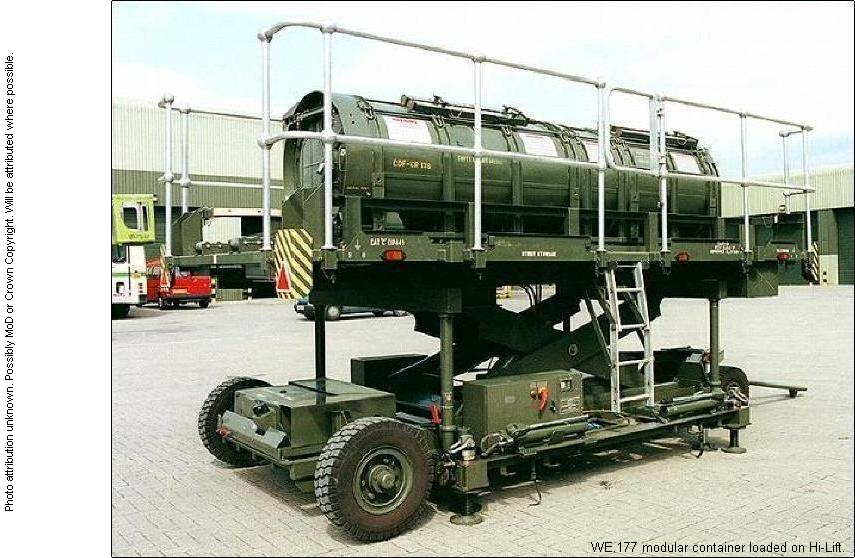
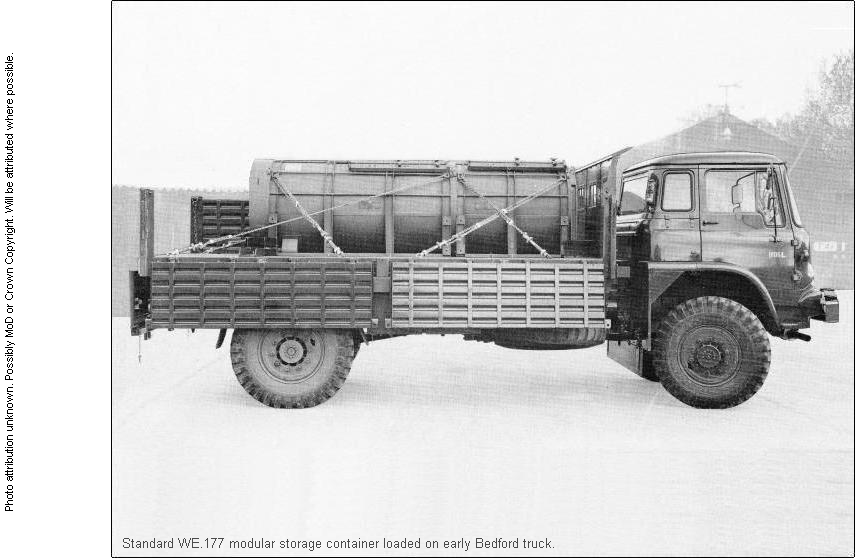
WE.155 was a watertight and airtight storage and transport container adaptable for all versions of the WE.177 bomb. The short version
used for the WE.177A tactical bomb was made up of only two sections, the nose and the tail sections bolted together, and lengthened to
accommodate WE.177B and WE.177C by the insertion of a 21 inch section bolted into the centre.
Its function was to protect the weapon from climatic conditions, rough handling and accidents, including fire, and being lost overboard from
ships. It was designed to float in seawater while fully loaded to enable recovery, and it was insulated to ensure a slow rate of heat transfer if
exposed to fire.
Although little is known from declassified sources of the environmental standards required for storage of the WE.177 weapon, standards
were less demanding than for the earlier weapons replaced by WE.177, which required self-sufficient air-conditioned storage, powered by their
container's own internal diesel generators. WE.155 containers had no internal power sources, no connections to external power sources, and
no air-conditioning.
|
|
Description
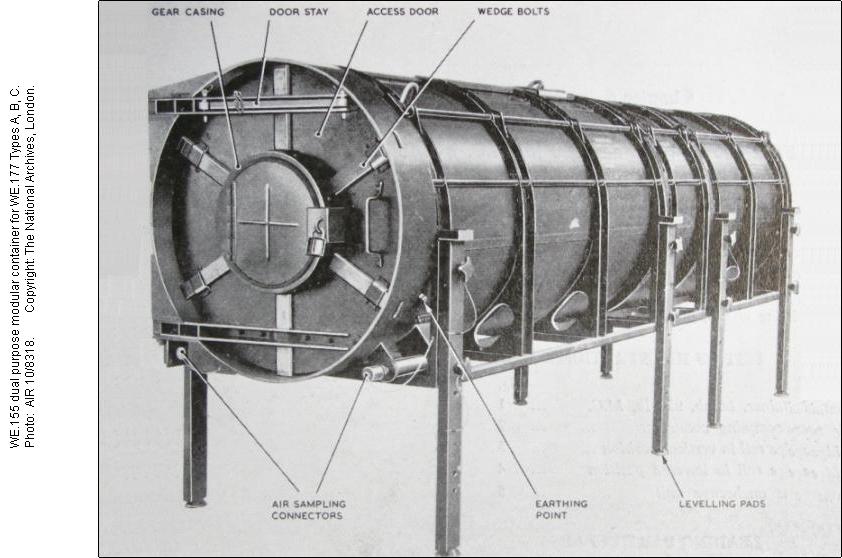
Basically cylindrical in shape, divided into a forward, centre, and an aft section bolted together end-to-end as required. The sections had mild
steel inner and outer skins separated by a two inch thick filling of calcium silicate thermal insulation. The steel cylinders were strengthened by
D-shaped hoops of U-channel joined by longitudinal tubing. The hoops were attached at their lower ends to a horizontal framework of hollow
square-section members that formed a platform on which the cylinder appeared to rest. With eight adjustable legs added, this horizontal frame
forms a table-like structure onto which the cylinder was secured by the D-shaped hoops. With the legs fully raised the container can be stacked
up to three in height, allowing sufficient height clearance for forklift handling.
|

|
A hinged circular door closes the end of the forward section. The mild steel door encloses a fire break of two inch thick layer of calcium silicate,
- a material intended to slow heat transmission to the container's contents. Six radially distributed locking bars lock the door closed by engaging
in slots in the container outer rim. The locking bars are activated by a spiral cam plate driven via a geartrain by a manually operated handle, and
the wedge-shaped ends of the locking bars compress the door against an 'O' ring seal. The central raised casing on the door contains the cam
plate, gears and the operating handle. A padlocked hinged flap to the right of the raised casing provides access to the operating handle.
The rear end is closed by a 'D' shaped cover bolted in position and sealed by two 'O' section rubber seals, and like the forward section door is
constructed of welded mild steel sheet enclosing a two inch thick layer of calcium silicate fire break.
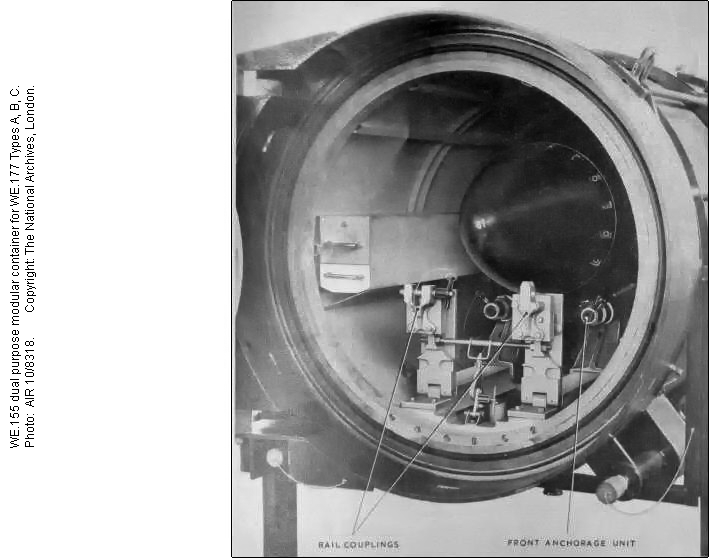
Two rails joined by crossmembers are secured inside the forward section and form part of a 10-inch gauge rail system. This supports a cradle
carrying the weapon. The cradle itself is not a part of the container, but is also used in conjuction with other weapon handling, servicing and
aircraft loading equipment. The forward ten inches of the rail system hinges vertically to permit the circular door to close, and lowers into a
horizontal position, bridging a gap to weapon servicing and preparation equipment, permitting the weapon cradle to be slid along the rail, to
exit the container. Adustable legs permit the rail height to be aligned with external equipment.
|

|
|
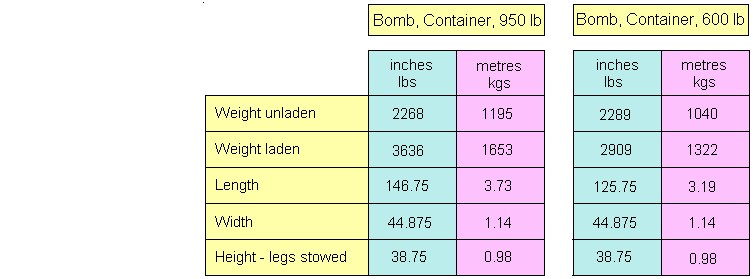
Weights and Dimensions
|
|
WE.176
|
|
|
Genesis
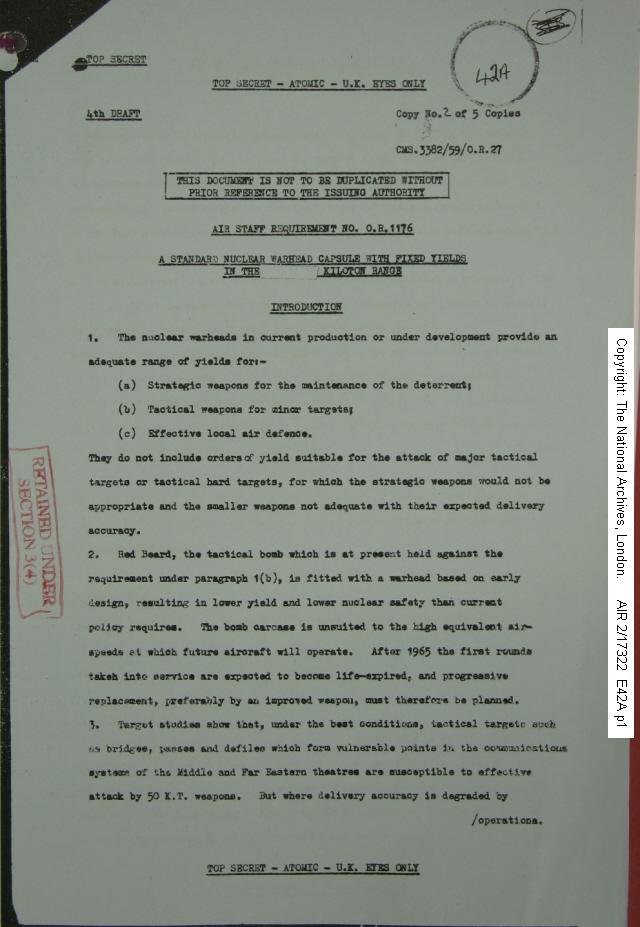
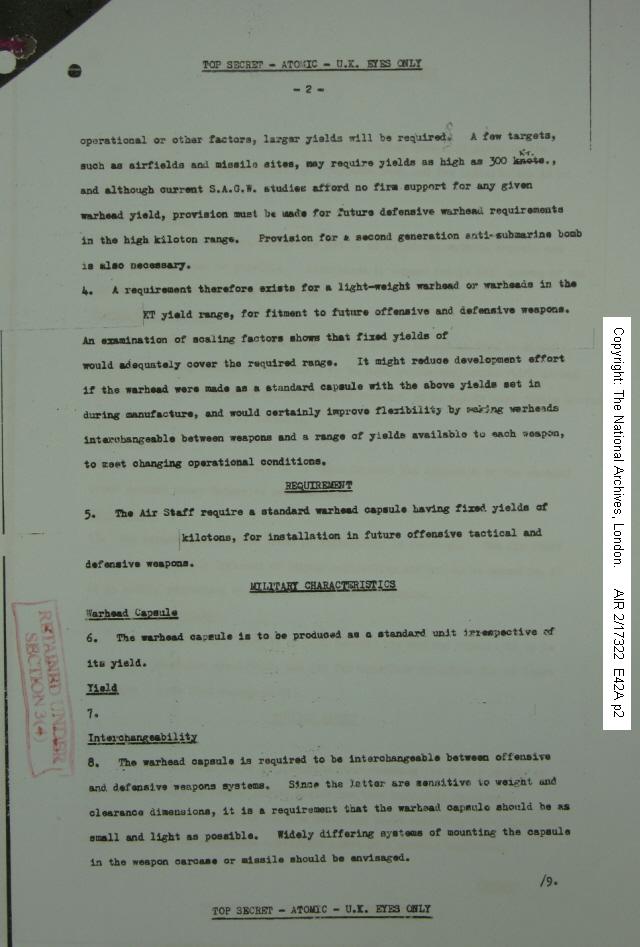
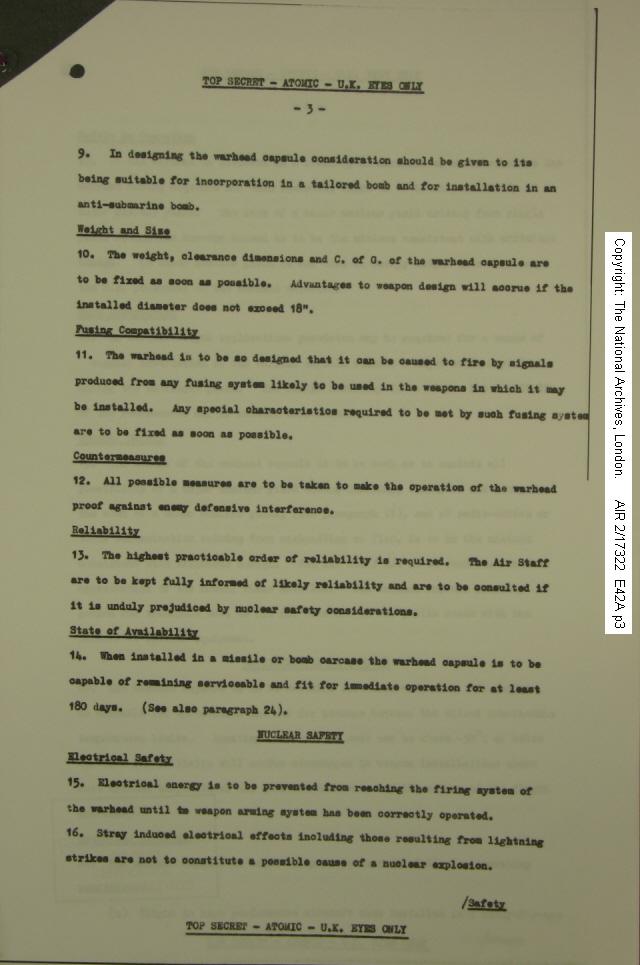
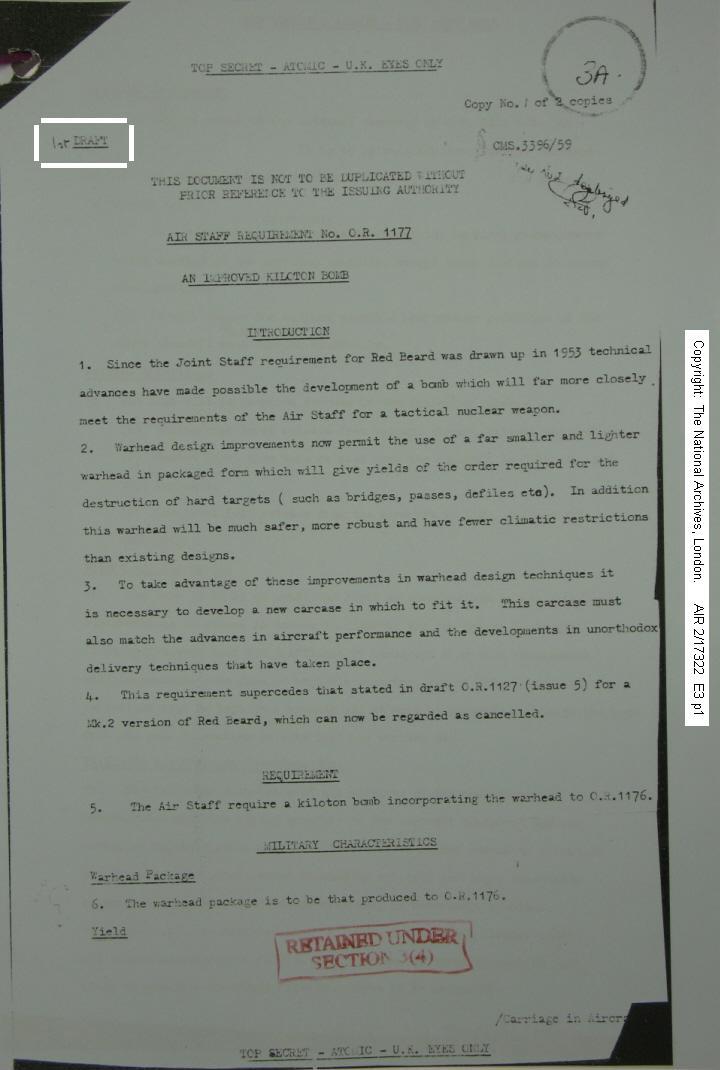
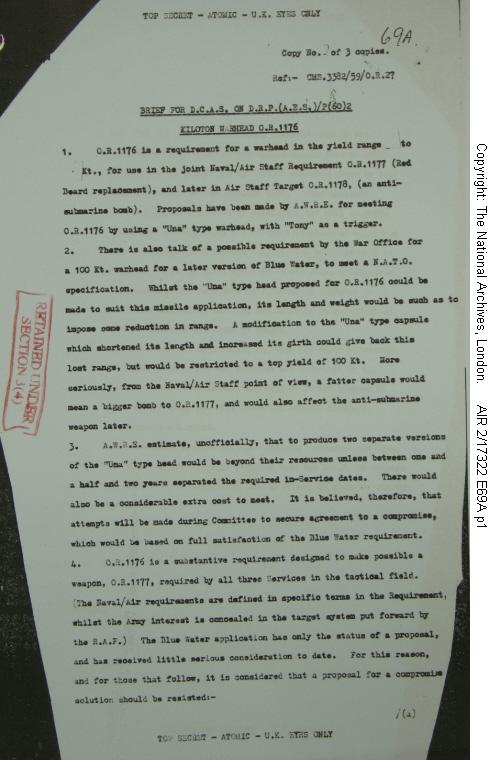
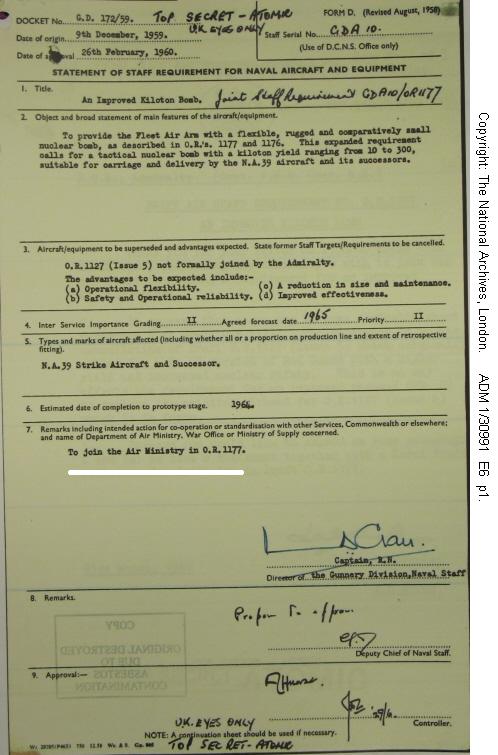
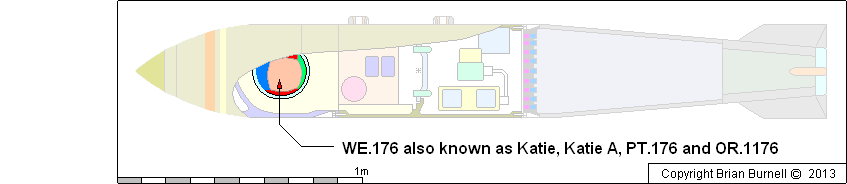
WE.176 was the warhead component (or 'physics package') for an Improved Kiloton Bomb to the twin specifications of
OR.1176 (for the warhead later known by the designator
PT.176) (1)
and OR.1177(2)
for the complete weapon (warhead plus casing) known as WE.177.
Development began possibly as early as
1958 (3)
as an Improved Kiloton Bomb and Red Beard replacement. The Red Beard bomb was heavy, large for fighter-bomber tactical aircraft to carry underwing, and the storage and handling
conditions, and especially the temperature limitations, were a hindrance, and it was aerodynamically unsuitable for high-speed low-level flight, whether carried externally or internally. Highly
radioactive warhead components in the Red Beard warhead, comprising a primitive impact initiator (a neutron generator) had a life measured in months rather than years, that had to be
returned to AWRE for re-lifing every six months from locations in the UK, Cyprus, Singapore and with the Fleet. The logistical issues that arose were
severe, (4)
and in the replacement warhead, WE.176, this initiator arrangement was replaced with an Electronic Neutron Initiator (ENI).
The first generation warhead installed in Red Beard was armed before take-off with no possibility to change selections in-flight, or to disarm the weapon for a return to base. A replacement was
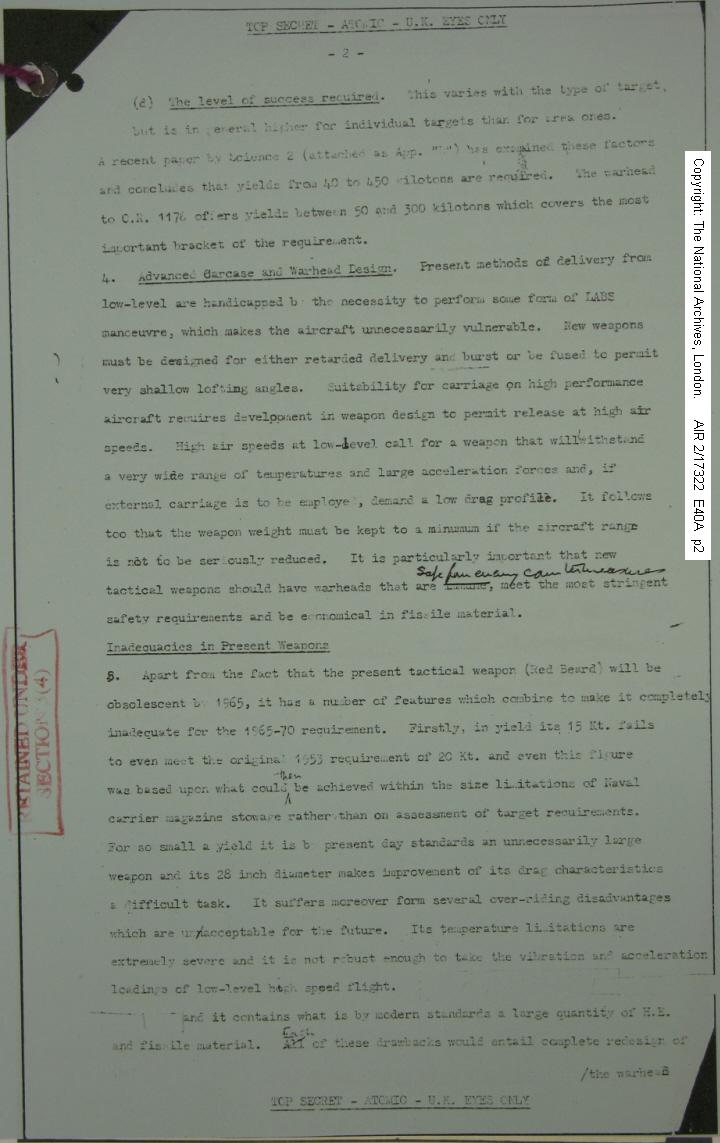
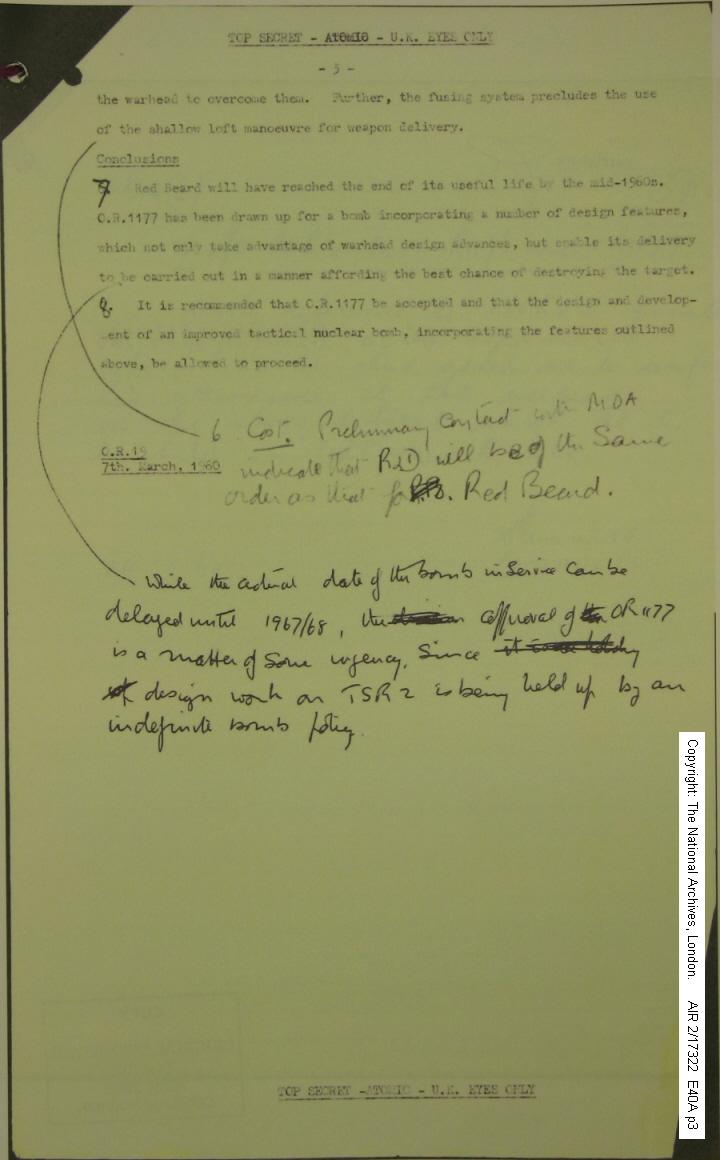
urgently sought, even before Red Beard entered service, and an Air Ministry Operational Requirement was issued as OR.1176 for the warhead, and OR.1177 for the complete
weapon, in Aug 1959. (5)
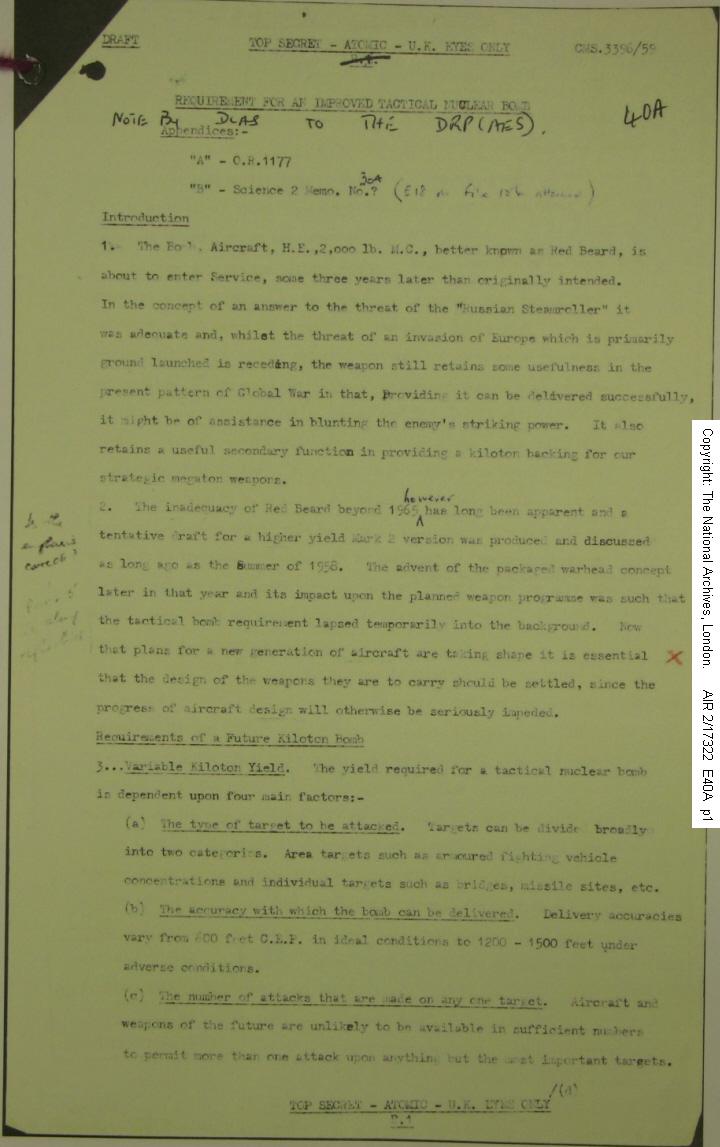
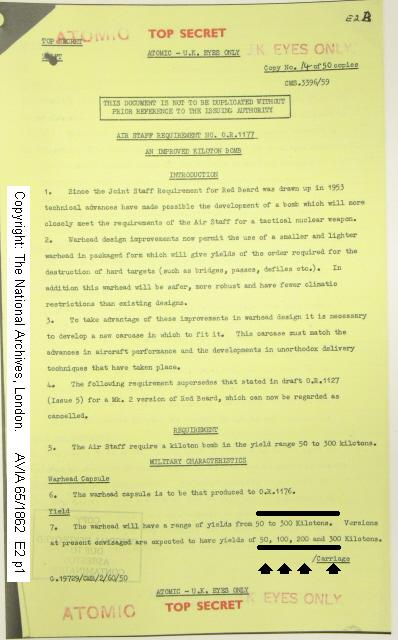
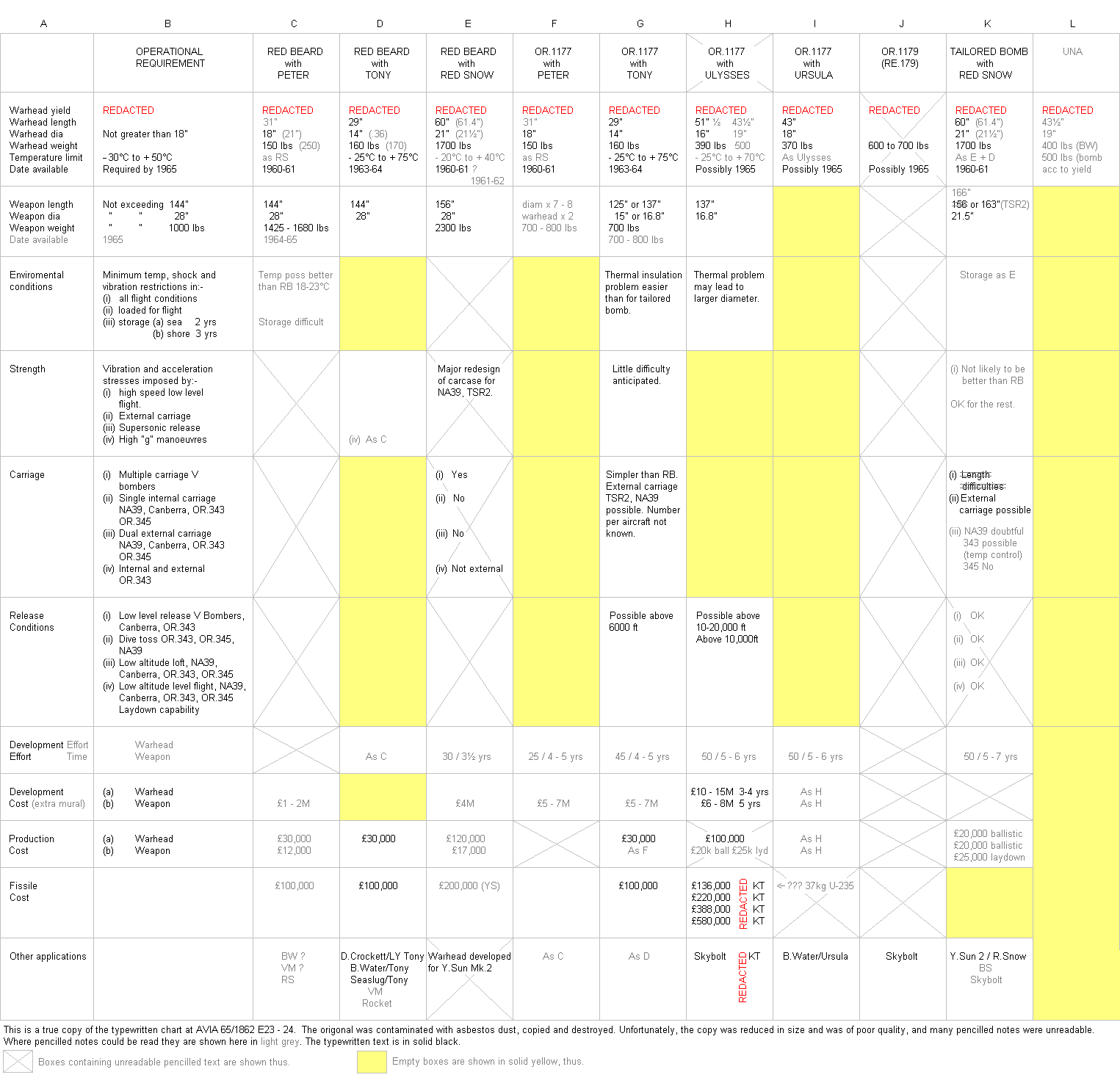
The RAF concluded that the 15 kt yield of Red Beard was insufficient to ensure destruction of the type of targets they were assigned, and OR.1177 as originally issued specified several
non-variable, manufacturer-set yields of 50, 100, 200, and 300
kilotons(6)
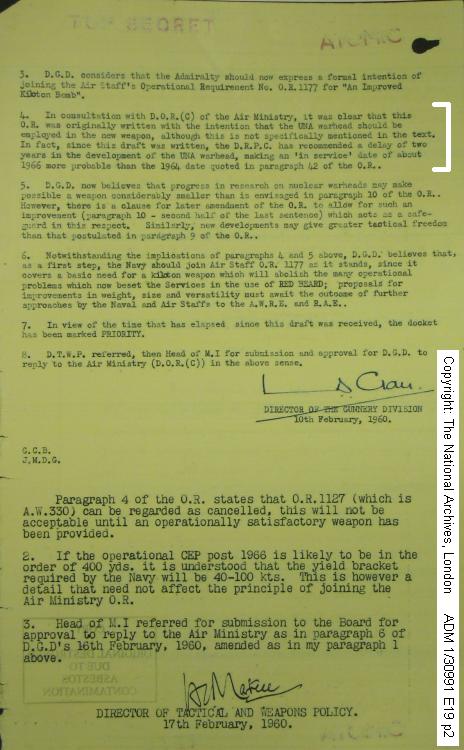
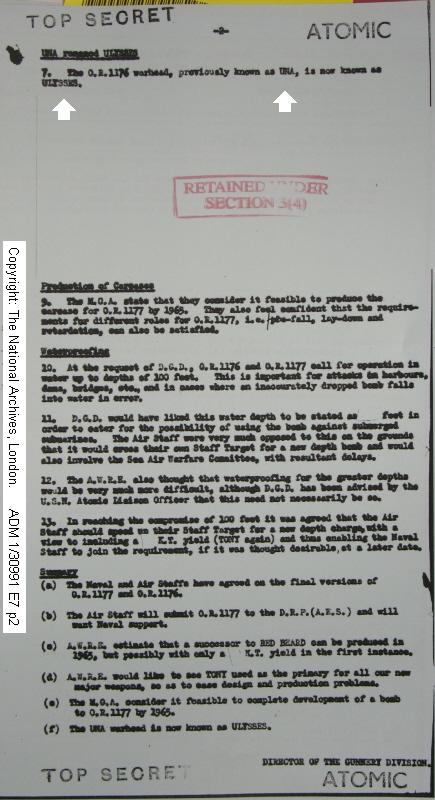
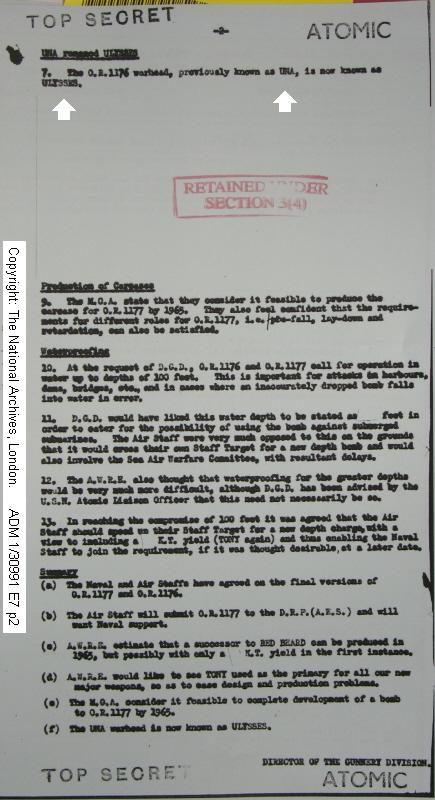
in a weapon using the Una
warhead (7)
later renamed
Ulysses(8)
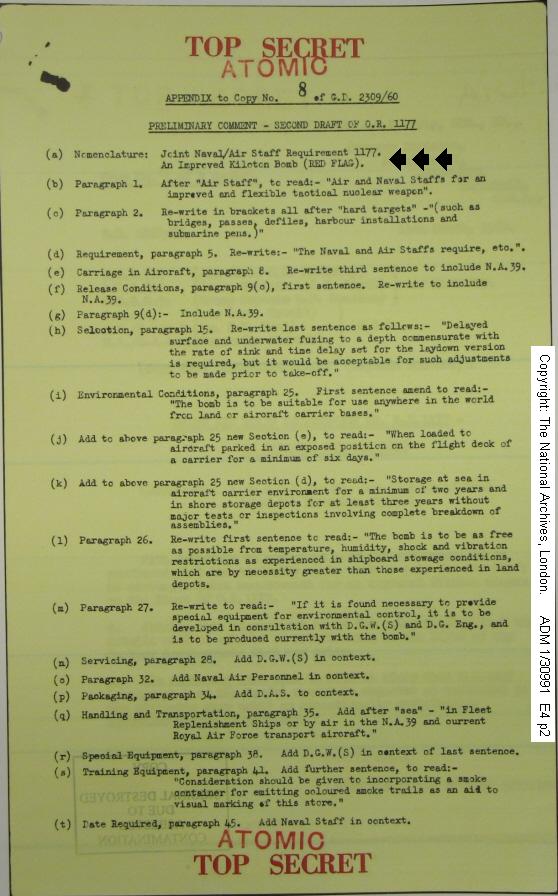
and weighing up to 1'000 lbs, and with a diameter no larger than Red Beard's at 28 inches. The Royal Navy requirement GDA.10 for a weapon of lower yields and weight, assigned the
codename Red
Flag(9)
was merged into OR.1176/OR.1177 as a joint
requirement, (10)
and sometime later an RAF Coastal Command requirement OR.1156, updated to OR.1178 for an anti-submarine nuclear depth bomb (NDB) was
added, (11)
although a UK-owned NDB was subsequently never issued to RAF maritime anti-submarine patrol aircraft, which only used US-supplied and owned
weapons. (12)
Although many aircraft were fitted to carry the Improved Kiloton Bomb, the main users were originally intended to be the principal tactical strike aircraft of the RAF and Royal Navy, TSR2 (a
Canberra replacement), and in the Fleet Air Arm the Buccaneer. Design was primarily focussed on the needs of these two key aircraft, although other aircraft were included in the specification;
principally, the aircraft being developed to OR.345 that became the Harrier, the three V-bombers and
Canberra. (13)
Although the Air Ministry's original OR.343 specification required Red Beard to be carried by TSR2, it was quickly realised that high drag, temperature and other limitations made internal or
external carriage of Red Beard by TSR2 impossible. Unfortunately, the dimensions of the TSR2 bomb bay were largely determined by the dimensions of Red Beard, and in later years, when it
was too late to change these dimensions, twin carriage of WE.177 gave rise to great difficulties. In particular the RAF and Royal Navy requirement written into later issues of OR.1177 for
'stick-bombing' delivery techniques of WE.177 by TSR2 and the
Buccaneer. (14)
|
|
|
|
Construction
The WE.176 warhead and the WE.177 weapon it was originally intended for, differed in one principal respect from the earlier weapon it replaced. Red Beard like similar early British and US
weapons had a first generation spherical implosion device that used a removable fissile core that could be stored separately from the high-explosive components, with the fissile core inserted
into the weapon at the last possible moment, either in-flight by mechanical loading devices (IFL) or on the ground immediately before take-off (LML). These arrangements were thought to
enhance the safety of what were very complicated, yet primitive devices that mishandled would have devastating consequences. However, there was little practical experience of performing
delicate servicing and assembly operations on equipment so complicated and so demanding of precision. The Red Beard weapon was broken down for storage into four major sections; the
nose, the centre section containing the HE which was stored in its own air-conditioned container, the tail unit, and in separate containers, the fissile core and the highly radioactive impact
initiator.
The WE.176 replacement warhead was engineered rather differently, with fewer restaints on operational flexibility a principal objective.
It was the first British-designed weapon to incorporate a
sealed pit.
This characteristic was fundamentally incompatible with the design approach used for Red Beard and the earlier Blue Danube weapons, in that it was not possible by Service crews to withdraw
the fissile core from the weapon in operational use. Instead the fissile core was inserted into the implosion device at manufacture, and it could only be removed in a complete strip-down of the
weapon in a factory environment. Advantages of the sealed pit design was that it made possible great advances in reliability, greater yield from a given amount of fissile material by means of
boosting and other techniques, and eliminate the coarse dimensional standards that the older designs required to enable LML and IFL methods. The closer fits and tolerances possible in a
sealed pit design also contributed to a more efficient implosion and higher yields in a much reduced size of weapon. All subsequent modern weapons have adopted the sealed pit design
characteristic.
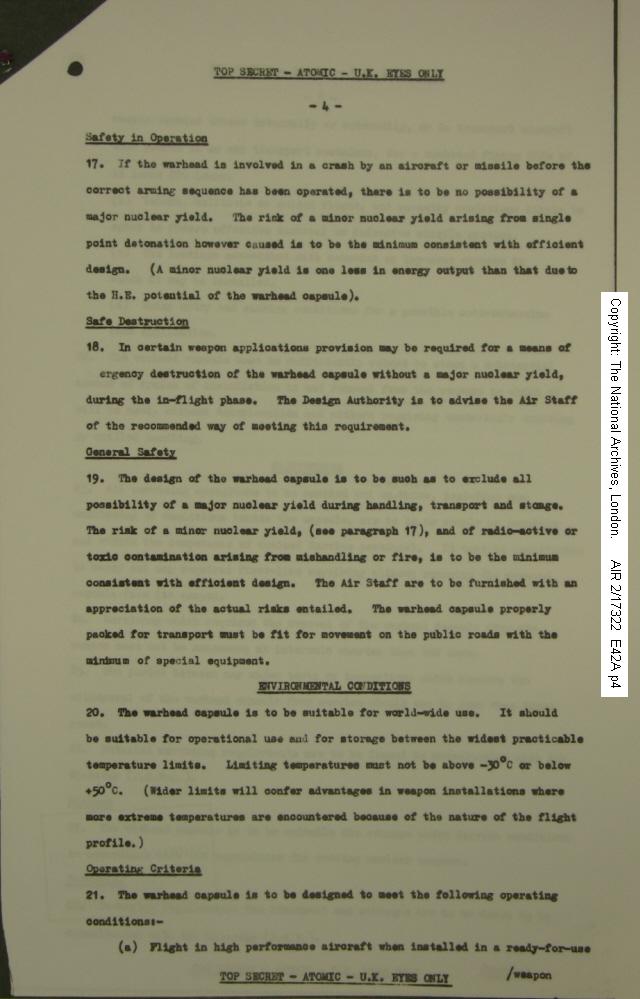
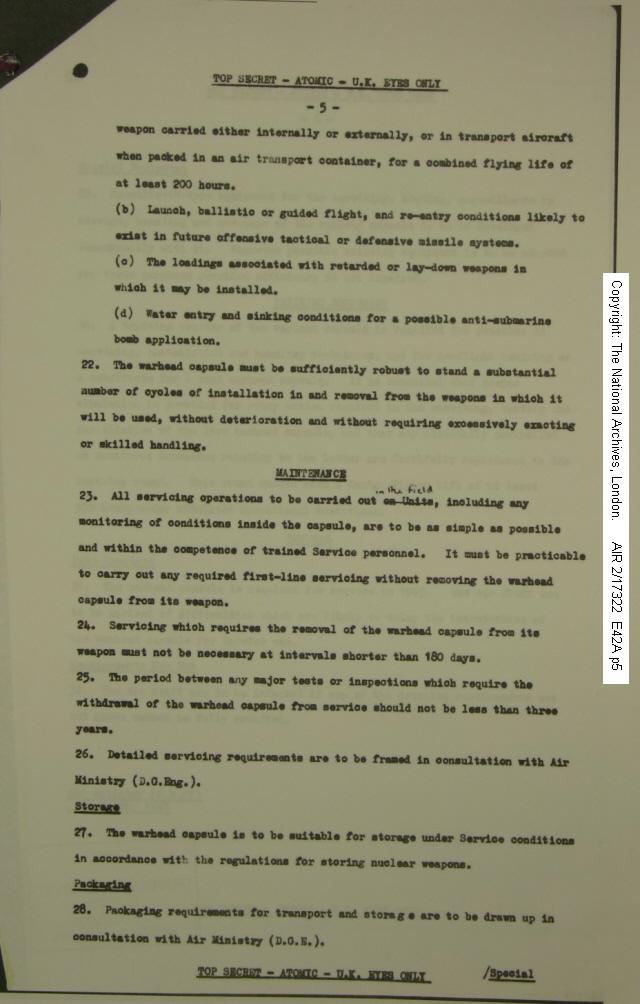
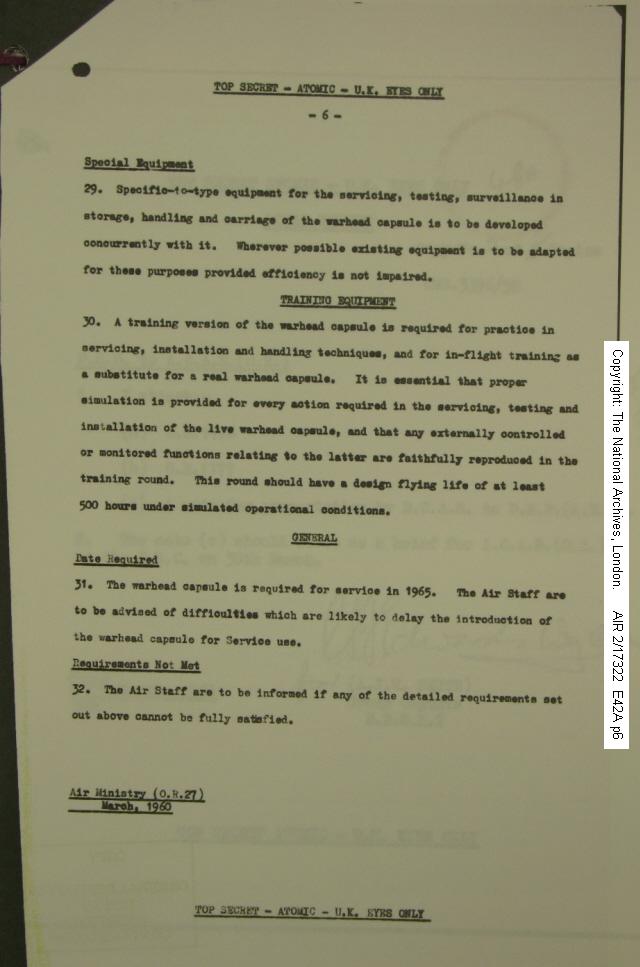
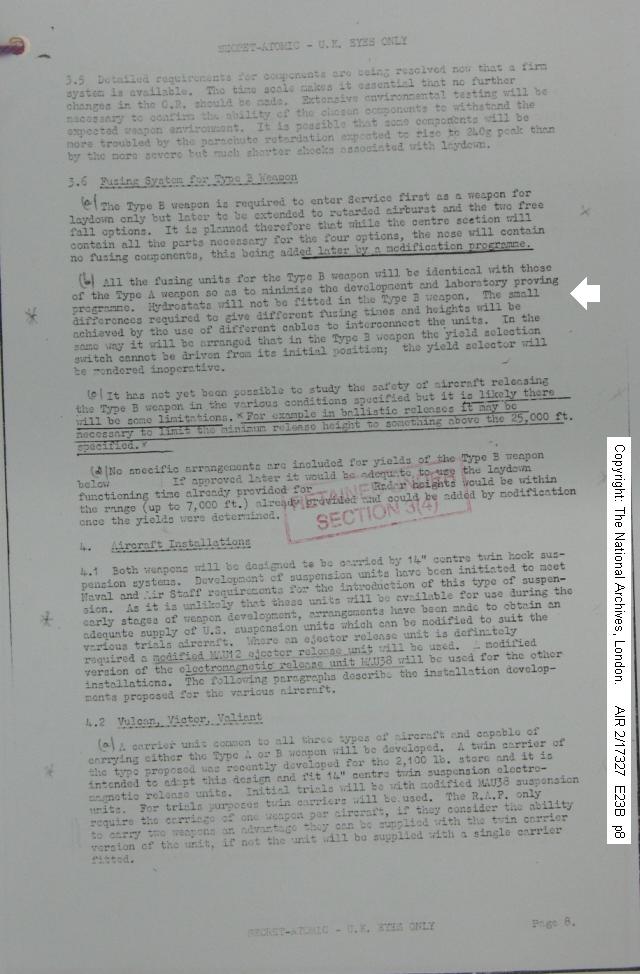
The first draft of the specification OR.1177 called for the weapon to be supplied, stored and transported in several main sections (nose with radar elements, centrebody, tail, and warhead
capsule). (15)
It had been hoped that the warhead capsule itself could be transferred between different weapons as and when operations required. For example: it was envisaged that a warhead capsule
might be transferred between a bomb and another delivery vehicle, eg. an air-defence missile, an anti-submarine missile, or a
torpedo. (16)
This arrangement was quickly seen to be impractical and inflexible if other operational requirements were to be met, and a self-contained warhead enclosed in a shock-resistant capsule was
installed in the fully assembled bomb casing at manufacture, and was issued to the Service in that state, installed in a non-air-conditioned storage container. It required no servicing or
assembly operations by the Service user other than periodic checks for leakage and routine checks of the electrical systems.
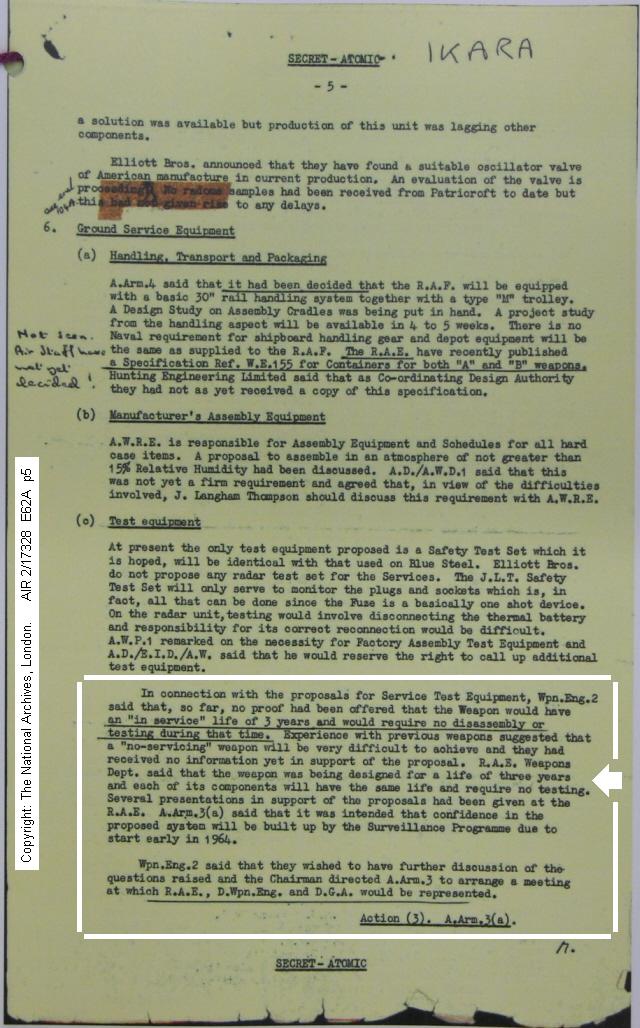
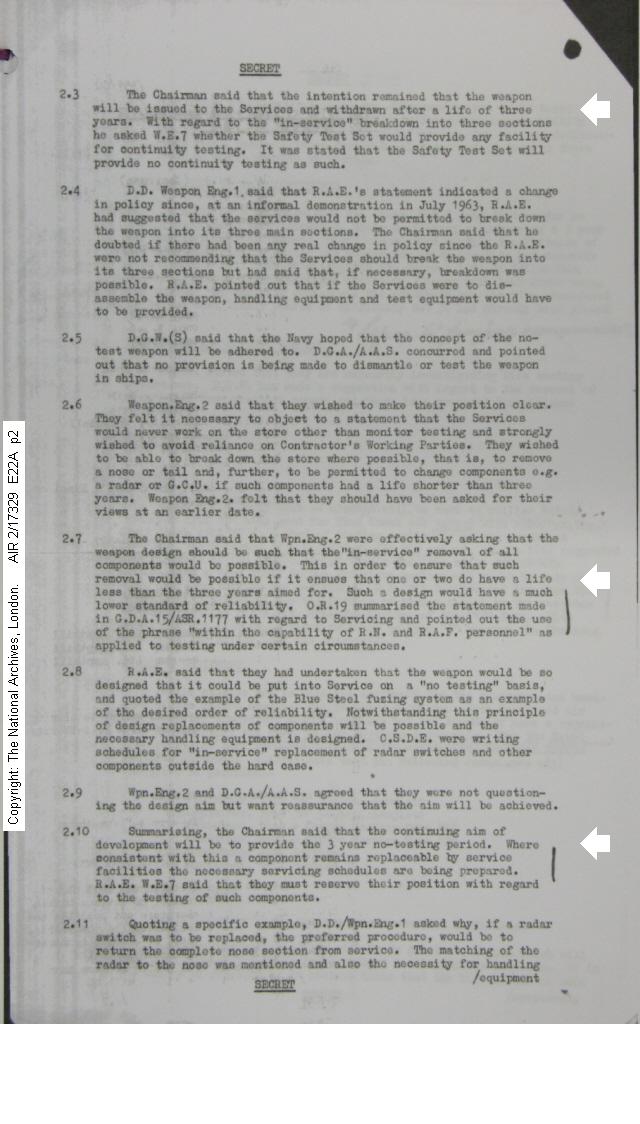
The life-limiting factor was the radioactive tritium gas used in the warhead, which decays at a known rate, and was specified to be replaced at three-year intervals initially. All other components
were designed to match that expected three-year
life, (17)
and the entire weapon was returned to the manufacturer at that interval, when all routine servicing was done. This practice has been the norm for all subsequent British nuclear warheads.
|
|
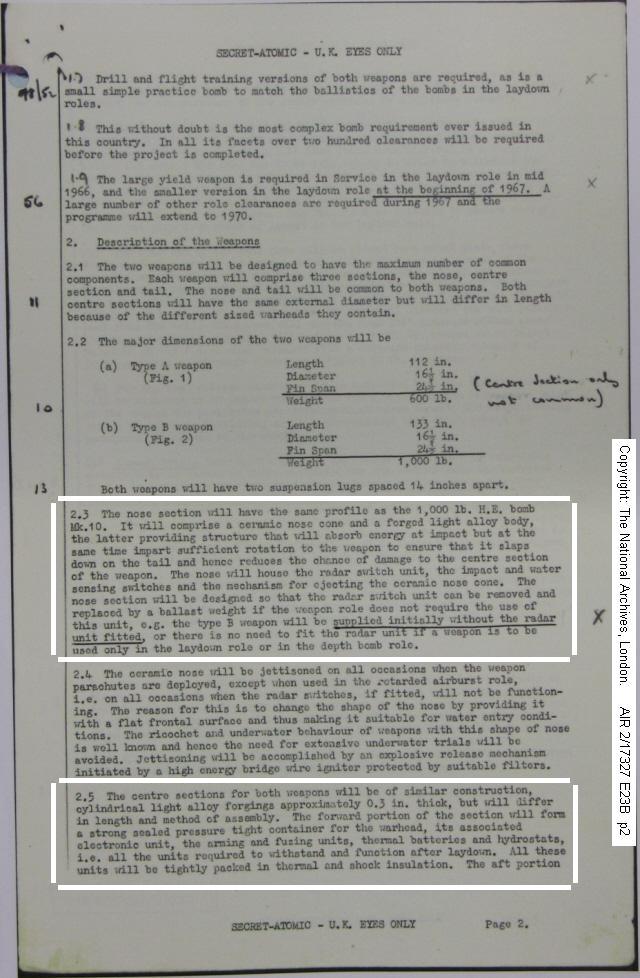
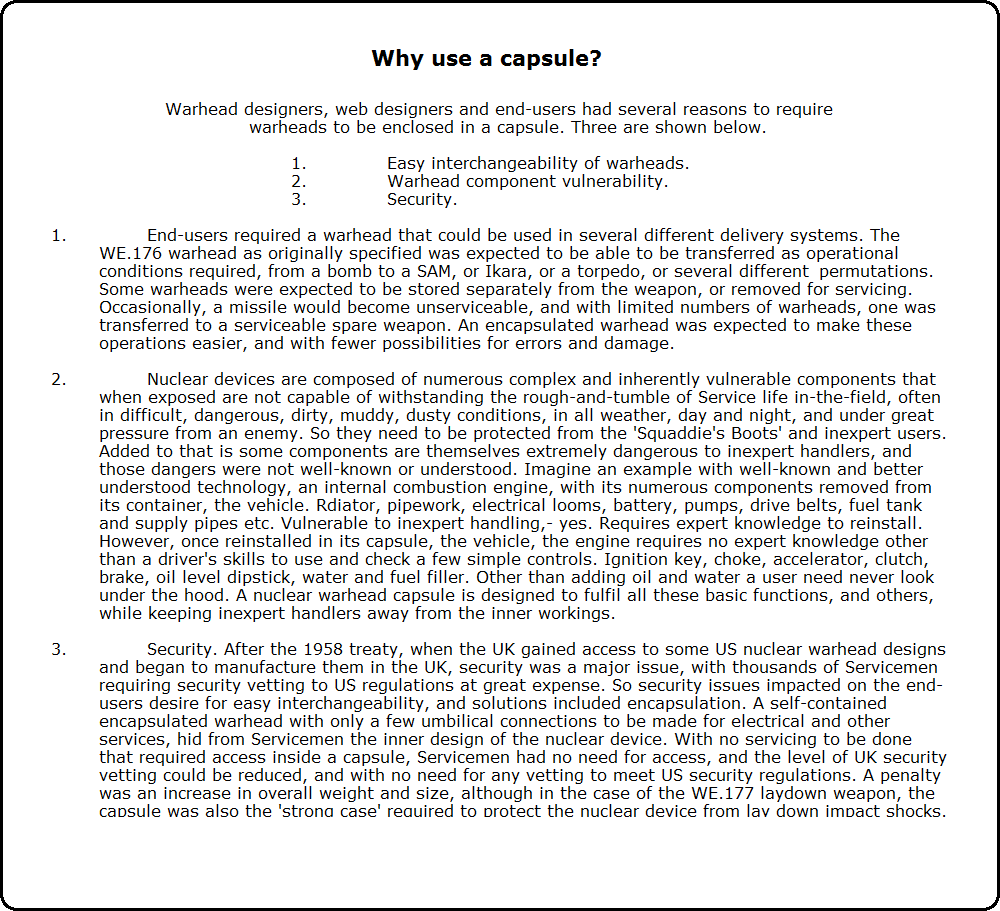
The armoured, shock-resistant warhead capsule contained an independent power supply and all the equipment needed for the warhead to function to detonation after a hard landing on the
ground or in water in what is termed a 'laydown' delivery; in reality, a hard landing at up to 200 mph slowed by several tail parachutes. The warhead capsule was protected by the
shock-absorbing qualities of the nose and tail, and the after part of the centre
section. (18)
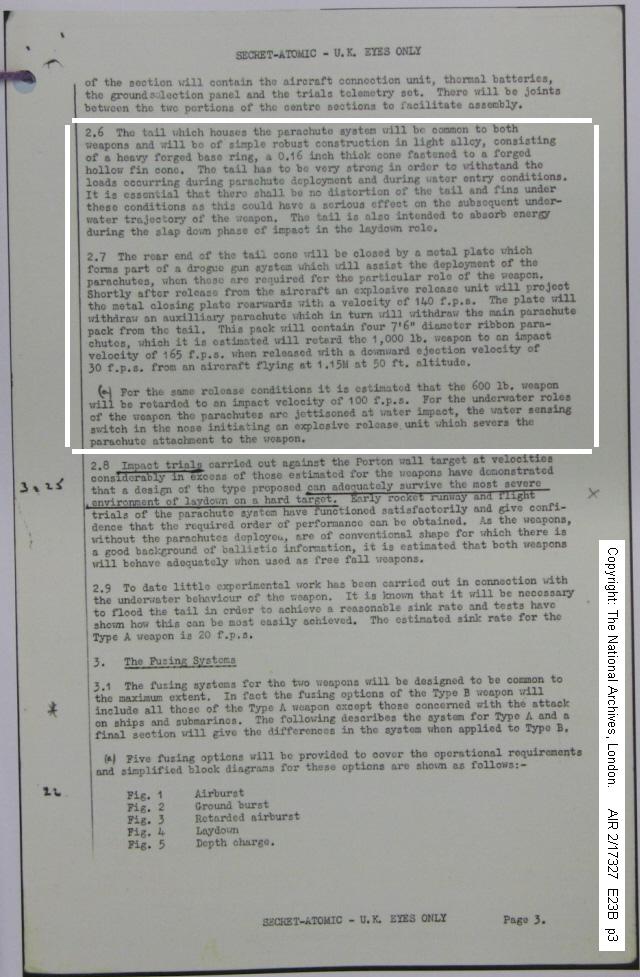
The equipment housed in these sections was no longer required after laydown. The tail was said to 'slap-down' on
landing, (19)
and in doing so absorbed some of the landing shocks, protecting the armoured warhead capsule, itself secured inside a forged high-strength aluminium alloy centre section
casing. (20)
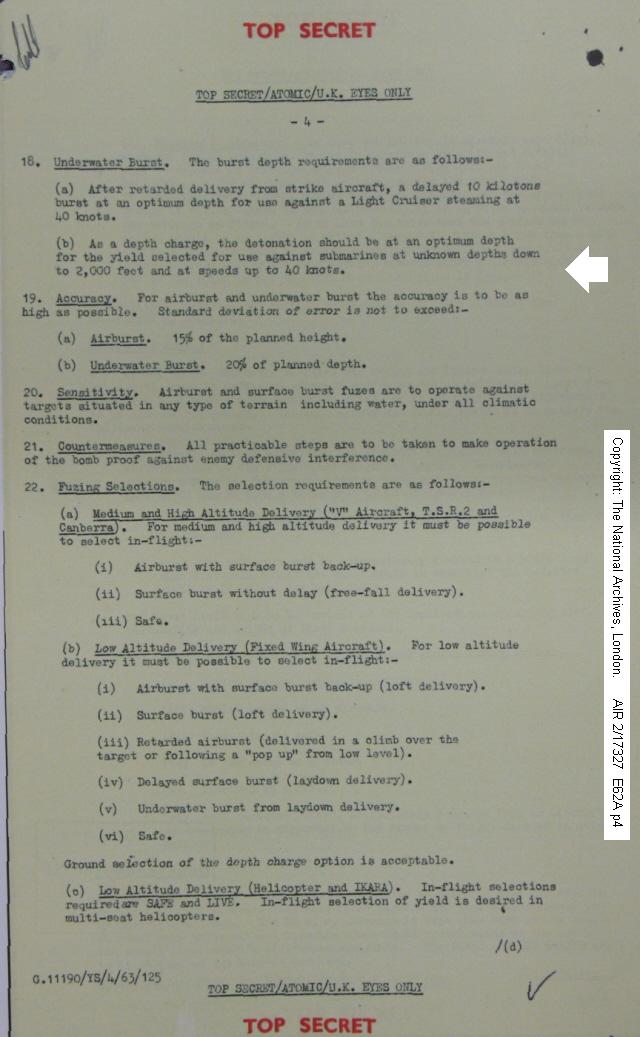
The warhead capsule was gas pressurised and watertight. Hydrostatic firing pistols were incorporated in the warhead capsules fitted to WE.177A to detonate the warhead at the required water
depth down to 2'000 ft.
(21)
The hydrostats were not fitted to warhead capsules used in
WE.177B, (22)
and possibly not in WE.177C. Radar units in the nose of WE.177A could be removed and replaced by ballast when the weapon was only required to be used in the NDB role, and WE.177B
weapons did not have radar units fitted from the outset because they were only required to be used in the laydown
role. (23)
Radar units were added later so that high and medium altitude ballistic releases were possible. It is likely that the WE.177C variant had similar arrangements to WE.177B, but as yet there is
no hard evidence.
|
|
A change of direction
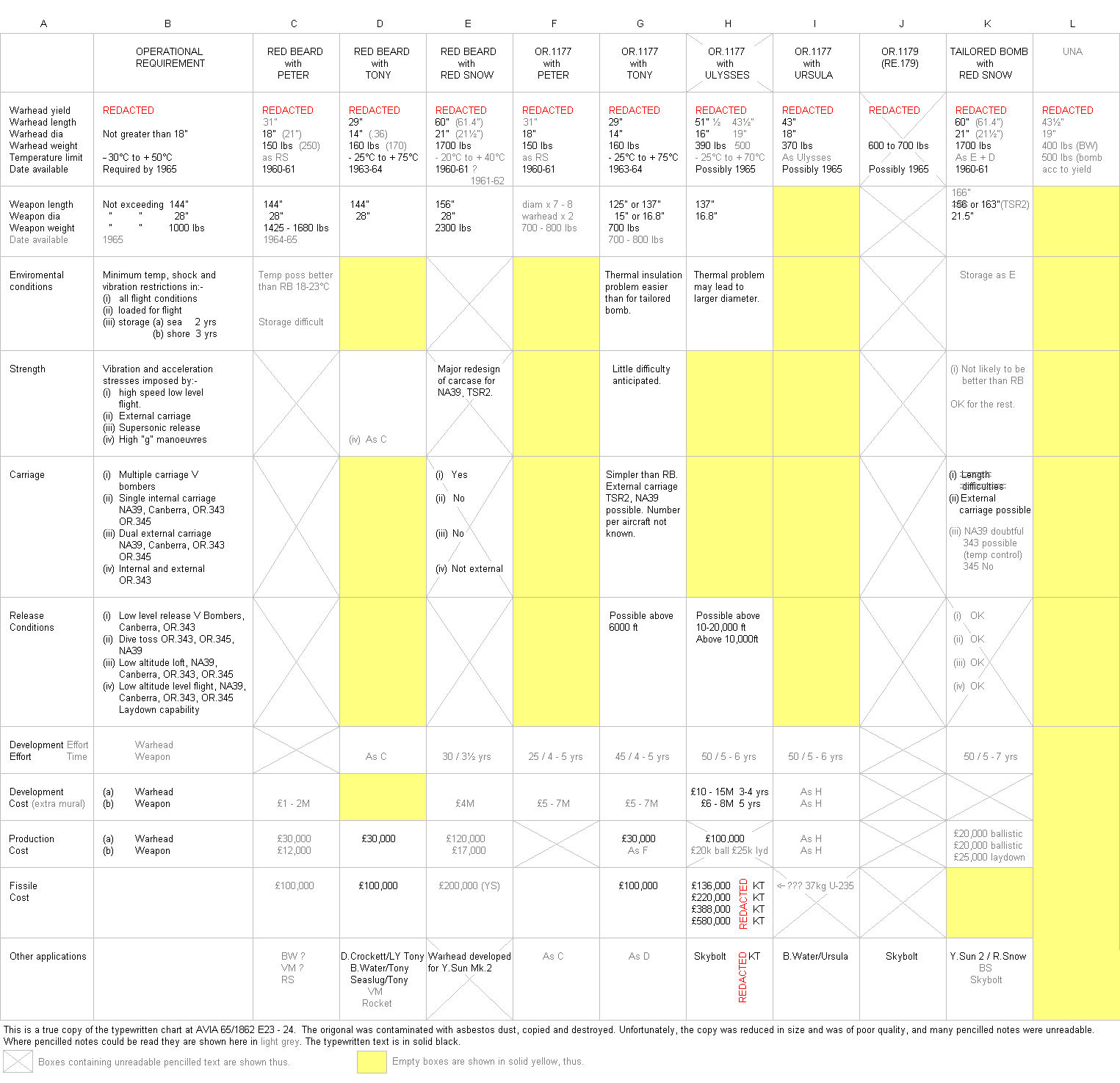
Development of a warhead to replace Red Beard had been proceeding since 1959, and the options initially favoured included an indigenous UK thermonuclear design codenamed Una
, later known as Ulysses, (24)
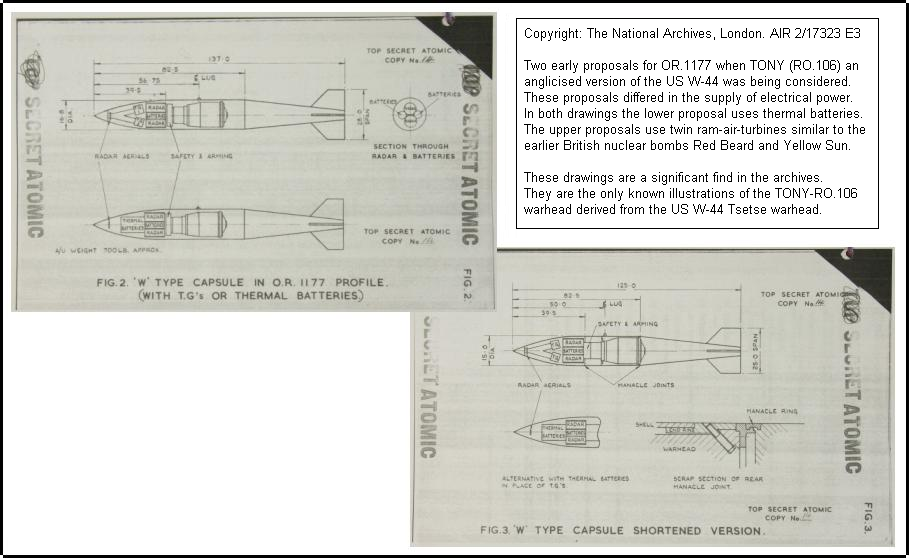
and a lower yield variant of RE.179, an anglicised version of the US W-59 thermonuclear warhead used on some Minuteman 1 ICBMs. Both Una / Ulysses and RE.179 were to
use as a fission primary the anglicised version of the US W-44 Tsetse warhead,
Tony. (25)
Una / Ulysses and RE.179 were also being developed for the strategic system Skybolt, the Blue Water SSM for the Army, and the WE.177 tactical bomb for the RAF to spec OR.1177 when
political events elsewhere required significant changes in plans.
The Skybolt ALBM intended to extend the usefulness of the V-bomber force as a strategic deterrent was cancelled by the US, and the UK chose to replace Skybolt with Polaris SLBMs and
submarines. A warhead for Skybolt was well-advanced, and plans emerged to adapt that warhead for an emergency 'stop-gap' weapon for the V-bombers, based on an enlarged WE.177, and
later for the UK Polaris A3T. The warhead intended for the defunct Skybolt was a UK-manufactured copy of
the US W-59 (26)
thermonuclear warhead with a UK-manufactured copy of the US W-44 Tsetse as the fission primary. The latter known
as Tony and later
as RO.106.
(27)
However, the US W-44 used a HE composition known as PBX-9404 that was too shock-sensitive to comply with strict UK explosives safety standards and Tony (RO.106) used a less sensitive
but less powerful British HE. Although the HE retained its power in storage, tritium used to boost and accelerate fission, decays at a rate of approximately 5.5% per year, and after a lengthy
period in storage, Tony was not sufficiently powerful at an estimated 8½ kT to assure detonation of the secondary fusion component of the RE.179
warhead. (28)
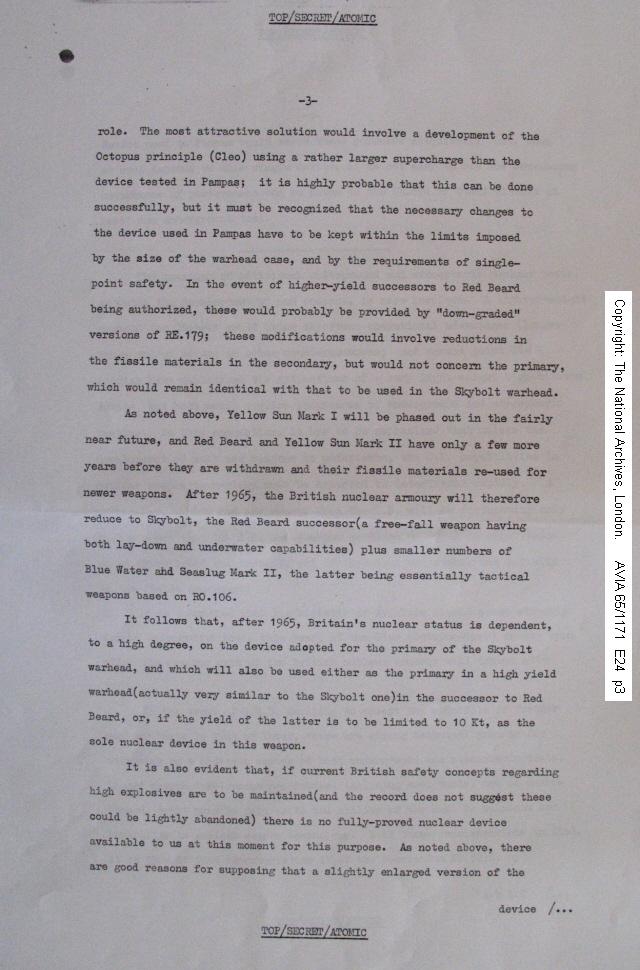
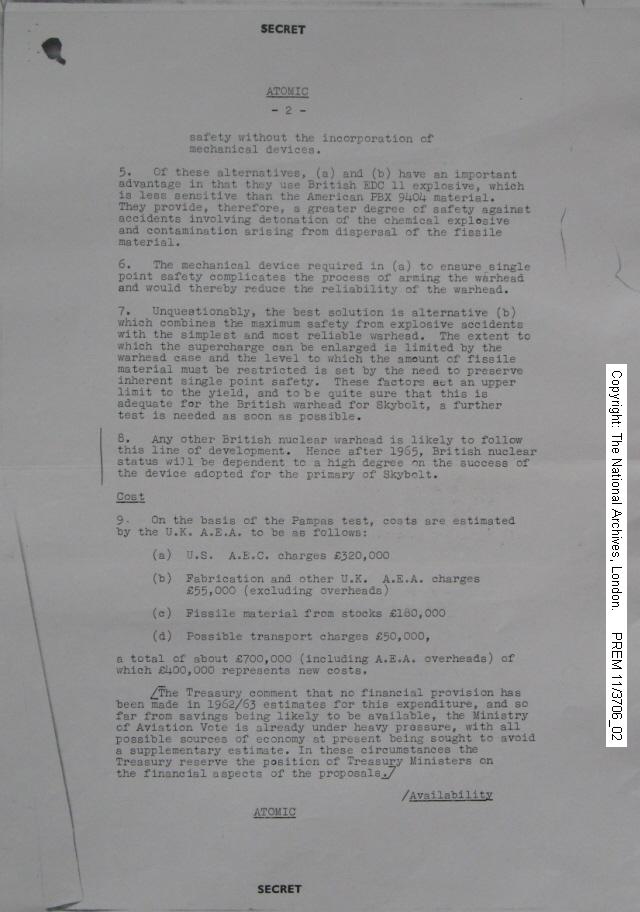
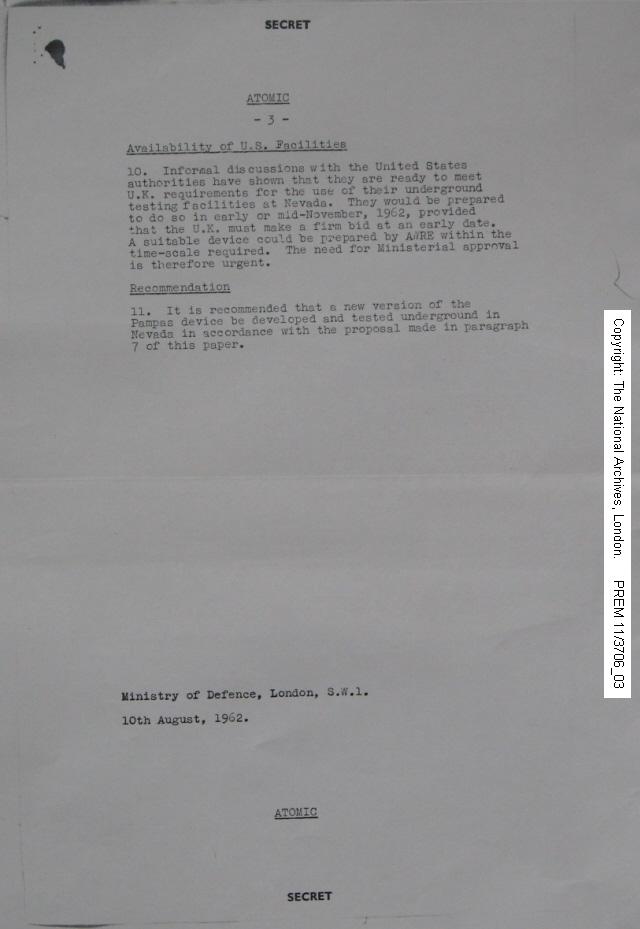
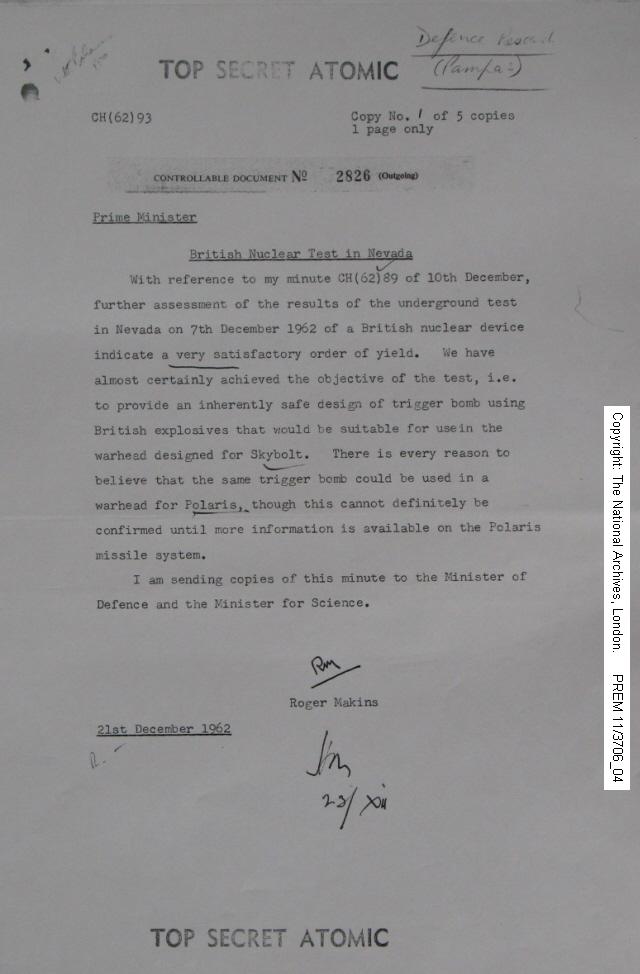
Various alternatives were studied before a solution was adopted to use a wholly-British original design of primary based on earlier UK designs Super Octopus and
Cleo. (29)
These were tested as
Pampas (30)
and Tendrac. This British device was the base-design used in various forms for UK Polaris, WE.177B, WE.177A and WE.177C as Jenny, Katie, Katie A, and Cirene.
Production of a replacement for the Red Beard tactical bomb by 1965 to coincide with the introduction into service of TSR2 and the carrier-borne Buccaneer was postphoned until 1971, and
priorities were re-arranged. First priority was a stop-gap weapon to allow the V-bomber force to soldier on, penetrating Soviet airspace at low level to improve their survivability until Polaris was
ready in 1969. To do that, the V-bombers required a laydown weapon that could be released at low level. Their existing strategic free-fall weapon was Yellow Sun, and this was limited to
releases from high altitudes where the bombers were becoming vulnerable to Soviet SAM defences. Some efforts were made to adapt Yellow Sun for release from approx 12'000 ft after a
'pop-up' maneouvre from low level, but the only realistic solution was a new weapon designed for low level release.
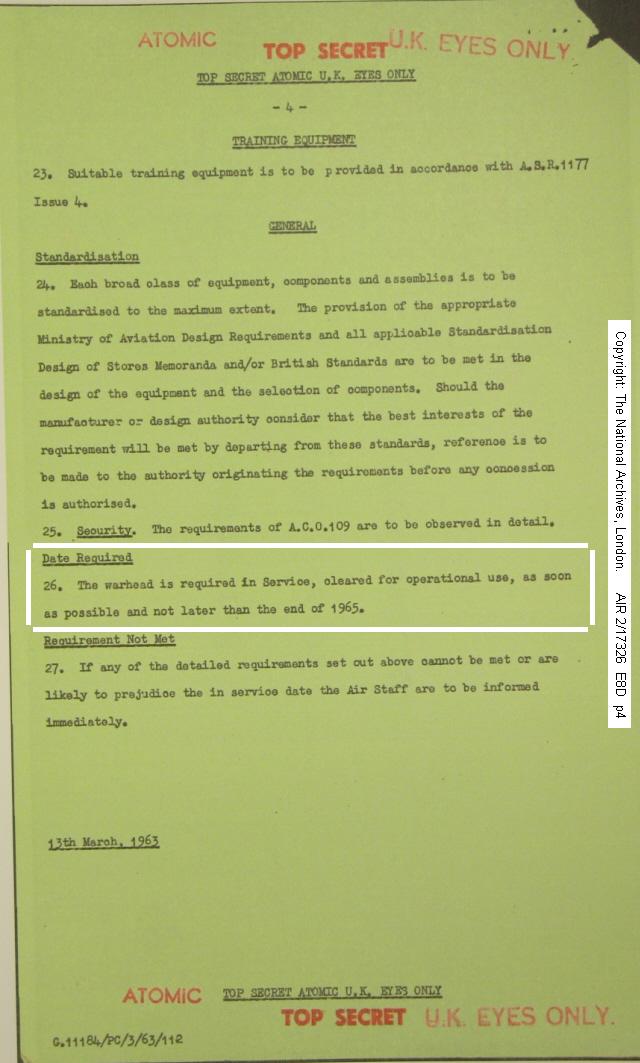
Assigned first priority for an in-service date of end-1965 later extended to mid-
1966 (31)
was this new laydown weapon WE.177B, adapted from existing plans for OR.1177, using a warhead adapted from the fusion secondary of the defunct Skybolt warhead mated to the
UK-designed Super Octopus/Cleo fission primary tested at Pampas and Tendrac. A specification was quickly produced as
OR.1195 (32)
for the complete weapon, also known unofficially as Weapon X and the stop-gap
weapon. (33)
The complex multi-faceted fuzing options of OR.1177 were not required for this stop-gap laydown weapon and these were not incorporated, although planned for retrofit
later. (34)
Assigned second priority was the warhead for the UK Polaris force. After a study of options, the solution chosen was similar to WE.177B. The same fusion secondary used in WE.177B was
adapted in a less powerful form, yielding 200 kt rather than 420 kt. The UK-designed Super Octopus/Cleo primary used was an adaptation of the primary used in WE.177B. Benefits
included a reduced need for expensive and politically undesirable nuclear
tests, (35)
and design experience with the earlier warhead permitted economies in use of scarce fissile material.
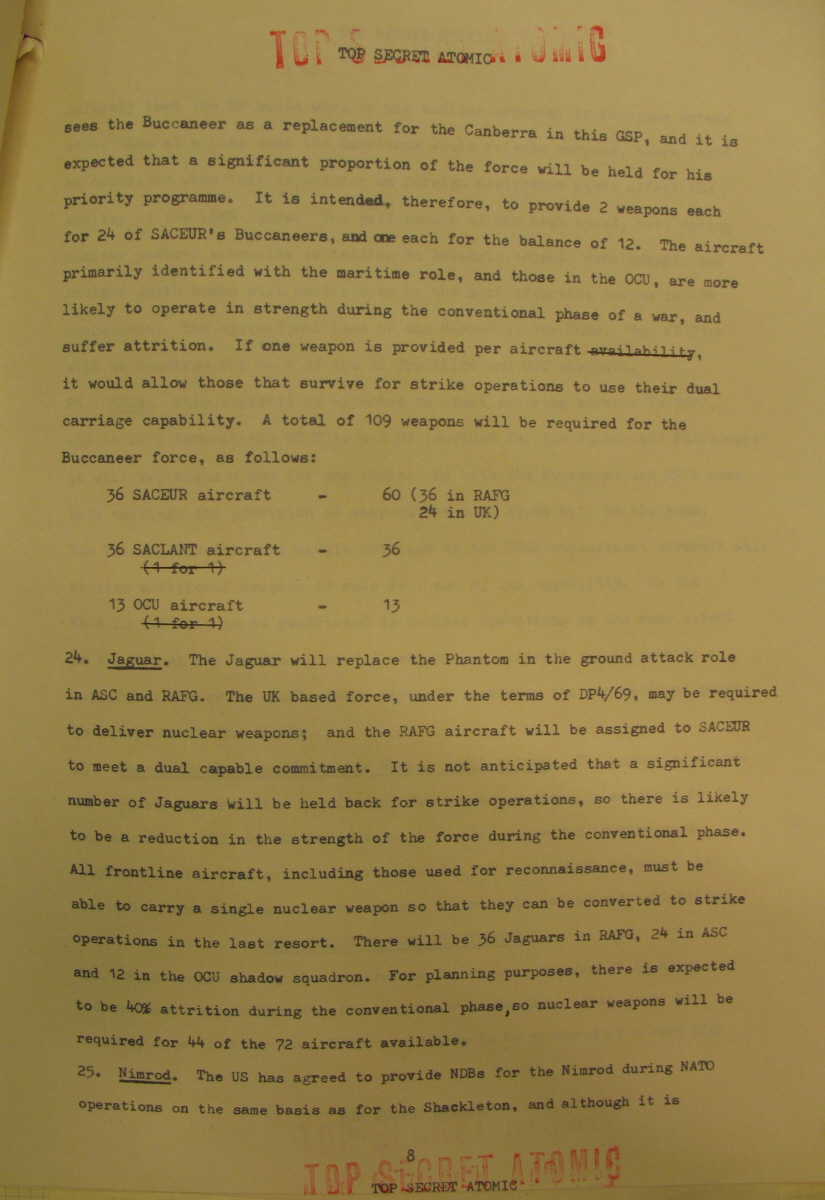
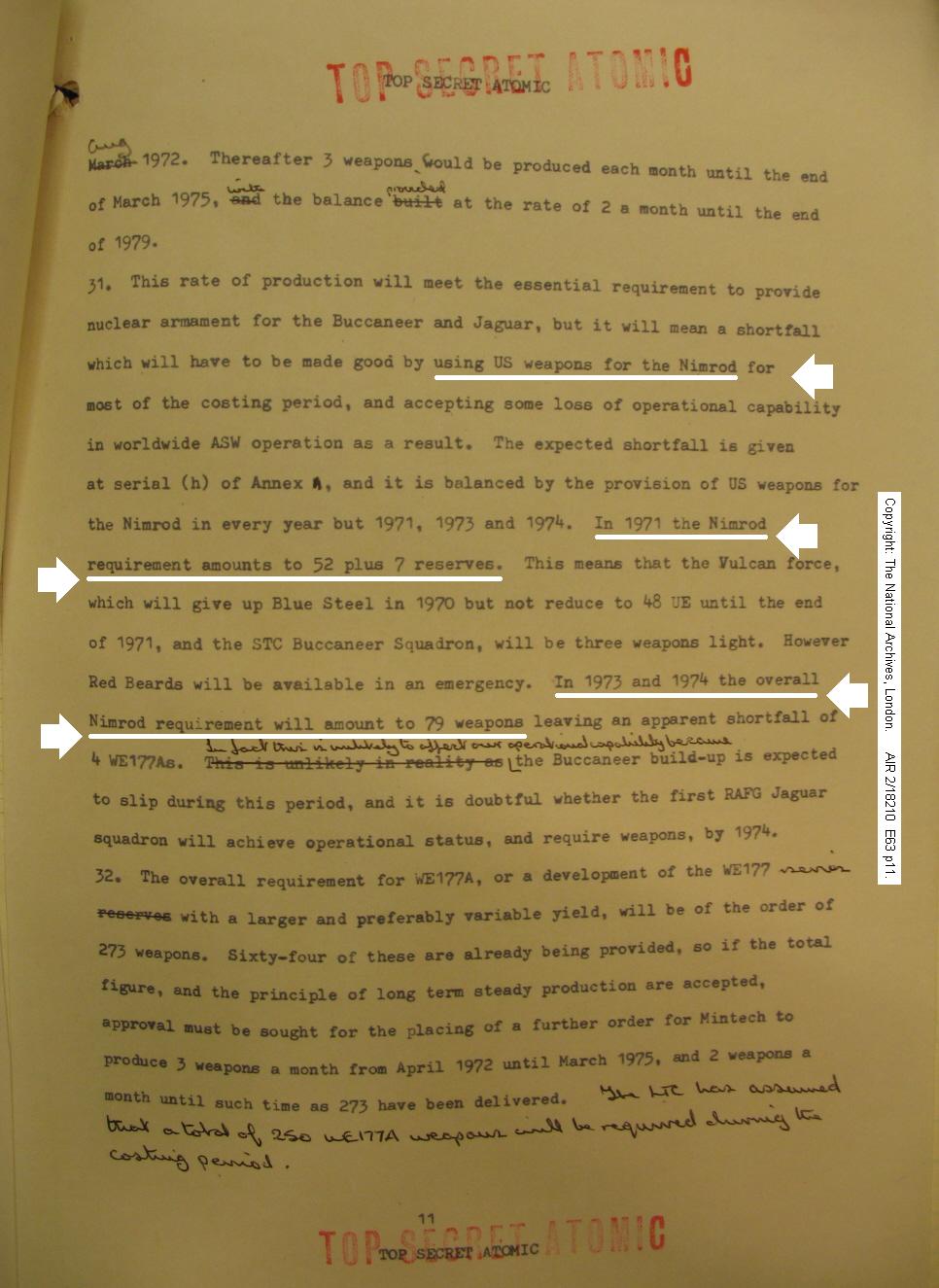
Assigned third priority was the PT.176 warhead and capsule to specification OR.1176 limited to 10 kt for WE.177, now relabelled WE.177A, the Improved Kiloton
Bomb, intended to replace Red Beard, which now had to remain in use until replacement began in 1969, with the first deliveries to the Royal
Navy, (36)
followed by first deliveries to the RAF in
1971. (37)
|
|
Octopus, Super Octopus and Cleo
There is evidence that the Octopus/Super Octopus concept dating from before 1958 that evolved into the Cleo device tested at PAMPAS, and used in various formats in WE.176, WE.177
and ET-317 for UK Polaris was a multi-point ignition implosion
device. (38)
In its WE.177 incarnation it remained in operational use until 1998, a remarkable 40 years, and testimony to the robustness of its
design concept. Hard evidence from official archives disclose that only six HE
"tiles" (39)
detonated a HE supercharge. A semi-official
source (40)
claims that only two EBW detonators initiated a multi-point detonation of the explosive tiles using HE filled channels on the outer surface of two aluminium hemispheres of 350mm
diameter. (41)
There is independent confirmation from another non-offical
source. (42)
A lack of provision for the cables required for multi-point electrical detonators is apparent in the sectioned WE.177A operational round found in the A&AEE Boscombe Down museum collection
at Old Sarum. (43)
Little else is known other than that London archives disclose evidence that this was a DT boosted design, that the pit incorporated
plutonium (44)
hemispherical pressings with the device encased overall in a beryllium outer
shell, (45)
clad in stainless steel, (46) and in its thermonuclear trigger role, the thermonuclear jacket was of depleted uranium. (47)
However papers declassified subsequently dated December 1964, disclose that WE.176 used delta phase plutonium(48) and a mechanical safing device was being incorporated in production warheads for both Polaris and WE.177.(49) and that there were production plans to purchase machine tools specifically to lathe-turn semi-spherical hemispheres of both plutonium and uranium. The conclusion from that can only be that the WE.176 core was a boosted composite one.(50)
These official sources detailing factory processes are the hardest of hard evidence, but as always in this difficult area, researchers are wary of the possibilities for disinformation, especially in semi-official sources.
|
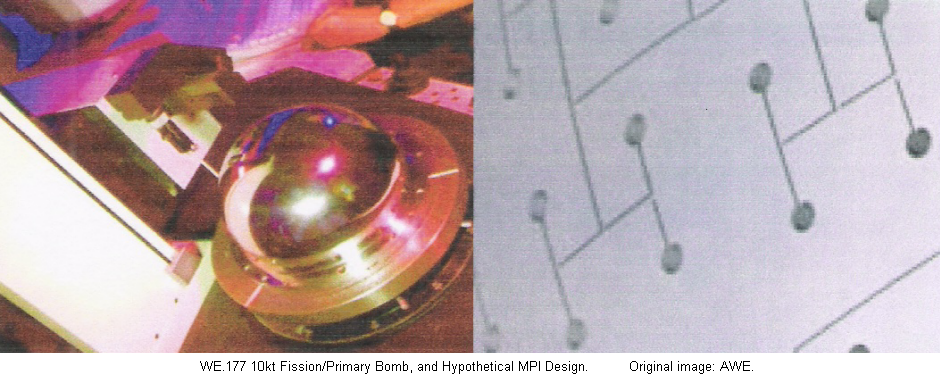
|
National Archives declassified files provide hard evidence that the Cleo device tested at Pampas UGT was not
one-point-safe. (51)
It used a mechanical safety device consisting of a core filling of two litres of five micron diameter glass
balls (52)
with a texture of a fine powder that were to be ejected during the arming sequence, presumably before the void was evacuated to a vacuum. Prior to detonation the void was filled with
pressurised tritium. The TSR2 aircraft manufacturers, Vickers, had concerns about the consequences of ejecting these glass balls into the aircraft mechanisms and rivetted structures, and the
possibilities for unpredictable and premature metal
fatigue; (53)
and there were concerns about the mechanical reliability of the ejection
mechanisms. (54)
Similar arrangements in earlier weapons had led to a weapon being in an unsafe condition in storage when the core filling escaped from the warhead onto the storage area floor. See Violet
Club at Footnote 43.
Nevertheless, there is hard documentary evidence in declassified official files dating from 1964 ;(55) that describe in some detail the manufacturing processes for what these documents describe as a "safing system" for the ET.317 (Polaris A3T missile) version of this fission warhead. The documents suggest that the safing system was related to the DT-boosting equipment. By this time manufacturing of the Polaris version was well advanced, with materials ordered and delivered, contractors agreed and contracts entered into, with the design probably frozen. There is a possibility that the safing system described in these documents referred to some other part of the warhead, although that appears unlikely. As always, where there is doubt, readers will need to make their own judgement.
The TENDRAC UGT on 07 December 1962 was of an enlarged modified device, (56) and a declassified National Archives file refers to this device having a smaller fissile core than PAMPAS, and being inherently one-point-safe. (57)
It also dispensed with the mechanical safety device, (58) eliminating concerns about the glass ball core filling, and easing the provision of a gastight fissile core. Plutonium hemispheres manufactured at ROF Burghfield
(59)
were probably closed by welding, (although there is no direct hard evidence for this) and seated on polymeric (plastic) cushions (60) inside a gastight beryllium tamper, welded closed. (61)
Although further changes were made, and further UGTs were done to optimise the device as a primary for Polaris after the cancellation of Skybolt and the Army's Blue Water SSM, the
enlarged-Cleo device tested at TENDRAC was used as the primary for WE.177B, and alone
(62)
as the fission warhead PT.176 for WE.177A, remaining essentially as it was when tested at TENDRAC. Some changes may have been incorporated after the CORMORANT UGT two years
later, and the so-called Economy Tests COURSER UGT (a failure) and CHARCOAL UGT. These later tests were not originally mounted for warhead development, but were a programme of
advanced research unconnected with Skybolt, WE.177 and Polaris. (63) Although some use was made of them to optimise the Polaris warhead, especially in economising on fissile material, (64)
they may have been too late to influence major changes to WE.177B on the eve of deployment. That may explain the retention of the mechanical safeing device, now known to be a feature of WE.177. The principal changes from the Skybolt proposal was a reduction in fissile material used in the
W-59 Skybolt thermonuclear secondary (65) to acheive a yield of approximately ½ MT for WE.177B (or as much as possible given the restraints on casing size), and this change, and a similar later change for Polaris, did not directly impact on the design of the Pampas-Tendrac enlarged-Cleo design of a primary device, which could remain essentially unchanged. (66) Although weight reduction was possibly a prime concern for the Polaris version. There is no hard evidence either way.
Thus did the UK develop a series of fission warheads all different, yet all related to the same forebears, Super Octopus and Cleo, each used for a different purpose as either a fission trigger, or
a stand-alone warhead.
- Known as Katie,(67) the design met the requirement for a gas-boosted fission primary for ZA.297(68) thermonuclear warheads used in WE.177B, to specification OR.1195, also known as Weapon X, the stop-gap strategic laydown weapon.
- Known as Jennie,(69) the same design met the requirement for a gas-boosted fission primary for ET.317(70) thermonuclear warheads used by the Royal Navy A3T Polaris SLBM.
- Known as
Katie A,(71)
the same design met the requirement for a gas-boosted fission warhead PT.176, also known as WE.176 to specification OR.1176, for the Improved Kiloton Bomb,
or WE.177A.
- Known as Cirene,(72) a variant of the same design met the requirement for a warhead fitted in WE.177C, the medium-yield tactical thermonuclear bomb deployed by the RAF in the mid-1970's. Some were converted from existing WE.177A weapons. Others were new-build examples. This weapon most closely resembled the weapon specified in the original RAF OR.1177 specification of 1960.
- Known as
Scenic,(73)
this was a variant of PT.176 that is described in declassified files as an all-oralloy Katie, meaning a version using no plutonium, but only U-235 (HEU). Nothing further is known of this
variant, or its purpose. A possible explanation for it is that it may have been intended as an 'insurance policy' against problems encountered in development of PT.176, or a shortage of plutonium
or other materials. However, further details are still classified, and no hard evidence as to its purpose exists.
|
|
References and further reading
- Dr Richard Moore. Nuclear Illusion, Nuclear Reality. Britain, the United States and Nuclear Weapons,1958-64.
- Dr Richard Moore. The Real Meaning of the Words: a Pedantic Glossary of British Nuclear Weapons.
- Cocroft & Thomas. Cold War, Building for Nuclear Confrontation 1946-89. ISBN 1-873592-69-8. Pub: English Heritage. 2003.
- Chris Gibson. Vulcan's Hammer: V-Force Projects and Weapons Since 1945.
ISBN: 9-781902-109176. Published 2011 by Hikoki Publications Ltd, Manchester, UK. Undoubtably, the definitive account of V-Force weaponry, and the "stop-gap" weapons proposed after the Americans cancelled Skybolt, and intended to extend the operational life of the airborne deterrent until Polaris and the Royal Navy took over the UK strategic nuclear deterrent. It appears unlikely that a more comprehensive and better researched account than this one will be published.
- C Gibson & T Buttler. Hypersonics, Ramjets and Missiles: British Secret Projects.
ISBN 978-1-85780-280-0 Midland Publishing, 2007. An outstanding account of British missile development from infancy, and especially useful for an account of the 'stop-gap' weapons that competed with WE.177B.
- Dr John R. Walker. British Nuclear Weapons and the Test Ban 1954–1973. Britain, the United States, Weapons Policies and
ISBN: 9781409481201 Publisher: Ashgate, London. 2010. Dr Walker is employed in the Arms Control and Disarmament Research Unit, Foreign and Commonwealth Office, London.
Tim McLelland The Avro Vulcan: a complete history.ISBN 978-0-85979-127-4 Crécy Publishing, Manchester 2007.Some contradictions, but a good account of early UK atom bomb history and rationale for the V-bombers.
Philip Birtles The Avro Vulcan: Britain's Cold War Warrior.ISBN 978-1-85780-269-6 Midland Publishing 2007. Good photograph resource.
Andrew Brookes. The Handley Page Victor. ISBN 0-7110-1803-0. Published 1988 by Ian Allen, London.
Richard Moore. Prospero, - Journal of the British Rocketry Oral History Project, Spring 2004.Dr Moore is a Visiting Research Fellow at the Centre for Science and Security Studies in the Dept of War Studies, King's College, London; the Official Historian at AWE Aldermaston and formerly a Visiting Research Fellow, Mountbatten Centre for International Studies, University of Southampton.
Richard Rhodes The Making of the Atomic Bomb. ISBN 0-684-81378-5 Simon & Schuster, New York 1986. Just what it says on the cover, although US-centric. Very readable account from a Pullizer Prizewinner. Not too technical.
Richard Rhodes Dark Sun, The Making of the Hydrogen Bomb. ISBN 0-684-80400-X Simon & Schuster, New York 1995. Very readable account.
Carey Sublette. nuclearweaponarchive.org Immensely useful although showing its age with the British section outdated and
Mike Fazackerley For his superb illustrations of delivery methods and much other information.
middle-watch.com History of Royal Navy Leander class frigates and their nuclear role with WE.177A.This superb website is now no longer with us.
And of course, the staff of the National Archives, London.
|
Footnotes
- back TNA AIR 2/17322 E42A p1 OR 1177: improved kiloton bomb. 1959-1960.
back TNA AIR 2/17322 E42A p2 OR 1177: improved kiloton bomb. 1959-1960.
back TNA AIR 2/17322 E42A p3 OR 1177: improved kiloton bomb. 1959-1960.
back TNA AIR 2/17322 E42A p4 OR 1177: improved kiloton bomb. 1959-1960.
back TNA AIR 2/17322 E42A p5 OR 1177: improved kiloton bomb. 1959-1960.
back TNA AIR 2/17322 E42A p6 OR 1177: improved kiloton bomb. 1959-1960.
- back TNA AIR 2/17322 E3A p1. OR 1177: improved kiloton bomb. 1959-1960.
- back TNA AIR 2/17322 E40A p1 OR 1177: improved kiloton bomb. 1959-1960.
- back TNA DEFE 7/2340 E1 p3e Operational use of atomic weapons.1953-1955.
Report by OAW Working Party staff to Chiefs of Staff Committee.
back TNA AIR 2/13759 E8A p1 Megaton bomb (Zodiac MK 3). 1953-1954.
- back TNA AIR 2/17322 E3A p1 OR 1177: improved kiloton bomb. 1959-1960.
- back TNA AVIA 65/1862 E2B p1 ASR 1176 and 1177: nuclear weapon development. 1959-1963.
- back TNA ADM 1/30991 E19 p2 OR 1177: An improved kiloton bomb. 1959-1961.
Original Admiralty specification for a naval weapon, Red Flag.
- back TNA ADM 1/30991 E7 p2 OR 1177: An improved kiloton bomb. 1959-1961.
Original Admiralty specification for a naval weapon, Red Flag.
- back TNA ADM 1/30991 E4 p2 OR 1177: An improved kiloton bomb. 1959-1961.
Original Admiralty specification for a naval weapon, Red Flag.
- back TNA AIR 2/17322 E51A p1 OR 1177: improved kiloton bomb. 1959-1960.
- back TNA AIR 2/17322 E41B p2 OR 1177: improved kiloton bomb. 1959-1960.
- back TNA AIR 2/13759 E8A p1 Nuclear weapons policy. 1969-1970.
RAF Plan R. Nimrod MPA were supplied with US weapons.
back TNA DEFE 24/691 E28 ¶4 Polaris, Poseidon and the Holy Loch. 1970-1971."There is also an understanding in respect of US nuclear weapons, destined for release in times of emergency to maritime aircraft of the Netherlands [and the RAF] and stored in St Mawgan, Cornwall, which was set out in an exchange of letters between Prime Minister Wilson and President Johnson in 1965…. "
- back TNA AIR 2/17322 E3 p2 OR 1177: improved kiloton bomb. 1959-1960.
- back TNA AVIA 65/1862 E69 p3 ASR 1176 and 1177: nuclear weapon development. 1959-1963.
- back TNA AIR 2/17327 E1A p2,9 OR 1177: improved kiloton bomb. 1963. Pages 2 & 9 fragments merged.
back TNA AIR 2/17327 E23B p10 OR 1177: improved kiloton bomb. 1963.
back TNA AIR 2/17328 E72B p1 OR 1177: improved kiloton bomb. 1963.
- back TNA AIR 2/17322 E41B p2 OR 1177: improved kiloton bomb. 1959-1960.
- back TNA AIR 2/17328 E62A p5 OR 1177: improved kiloton bomb. 1963.
back TNA AIR 2/17329 E22A p2 OR 1177: improved kiloton bomb. 1963.
- back TNA AIR 2/17327 E23B p2 OR 1177: improved kiloton bomb. 1963.
back TNA AIR 2/17327 E23B p3 OR 1177: improved kiloton bomb. 1963.
- back TNA AIR 2/17327 E23B p2 OR 1177: improved kiloton bomb. 1963.
back TNA AIR 2/17327 E23B p3 OR 1177: improved kiloton bomb. 1963.
- back TNA AIR 2/17327 E23B p2 OR 1177: improved kiloton bomb. 1963.
- back TNA AIR 2/17327 E62A p4 OR 1177: improved kiloton bomb. 1963.
JDASR GDA.15/OR.1177 final issue 16 Apr 1963. Page 4 of 14 pages.
- back TNA AIR 2/17327 E23B p8 OR 1177: improved kiloton bomb. 1963. Hydrostats not fitted to Type B warhead.
- back TNA AIR 2/17327 E23B p2 OR 1177: improved kiloton bomb. 1963.
Radar unit replaced with ballast when used as NDB or laydown.
- back TNA AVIA 65/1862 E16 p23-24 ASR 1176 and 1177: nuclear weapon development. 1959-1963.
Original not usable. This is a stitched chart reproduction.
- back TNA AVIA 65/1862 E16 p23-24 ASR 1176 and 1177: nuclear weapon development. 1959-1963.
Original not usable. This is a stitched chart reproduction.
- back TNA AVIA 65/1771 E24 p2 Defence Committee on Nuclear Requirements. 1959-1963.
- back TNA AVIA 65/1771 E24 p2 Defence Committee on Nuclear Requirements. 1959-1963.
- back TNA AVIA 65/1771 E24 p2 Defence Committee on Nuclear Requirements. 1959-1963.
back TNA AVIA 65/1771 E24 p3 Defence Committee on Nuclear Requirements. 1959-1963.
back TNA PREM 11/3706 p1 Underground testing of UK weapons in US. 1961-1962. Prime Minister's briefing papers.
back TNA PREM 11/3706 p2 Underground testing of UK weapons in US. 1961-1962. Prime Minister's briefing papers.
back TNA PREM 11/3706 p3 Underground testing of UK weapons in US. 1961-1962. Prime Minister's briefing papers.
back TNA PREM 11/3706 p4 Underground testing of UK weapons in US. 1961-1962. Prime Minister's briefing papers.
- back TNA AVIA 65/1771 E24 p2 Defence Committee on Nuclear Requirements. 1959-1963.
back TNA AVIA 65/1771 E24 p3 Defence Committee on Nuclear Requirements. 1959-1963.
- back TNA PREM 11/3706 p1 Underground testing of UK weapons in US. 1961-1962. Prime Minister's briefing papers.
back TNA PREM 11/3706 p2 Underground testing of UK weapons in US. 1961-1962. Prime Minister's briefing papers.
- back TNA AIR 2/17326 E8D p4 OR 1177: improved kiloton bomb. 1963.
back TNA AIR 2/17327 E3A p1 OR 1177: improved kiloton bomb. 1963.
back TNA DEFE 19/103 Weapons Development Committee: Nuclear Sub-Committee. 1964-1966.Brief prepared by the Chief Scientific Officer for the incoming Prime Minister, Harold Wilson, after the 1964 General Election.
- back TNA AIR 2/17326 E8D p1 OR 1177: improved kiloton bomb. 1963.
- back TNA AIR 20/11515 E8 Nuclear weapon ASR 1177: handling and environmental trials. 1964-1968.
"It is in fact the mysterious Weapon X, with which the Secretary of State comforted the Tory back-benchers after Skybolt's decease."
- back TNA AIR 2/17327 E23B p8 OR 1177: improved kiloton bomb. 1963. Hydrostats and radar units not fitted to Type B warhead.
- back TNA AVIA 65/1771 E68A p3 Defence Committee on Nuclear Requirements. 1959-1963.
- back TNA DEFE 24/389 E42 Annex Mk 24 torpedo. 1958-1969. Appendix 1 p2 June 1969.
- back TNA AIR 2/18210 E14 p3 Nuclear weapons policy. 1969-1970. RAF Plan R.
- back Ara Barsamian Nuclear Weapons Glossary 2013. Publisher: Nuclear Non-Proliferation Institute.
- back TNA AVIA 65/1845 Planning and estimates for Polaris warhead. 1964-1965.
back TNA AVIA 65/1846 Planning and estimates for Polaris warhead. 1965.
- back Ara Barsamian Unpublished essay contained in personal correspondence.
2013. Nuclear Non-Proliferation Institute. "AWRE started a study on the use of MPI in 1957 to explore elimination of lenses and reduce weight for a given yield. This effort culminated in the Octopus and Super Octopus MPI initiation system, tested in the Pampas and Tendrac shots in Nevada, in March and December 1962, yielding about 10 kt. The new system was more compact, more robust, and less critical regarding tolerances in manufacture and assembly. It was the basis of the UK WE.177 weapon fission primary. A dismantled specimen is about 350 mm in diameter compared with Fat Man’s 1,500mm diameter. It is conjectured without public proof that the MPI system is an aluminum shell with 1mm² grooves filled with HE distributed uniformly over two hemispheres, and ending at holes filled with HE in contact with the main HE charge. Two polar exploding bridgewire (EBW) detonators initiate the whole MPI system."
- back Ara Barsamian Unpublished essay contained in personal correspondence. See note 40 above.
- back Mike Fazackerley Information in personal correspondence from a WE.177 assembly worker via a third party.
- back Brian Burnell photograph 1 Sectioned ex-operational WE.177A round at
back Brian Burnell photograph 2 Sectioned ex-operational WE.177A round.
back Brian Burnell photograph 3 Sectioned ex-operational WE.177A round.
back Brian Burnell photograph 4 Sectioned ex-operational WE.177A round.
back Brian Burnell photograph 5 Sectioned ex-operational WE.177A round.
back Brian Burnell photograph 6 Sectioned ex-operational WE.177A round.
back Brian Burnell photograph 7 Sectioned ex-operational WE.177A round.
back Brian Burnell photograph 8 Sectioned ex-operational WE.177A round.
back Brian Burnell photograph 9 Sectioned ex-operational WE.177A round.
- back TNA AVIA 65/1792 History of atomic weapon production. 1963.
- back TNA AVIA 65/1846 E42 E53 Planning and estimates for Polaris warhead. 1965.
back TNA AVIA 65/1846 E68 p4 Planning and estimates for Polaris warhead. 1965.
- back TNA AVIA 65/1846 E53 p1 Planning and estimates for Polaris warhead. 1965.
back TNA AVIA 65/1846 E68 p4 Planning and estimates for Polaris warhead. 1965.
back TNA AVIA 65/1846 E71 p1 Planning and estimates for Polaris warhead. 1965.
back TNA AVIA 65/1845 E22 p1 Planning and estimates for Polaris warhead. 1964-1965.
back TNA AVIA 65/1845 E88/1 p1-5 Planning and estimates for Polaris warhead. 1964-1965.
- back TNA AVIA 65/1846 E42 p1 Planning and estimates for Polaris warhead. 1965.
back TNA AVIA 65/1846 E62 p1 Planning and estimates for Polaris warhead. 1965.
back TNA AVIA 65/1846 E83 p1 Planning and estimates for Polaris warhead. 1965.
- back TNA AB/4575 p10 UKAEA Weapons Department: Atomic Warheads Production Committee. 1964.
- back TNA AB/4575 p11 UKAEA Weapons Department: Atomic Warheads Production Committee. 1964.
- back TNA AB/4575 p11.6(a) UKAEA Weapons Department: Atomic Warheads Production Committee. 1964.
- back TNA PREM 11/3706 p1 Underground testing of UK weapons in US. 1961-1962. Prime Minister's briefing papers.
back TNA PREM 11/3706 p2 Underground testing of UK weapons in US. 1961-1962. Prime Minister's briefing papers.
- back TNA AIR 2/17324 E41A p1 OR 1177: improved kiloton bomb. 1961-1962.
back TNA AIR 2/17324 E47B p3 OR 1177: improved kiloton bomb. 1961-1962.
- back TNA AIR 2/17324 E41A p1 OR 1177: improved kiloton bomb. 1961-1962.
back TNA AIR 2/17324 E47B p3 OR 1177: improved kiloton bomb. 1961-1962.Putting these glass beads into a context understandable to laymen; the maximum permitted particle size for talcum powder sold for personal and domestic use in the UK and the EU is just 5 microns, exactly the same size as these glass beads. Although the beads would be unlikely to have a similar softness of touch as talcum. Embedded into aircraft structures and mechanisms they would probably be more abrasive, and the consequent fretting of parts is what the aircraft manufacturers feared.
- back TNA PREM 11/3706 p2.6 Underground testing of UK weapons in US. 1961-1962. Prime Minister's briefing papers.
- back TNA AVIA 65/1845 E7 p1-3. Planning and estimates for Polaris warhead. 1964-1965.
back TNA AVIA 65/1845 E19 E25 Planning and estimates for Polaris warhead. 1964-1965.
back TNA AVIA 65/1846 E16 p2. Planning and estimates for Polaris warhead. 1965.
back TNA AVIA 65/1846 E18 E20 Planning and estimates for Polaris warhead. 1965.
back TNA AVIA 65/1846 E47 E56 Planning and estimates for Polaris warhead. 1965.
- back TNA AVIA 65/1771 E24 p2 Defence Committee on Nuclear Requirements. 1959-1963.
back TNA PREM 11/3706 p2.7 Underground testing of UK weapons in US. 1961-1962. Prime Minister's briefing papers.
- back TNA PREM 11/3706 p1 Underground testing of UK weapons in US. 1961-1962. Prime Minister's briefing papers.
- back TNA PREM 11/3706 p1 Underground testing of UK weapons in US. 1961-1962. Prime Minister's briefing papers.
- back TNA AVIA 65/1792 History of atomic weapon production. 1963.
- back TNA DEFE 19/208 E47/2 p2 ¶2.2 Ad hoc committees on Polaris improvements. March 1974 - Jan 1975.
- back Mike Fazackerley Information in personal correspondence from a WE.177 assembly worker via a third party.
- back TNA AVIA 65/1836 E49A p3 Future UK atomic weapons trials: policy. 1961-1966.
- back TNA AVIA 65/1771 E82 p1 Defence Committee on Nuclear Requirements. 1959-1963.
back TNA AVIA 65/1771 E82 p2 Defence Committee on Nuclear Requirements. 1959-1963.
- back TNA PREM 11/5172 MO.18/1.6 Nuclear weapons programme: requirements for fissile material. 1963-1964.
" ... the [Nuclear Research for Defence] Committee have considered the posssibility of reducing the amount of plutonium to be used in warheads not yet fabricated. ... The most urgent and pressing case is that of the Polaris warhead. The UKEA estimate that a saving of 130 kg of plutonium could be made in the planned Polaris warhead programme, subject to satisfactory results from one UGT, ... The Committee propose that the second UGT should have this objective, ... We can leave for later consideration whether a further economy test, which might increase the plutonium saving ... to 200 kg should be carried out. ... The recommendation ... does not invalidate the claim that the British warhead for Polaris can be produced and commissioned without further test. In order to be sure of this without a test, the planned amount of plutonium has been deliberately increased beyond what was thought to be required. A test would almost certainly allow a small reduction in plutonium per warhead ... "
- back TNA AVIA 65/1771 E24 p3 Defence Committee on Nuclear Requirements. 1959-1963.
The savings in fissile material from the secondary referred to here were possibly reductions in the size of the 'spark-plug', usually of plutonium, and the size or thickness of the fusion casing, often, but not always or exclusively of HEU. There is no hard evidence, and none may ever be declassified, although the earlier reference at Footnote 48 to HEU hemispheres manufactured at AWRE Aldermaston could be an indicator that the fusion design may have been spherical rather than the cylinder of the classical Teller-Ulam configuration. Or the HEU hemispheres may have been part of a composite primary.
- back TNA AVIA 65/1771 E24 p3 Defence Committee on Nuclear Requirements. 1959-1963.
- back Dr Richard Moore. The Real Meaning of the Words: a Pedantic Glossary of British Nuclear Weapons.
Nuclear History Working Paper No 1. First published by the Mountbatten Centre for International Studies, University of Southampton. Dr Moore is a Visiting Research Fellow at the Centre for Science and Security Studies at King's College, London, the Official Historian at AWE Aldermaston and formerly a Visiting Research Fellow at the Mountbatten Centre for International Studies, University of Southampton.
- back Dr Richard Moore Ibid.
- back TNA ES 10/1320 Effects of neutron irradiation of JENNIE. 1966. File remains secret. Only the title is declassified.
back TNA ES 10/1609 Neutron heating of JENNIE. 1969.File remains secret. Only the title is declassified, as are numerous other similar files.
- back Dr Richard Moore Ibid.
- back TNA AVIA 65/1771 E24 p3 Defence Committee on Nuclear Requirements. 1959-1963.
back TNA DEFE 19/208 E47/2 p6 ¶4.3 Ad hoc committees on Polaris improvements. March 1974 - Jan 1975.
- back TNA DEFE 19/208 E47/2 p2 ¶2.2 Ad hoc committees on Polaris improvements. March 1974 - Jan 1975.
- back TNA ES 10/1675 Some calculations on SCENIC, the all-oralloy KATIE [warhead].
File remains secret. Only the title is declassified.
|
|
WE.177
|
|
WE.177 was the last air-launched nuclear bomb deployed by the UK, and the most complex weapon ever designed for the Royal Air Force and Royal Navy.
(1) There were three
versions, all free-fall and parachute-retarded. Two of these versions, WE.177B and WE.177C were thermonuclear weapons. The remaining version, WE.177A was a boosted fission weapon.
The first version to be deployed, the thermonuclear WE.177B, was delivered to the Royal Air Force in September 1966 followed by deliveries of WE.177A to the Royal Navy beginning in 1969,
(2) and the RAF in
1971, after a delay caused by the need to produce the ET.317 warhead for the UK Polaris A3T first; and was followed by WE.177C deliveries to the RAF. The Navy weapons were retired by
1992 and all other weapons with the RAF were retired by 1998.
(3)
The WE.177A boosted fission weapon, deployed in 1971, was originally conceived as an Improved Kiloton Weapon to replace Red Beard, a tactical kiloton-range bomb. WE.177A was a
dual-purpose weapon, being used by RAF and Royal Navy fixed-wing aircraft as a surface attack tactical bomb against land and sea surface targets. It could be delivered by several methods
including low-level loft bombing. Forty-three were also deployed aboard Royal Navy surface vessels of frigate size and larger for use by embarked helicopters as an anti-submarine NDB
(Nuclear Depth Bomb).
(4)
WE.177B was a stop-gap measure designed to fill a gap after the cancellation of another project, and was intended for a strategic role as described below.
WE.177C was added later to meet a Nato requirement for a high-yield tactical bomb not exceeding 200 kt yield, also described in more detail below.
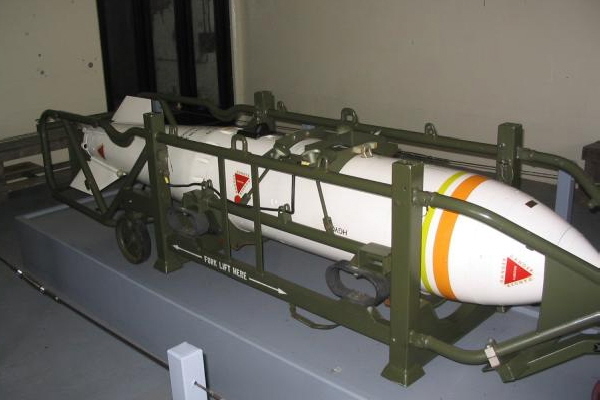
|
|
|
Genesis
WE.177 development began possibly as early as 1958 as an Improved Kiloton Bomb and Red Beard replacement. The Red Beard bomb was heavy, large for fighter-bomber
tactical aircraft to carry underwing, and the storage and handling conditions, and especially the temperature limitations, were a hindrance, and it was aerodynamically unsuitable for high-speed
low-level flight, whether carried externally or internally. Highly radioactive warhead components in the Red Beard warhead, comprising a primitive impact initiator (a neutron generator) had a life
measured in months rather than years, that had to be returned to AWRE for re-lifing every six months from locations in the UK, Cyprus, Singapore and with the Fleet. The logistical issues that
arose were severe, and in the replacement warhead, WE.176, this initiator arrangement was replaced with an Electronic Neutron Initiator (ENI).
Red Beard was armed before take-off with no possibility to change selections in-flight, or to disarm the weapon for a return to base. An improved Mk.2 Red Beard casing with in-flight loading of
the fissile core, and separately, an improved Mk.2 warhead (that could be inserted into the Mk.1 casing) with a higher yield and fewer environmental restrictions on storage was in the
development pipeline but there is no hard evidence that the Mk.2 Red Beard warhead was ever issued to the Services. Other limitations of Red Beard remained, principally its size and weight
on aircraft and in storage, and its aerodynamic unsuitability for external carriage at high speed, and the Mk.2 Red Beard casing was cancelled with the issue of
OR.1177.
(5) A replacement
was urgently sought before Red Beard entered service, and an Air Ministry Operational Requirement was issued as OR.1176 for the warhead, and OR.1177 for the complete
weapon, in August 1959.
(6)
The RAF had concluded that the 15 kt yield of Red Beard was insufficient to ensure destruction of the type of targets they were assigned, and OR.1177 as originally issued specified several
non-variable, manufacturer-set yields between 50 and 300 kilotons in a weapon weighing up to 1'000 lbs, and a diameter no larger than Red Beard's at 28 inches.
(7) The Royal Navy
requirement GDA.10 for a weapon of lower yields and weight, assigned the codename Red Flag was merged into OR.1176 / OR.1177 as a joint requirement,
(8) and sometime
later an RAF Coastal Command requirement OR.1156, updated to OR.1178 for an anti-submarine nuclear depth bomb (NDB) was added,
(9) although a
UK-owned NDB was subsequently never issued to RAF maritime anti-submarine patrol aircraft. They were issued with an American B-57 NDB from US Navy stocks held in Europe.
(10)
As originally envisaged WE.177 was to be merely a tactical nuclear weapon for use in support of land forces and at sea, as an Improved Kiloton Bomb to the twin specifications of
OR.1176 for the warhead, and OR.1177 for the complete weapon. But the early 1960's was a period of rapid change in both warhead design and delivery systems. The era of
the manned high-speed, high-altitude bomber was ending with the arrival of guided missile defences and the ballistic missile, and several false starts were made in weapon choices. Efforts
to extend the life of the RAF strategic bomber force resulted in the Blue Steel short-range stand-off bomb and the Skybolt programme. Skybolt was intended to extend the bomber's strategic
role beyond the 1970's, and when cancellation came, followed by a decision to acquire Polaris, a gap appeared between 1965 and the arrival of Polaris in service at the end of the decade,
when the RAF strategic bomber force was unlikely to be able to penetrate Soviet defences at high-level. A stop-gap weapon was needed that would permit the bombers to penetrate at low-level,
beneath the radar, and SAM defences. That stop-gap weapon, referred to at the time occasionally as Weapon X
(11) was the genesis
of WE.177B to the specification OR.1195 for the complete weapon. It is not known if there was an Operational Requirement specification written for the warhead only, as had
been the case with WE.177A.
In this emergency, the Improved Kiloton Bomb, WE.177A, was put onto the back-burner, with efforts concentrated on the stop-gap WE.177B, followed by the Polaris warhead, followed by
WE.177A. Deployment of WE.177B began in 1966, with WE.177A service entry delayed until 1971.
|
|
OR.1176
OR.1195
It will be difficult and perhaps impossible to unscramble an account of OR.1176 that began as a requirement for a tactical warhead to replace Red Beard from some later additions. An account
of the Improved Kiloton Warhead, the OR.1195 strategic warhead, the others in a series of warheads proposed for Skybolt, Polaris, Blue Water and others that are inextricably linked would
make little sense if dealt with separately in isolation from each other. The account here will adopt that unified format.
OR.1176 is the Operational Requirement, or specification written for the warhead or warhead capsule. OR.1177 is the specification written for the complete weapon, WE.177.
As originally written, the warhead specification was split from the weapon specification because it was intended that the warhead capsule could be a stand-alone product that could be used in
several different weapon delivery systems, eg. bombs, SAMs, torpedos, SSMs etc, possibly with the capsule being transferred between weapons.
(12) As is normal
Service practice, as the OR was revised over time and the Service's requirements were more closely defined, and especially with the addition to the requirement of a laydown capability, it
became clear that the capsule would also take on the function of a 'strong' casing, inside the outer weapon casing. All the equipment that was required to continue functioning after laydown
(really a pre-planned controlled crash-landing) was installed inside the 'strong' casing or capsule. Equipment outside the capsule was redundant after laydown and not part of the warhead, but of
the weapon. So the warhead capsule was self-contained, with its own power supplies, and everything needed to function to the moment of detonation.
(13)
Numerous proposals were considered to meet OR.1176, some were thermonuclear devices, some boosted fission devices, and some of each in the existing Red Beard casing. The three
proposed for the Red Beard casing were:
(14)
|
|
- PETER
A boosted fission device, an anglicised copy of the W-34 Python primary used in the Red Snow strategic warhead and it was already in production in the UK, so could
be available quickly. Yield of 11 kt was not capable of enlargement to the sizes specified by OR.1176 / 1177.
|
|
- TONY
A boosted fission device, an anglicised copy of the W-44 Tsetse primary used in the RE.179 strategic warhead for Skybolt and planned for production in the UK, so
could be available earlier than a new design. Yield of 10 kt was not capable of enlargement to the sizes specified by OR.1176 / 1177.
|
|
- RED SNOW
A thermonuclear device, an anglicised copy of the W-28 thermonuclear strategic warhead in a Red Beard casing lengthened by 12 in to 13 ft. Yield of 1 MT was
much in excess of that specified by OR.1176 / 1177, but could be reduced, and it was already in production in the UK, so could be available quickly.
|
Two further options were then considered:
(15)
|
|
- PETER
In a newly designed casing of uncertain size, but likely to be of approximately 20 in diameter x 125 in length.
- TONY
In a newly designed casing of 15 in or 16.8 in diameter x 125 in or 137 in length.
|
Both casings were a better aerodynamic shape than Red Beard, but with similar design features, eg. ram-air turbogenerator powered. These five options were quickly discarded. Peter and
Red Snow in either casing could be available by 1961, two to three years earlier than Tony, and four years earlier than Ulysses or Ursula. That was an important consideration for the RAF, but
the Red Beard casing was unsuitable for the reasons referred to above, and neither Peter nor the Tony boosted-fission warhead could be sufficiently enlarged to meet OR.1176 / 1177, and so
the next two options were thermonuclear warheads claimed in declassified papers to be of British origin in the slimmed-down new casing considered with Tony above. These were:
(16)
|
- ULYSSES
A thermonuclear device of UK design originally codenamed Una, later renamed Ulysses.
(17) Although
information is sparse, declassified files state that the Una/Ulysses design was based on Red Snow,
(18) the anglicised
US W-28 thermonuclear warhead, with the anglicised US W-44 Tsetse warhead known as Tony substituted
(19) for Red Snow's
fission primary named Peter. All of which suggests that Una later renamed Ulysses was in reality merely a copy of Red Snow scaled down in size to fit into the
available space in the Skybolt ALBM and the Blue Water SSM it was originally intended for, with Ursula possibly an adaptation of Una/Ulysses for a different project, OR.1178,
later incorporated into OR.1177. Other declassified sketches show Tony as a primary in a casing identical to the one for Ulysses. Casing dimensions were 16.8 in diameter x 137 in length, and
with the same ram-air turbogenerator configuration as the previous sketches. Ulysses is known to be associated with the Skybolt ALBM and a tactical battlefield SSM for the British Army, and
commonality of warheads was known be a major design goal.
|

|
- URSULA
A thermonuclear device, believed to be a variant of the Ulysses design, possibly intended for a different weapon project. With shorter length and greater diameter
Ursula would be too large for the bomb casing identified with Ulysses, suggesting that it was originally intended for a different user, possibly the NDB to meet OR.1156, later OR.1178..
Designers estimated that neither Ulysses nor Ursula would be available to the RAF before 1965.
(20)
|
A mention should be made here of one further and final rejected option.
- RED SNOW TAILORED BOMB
Proposed by RAE Farnborough, this was a Red Snow thermonuclear warhead inserted into a new design of casing of 21½ ins diameter, the
minimum casing diameter possible with this warhead. Length was to be 156 inches, with a longer version at 163 inches. At 1.1 megatons the yield of Red Snow was much greater than
specified by OR.1176/1177 although it could be reduced at manufacture with some saving in fissile material. The advantages offered by this option were that the warhead was of a tested and
proven design that was already in production in the UK, and could be available to the RAF by 1961, much earlier than any other option, without the design deficiencies of the Red Beard casing,
and with fewer storage limitations. It would be 25% smaller in diameter, and could be carried externally by supersonic and transonic aircraft without the limitations imposed by Red Beard, or
the stretched bluff-nosed Red Beard with Red Snow warhead.
(21)
Disadvantages were that the new 'tailored' casing would embody none of the very complex fusing and laydown features specified for OR.1177; nor would the Red Snow warhead ever be
capable of withstanding the stresses of laydown delivery. This 'tailored' design was at best a short-term interim design.
|

|
- RE.179
Simultaneously with consideration of the options for OR.1176 and OR.1177 listed above, there was a new thermonuclear warhead codenamed RE.179 being considered with several
other contenders for OR.1179, a requirement for a warhead for the Skybolt strategic air-launched ballistic missile intended to re-arm the V-bombers. Weighing approximately 700-800
lbs, this was an anglicised copy of the US W-59 warhead.
(22) The W-59 aka
RE.179 warhead is known to be of less than 16 inches diameter
(23) and as a sealed
unit, not servicable by the end-users, with a natural uranium outer casing giving rise to handling and corrosion issues,
(24) A fusion casing
composed of natural uranium, suggests that the W-59 and RE.179 warheads were three-stage fission-fusion-fission devices. The fission primary was an anglicised US W-44 Tsetse
warhead, known in the UK as Tony.
|
When eventually Una/Ulysses was abandoned as the choice for OR.1176/OR.1177 along with the other contenders, and RE.179 selected as the warhead for Skybolt,
(25) its components
were also chosen as a common 'start-point' for a 'family' of similar warheads intended to arm OR.1177, OR.1195 and Blue Water. Sound economics. Scientific manpower and other resources
were scarce, and it made sense to standardise and reduce spares stockholdings. Later, after Skybolt cancellation and cancellation of the Army's tactical battlefield missile Blue Water,
the only remaining prospective users of RE.179 components were to be the OR.1195 'stop-gap' weapon WE.177B, and a warhead for Polaris, the UK successor to Skybolt;
and further away in time, and not then fully defined were applications for a naval SAM and an army ADM. Other designs also considered and rejected for the UK Skybolt and UK Polaris,
included the British Acorn,
(26) the US
W-47,
(27) the US
W-56,
(28) and later for
Polaris, the US W-58 warhead.
(29) The British
regarded the W-47 as unsafe;
(30) that it used
excessive amounts of fissile material;
(31) used a safety
device of doubtful reliability;
(32) that it had
corrosion problems that would degrade reliability;
(33) and its fissile
core was unduly vulnerable to neutron radiation from ABMs,
(34) and rejected it.
The W-56, an updated offspring of the W-47 concept and Acorn were also rejected for UK Polaris in favour of the W-58 that armed later versions of the USN Polaris. The primary reason for
prefering the W-58 was probably the desire to avoid further expensive underground nuclear tests in the US and the W-58 was about to enter service with the US Navy in the latest hardened and
cheapest Polaris variant, the A3T, which Britain was to purchase, easing access to stocks of common spares. Then another safety issue arose with the fission primary of both the W-58 and the
W-59; the US W-44 Tsetse; to be manufactured in the UK as Tony for use as the primary in RE.179.
The US W-44 Tsetse primary used a plastic-bonded explosive (PBX-9404)
(35) that was too
shock-sensitive to comply with more stringent British explosives requirements. If replaced in an anglicized version of the W-44 with a less shock-sensitive British explosive, the implosion device
would generate less compression at the core, and a lower yield insufficient to guarantee ignition of the fusion secondary.
(36) The reduction in
yield was especially important at a late stage in the weapon's life-cycle of approximately three years, when in a worst case scenario, tritium decay reduced Tony's yield to below its nominal 8½
kt (±¾ kt)
(37) by approximately
5.5% annually to 6½ kt.
The British solution was to substitute a different primary based on a wholly UK design that began as Octopus, then Super Octopus and then evolving into Cleo.
Declassified files
(38) describe it as "a
novel form of implosion", and it was tested (originally for the Skybolt warhead) underground at the Nevada Test Site as test Pampas on 01 March 1962.
(39) It was the first
British underground test, and its yield was 9½ kt. The design incorporated gas-boosting and a mechanical safing device, for the design was not inherently one-point-safe. Following Skybolt
cancellation and the start of the WE.177B project there were concerns that the mechanical safety device would not be reliable, and a modified design that had a larger HE supercharge
producing more compression at the core, a smaller core that was inherently one-point-safe, and dispensing with mechanical safing, was re-tested as Tendrac on 07 Dec 1962.
(40)
The Tendrac device became Katie, urgently required for the stop-gap weapon WE.177B to specification OR.1195. Katie was later developed into Katie A
(41) needed for the
OR.1176 Air Staff requirement for a ½ kt and 10 kt warhead for the Improved Kiloton Bomb, the naval staff requirement GDA.10 and GDA.15 for a Red Beard replacement and NDB, and
Coastal Command requirement OR.1178 for for a NDB that were all now subsumed into the OR.1176 and OR.1177 specification. The Tendrac device was also developed into Jennie
(42) for use as a
primary in ET.317, the UK Polaris A3T warhead, and Katie A stripped of hydrostatic sensors and other NDB features was the basis of a primary for the later variant of WE.177, the
Type C, or WE.177C.
(43)
Matched to Katie in WE.177B was a secondary derived from RE.179 (itself an anglicised copy of the US W-59) codenamed Simon,
(44) and the
complete WE.177B primary/secondary package was codenamed ZA.297.
(45) A similar
Katie-based primary was adopted for the Polaris warheads then being designed, using scaled-down components derived from RE.179 and WE.177B. No further nuclear testing was required
for the Katie device used in WE.177. The tests that followed Tendrac were concerned only with the Polaris variant of Katie codenamed Jennie, and were known as the Polaris Economy
Tests,
(46) because their
objective was to economise on the scarce and expensive fissile material used in their fissile cores and as a thermonuclear 'spark-plug'. Though it is reasonable to conclude that there were
spin-offs and beneficial effects for the same basic design used in all versions of WE.177.
The RE.179-derived secondary device used in WE.177 and Polaris, known as Simon and Reggie
(47) respectively,
had already been extensively tested in its original form as the US W-59 in the US Dominic test series in the Pacific in tests
Questa, Alma, Rinconada and Sunset, producing a yield of 1 MT in the Sunset test.
(48) There was no
need for further tests of the fusion secondary, suggesting that RE.179, Simon and Reggie were closely related.
Other versions of Katie emerged later. Katie A also known as PT.176, is identified in declassified files with WE.177A. Scenic
(49) is decribed as
an all-oralloy Katie. Oralloy being a term used to describe weapons-grade U-235. So there was a version of Katie that used no plutonium, although nothing is known of this version's purpose.
|
|
OR.1177
OR.1177 is the Operational Requirement, or specification written for the complete weapon WE.177 with the warhead to the separate specification OR.1176. Proposals for an
Improved Kiloton Bomb and Red Beard replacement began possibly as early as 1958, and the first draft of OR.1177 was issued from the Air Ministry on 6 Nov 1959. The Red Beard bomb was
heavy, large for fighter-bomber tactical aircraft to carry underwing, and the storage and handling conditions, and especially the temperature limitations, were a hindrance, and it was
aerodynamically unsuitable for high-speed low-level flight, whether carried externally or internally. A replacement was urgently sought before Red Beard entered service, and an Air Ministry
Operational Requirement was issued as OR.1177 for the complete weapon, in August 1959
(50) to use the
warhead specified as OR.1176.
The RAF had concluded that the 15 kt yield of Red Beard was insufficient to ensure destruction of the type of targets they were assigned, and OR.1177 specified several non-variable,
manufacturer-set yields of 50, 100, 200, and 300 kilotons in a weapon weighing up to 1'000 lbs, and not larger than the Red Beard casing diameter of 28 inches.
(51) The Royal Navy
requirement GDA.10 for a weapon of lower yields and weight, assigned the codename Red Flag
(52) was merged into
OR.1176 and OR.1177 as a joint requirement, and sometime later an RAF Coastal Command requirement OR.1156 updated to OR.1178 for an anti-submarine nuclear depth bomb (NDB) was
added,
(53) although a
UK-owned NDB was subsequently never issued to RAF maritime anti-submarine patrol aircraft. They were issued with an American B-57 NDB from US Navy stocks held in Europe.
(54)
As originally envisaged OR.1177 was to be merely a tactical nuclear weapon for use in support of land forces and at sea, as an Improved Kiloton Bomb, later known as WE.177.
As with many nuclear and aerospace projects of the time, OR.1177 underwent numerous revisions, attempts to reconcile the different requirements of the RAF and Royal Navy in a common
weapon casing, and attempts to design a 'common family' of warheads suitable for the Army, Navy and Air Force. To complicate matters further, a Ministerial ruling of July 1961 endorsed by
the Cabinet, still not declassified, limited all British tactical nuclear weapons to a yield of 10 kt.
(55) A further
complication was cancellation by the US of the Skybolt project. Polaris was substituted, and its warhead was eventually to be part of the 'common family' too, after several false starts. But until
Polaris could relieve the RAF of responsibility for the UK's nuclear deterrent, a 'stop-gap' weapon was urgently needed, and its warhead requirement numbered OR.1195 was also to
be derived from the 'common family' of warheads originating from OR.1177, OR.1176, a Skybolt RE.179 warhead derived from the anglicised US W-59 and W-44, and Army SSM Blue Water
warhead, also derived from the anglicised W-59 and W-44.
Ordnance Board concerns about the safety of some of the materials and techniques used in various warhead proposals also had to be satisfied, leading to major changes in plans and
alternative warhead choices. Not until mid 1961 did serious planning get underway, and not until 1962 was the final choice made.
(56) The US W-44
boosted-fission warhead was abandoned both as a 10 kt tactical weapon in its own right, and as the fission primary, or trigger, for the fusion secondary of RE.179, now being adapted for a
450 kt 'stop-gap' weapon Later found to be 420 kt actual yield) to the specification OR.1195 later known as WE.177B. Substituted for the anglicised W-44 TSETSE, known in the UK as TONY,
was CLEO.
(57) an all-British
boosted-fission design of 1958 codenamed Super Antelope. Cleo was tested at UGT PAMPAS in Nevada, refined as UGT TENDRAC, and became the base design used as a stand-alone
10 kt boosted-fission warhead for WE.177A, and as a 10 kt primary for WE.177B, WE.177C 450 kt and 190 kt thermonuclear warheads, and the ET.317 200 kt thermonuclear warhead for the
UK Polaris A3T SLBM.
|
|
GDA.10 naval requirement
GDA.15 naval requirement
GDA.10 was a naval requirement drafted in mid-1959 by the Gunnery Division (Air) for a replacement for the Red Beard bomb carried by carrier-borne strike aircraft of the Fleet Air
Arm. By December 1959 the Navy had agreed to an offer by the Air Ministry to merge GDA.10 into their OR.1177 requirement,
(59) and a process
of agreeing a common requirement began. Like OR.1177, the naval GDA.10 was limited in scope to be no more than a Red Beard replacement suitable for carriage and release at high-speed
and low-level by Buccaneer aircraft and their successors, using LABS loft release. Initially, there was no requirement for laydown release. That was added later to reduce aircraft vulnerability.
(60) A requirement
for use as an anti-submarine nuclear depth bomb (NDB) either helicopter delivered or on the Ikara missile appears to have been added later.
Maximum weight of 550 lbs was set at the limit for the shipborne Wasp helicopter. Yield requirements are still unclear, although some official declassified sources refer to three yields of ½ kt, 2
kt and 10 kt. These yields were possibly arrived at later after the NDB requirement was clarified. The ½ kt yield being needed only for NDB use in shallow water and other specialized
anti-submarine operations. The yield of the 10 kt naval weapon was intended for fixed-wing strike operations. The remaining 2 kt yield is less certain, although is consistant with a long-standing
naval requirement for a suitable small warhead of that yield for the naval SAMs Sea Slug Mk.2 and Sea Dart. The 2 kt requirement was abandoned later.
(61) The ½ kt and
10 kt yields were eventually selected as the yields of WE.177A.
The low weight and low yields specified in GDA.10 were significantly at variance with the higher yields and weights specified in OR.1177. The naval requirement could best be met by a boosted
fission warhead as was eventually selected for WE.177A. The RAF requirement in OR.1177 for yields of 40 - 300 kt could be most economically met by a thermonuclear warhead as installed in
WE.177B and later in WE.177C. Carriage by the Wasp helicopter for anti-submarine use made weight a critical factor with little possibility of compromise, while the RAF were content with a
weapon weighing up to 1'000 lbs; much too heavy for the Wasp and its successors.
Studies were made about adopting the B-57, a US-designed weapon used by the US Navy for fixed-wing strike and as an NDB. The weapon could be fitted with a British warhead in the UK
without conflicting with non-proliferation committments. The study eventually rejected this option, one difficulty being that the B-57 weapon detonated at depth using a timing device triggered at
splashdown,(62)
whereas the Royal Navy specified the safer option of detonation by depth-sensing hydrostatic pistols. Other objections concerned conflicting HE safety standards; The US B-57 used the W-44
Tseste warhead that could be produced in the UK as Tony, but the anglicised Tony used a safer UK HE composition that resulted in a lower yield. Towards the end of Tony's three-year service
lifespan, tritium decay coupled with the reduced explosive power of the British HE composition reduced the nuclear yield of Tony from a nominal 8½ kt (±¾ kt) by 5.5% annually
(63) to 6½ kt;
believed insufficient to guarantee ignition of the fusion secondary of the larger warheads required for OR.1177;
(64) and the fission
warhead was intended to be a common design suitable for multiple applications. A further objection was in the safety arrangements in the B-57 for the tritium gas-boosting systems that failed to
comply with British safety of explosives standards.
(65) The gas system
to contain radioactive tritium incorporated a fusible blow-out plug similar to those found in some gasoline automobile engine blocks. UK practice was different, with an explosive squib isolating
the tritium containment. The study concluded that major changes were required to an anglicised B-57 to comply with British practice for storage aboard ship.
(66) The B-57
proposal was not adopted, and the studies recommended a new design of British warhead in a newly-designed British casing.
(67)
Politicians then intervened. In July 1962, for reasons not entirely clear (and the Cabinet papers are still classified) the government decided on an upper limit of yield for all British tactical nuclear
weapons of all types and uses.
(68) The limit was set
at 10 kt, significantly lower than the yields required by the RAF for OR.1177, but high enough to include the naval GDA.10 requirement (and the US B-57). The RAF requirements for yields of 50,
100, 200 and 300 kilotons were dead in the water.
In adapting and redrafting OR.1177 to fit the changed circumstances, the naval requirement of GDA.10 was also modified. The requirement for a naval SAM nuclear warhead had lapsed, and
the Admiralty deleted their requirement for a 2 kt yield,
(69) leaving only the
½ kt and 10 kt requirement. The GDA.10 designation was also changed at this time to GDA.15. By this time the full range of carriage and release options seen in the OR.1177 section
above had been added to the joint RAF-RN requirement and an additional requirement for the strategic weapon WE.177B had been issued as OR.1195.
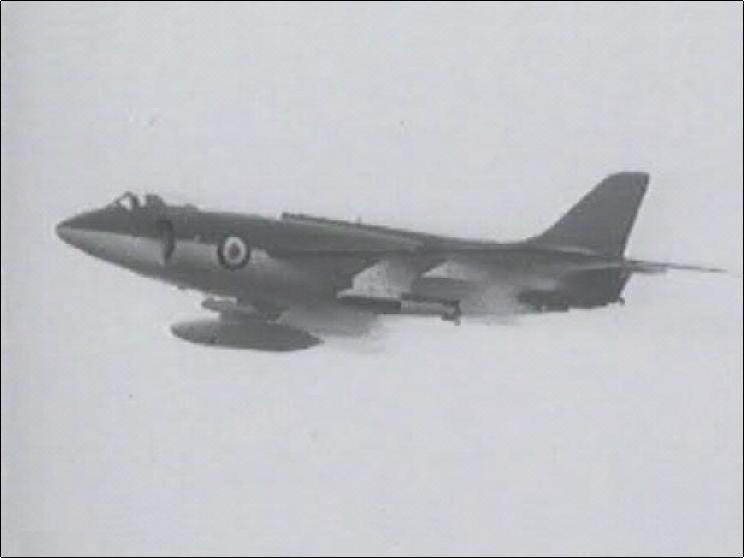 |
|
|
TSR2 & Buccaneer
The aircraft that the Improved Kiloton Bomb was intended for were the forthcoming TSR2 and Buccaneer, the principal tactical strike aircraft of the RAF and Royal Navy respectively, and their
successors. Although there were other aircraft that were expected to carry WE.177, these were of secondary importance to plans for TSR2 and Buccaneer.
The Operational Requirements for these two strike aircraft originally specified the then current tactical nuclear bomb, Red Beard, as their nuclear ordnance, because the Improved Kiloton Bomb
was not then contemplated. Consequently, the bomb bays of these two aircraft were sized to carry Red Beard. The Buccaneer S1 was never cleared
(70) or deployed with
WE.177; it carried only Red Beard. It soon became apparent that Red Beard was unsuited for carriage and release at the high speeds these aircraft were designed for, and Red Beard was
deleted from the TSR2 design. However, without a major redesign, the TSR2 bomb bay remained optimised for a Red Beard sized weapon, in part because early RAF planning for an improved
weapon specified a weapon not larger in diameter than Red Beard, and early planning was on the basis that it would likely be of 28 inches, then 18 inches, then finally 16½ inches diameter.
Without a major and costly redesign of TSR2 when its costs were already spiraling out of control for other reasons, the bomb bay remained unchanged in size. Oversized for a single WE.177
of high yield; and after the intervention of politicians limiting yield to 10 kt, undersized for twin lower-yield WE.177 bombs carried abreast. Buccaneer did not suffer from that problem because its
fuselage and bomb bay were wider and easily accommodated twin WE.177 weapons abreast
After the intervention of politicians referred to above, limiting for political reasons the yield of all British tactical nuclear weapons 10 kt, RAF requirements for yields of 50, 100, 200 and 300
kilotons were dead in the water; and while retaining those design features that would make addition of higher yields possible at a later date without major design changes, weapon designer's
and RAF tactician's thoughts turned to how they could use a 10 kt weapon to attack the hard targets assigned to the RAF by SHAPE.
One solution studied extensively was for multiple carriage of up to four weapons internally and externally on TSR2
(71) and two
internally aboard the Buccaneer,
(72) and at a late
stage in its design process TSR2 designers and weapon designers struggled to accommodate two weapons abreast or in tandem in the TSR2 bomb bay designed for a single larger weapon.
Multiple carriage was required to enable aircraft to release two or four weapons against a single target in a 'stick-bombing' technique,
(73) spaced at 1'000
yards, or simultaneous release, where up to four weapons were released together, with detonation of all weapons triggered simultaneously by one weapon to prevent nuclear fratricide of the
others. The tactical studies and modifications required for both the weapon and TSR2 were still ongoing up to the time of TSR2 cancellation.
With the large reduction in weapon diameter from Red Beard's 28 inches to ultimately 16½ inches offered by designers, the Navy also added a requirement for twin abreast carriage in
Buccaneer, that aircraft designers had no difficulty in accommodating, permitting Buccaneers to be assigned more than one target per sortie.
 |
|
|
Other aircraft
As with other complex weapons developed over an extended period of time, the aircraft expected to carry this weapon were themselves subject to cancellation and other changes in plans. The
many changes are too lengthy to catalogue here. The principal intended users were the TSR2 and naval Buccaneer, and Tornado aircraft were the eventual successors to the ill-fated TSR2. The
table shows the aircraft specified in RAF Plan 'R' circa 1970; with the naval fixed-wing and rotary-wing types added.
One aircraft appearing in Plan 'R' was not equipped with WE.177. Nimrod maritime patrol aircraft of the RAF continued to be deployed with US-owned B-57 NDBs supplied from US Navy
NATO stock located in the UK and Sicily,
(74) while the
WE.177 weapon stocks assigned to Nimrod units in Plan 'R' were allocated elswhere. Valiant bombers were retired prematurely after fatigue issues emerged. Victor B2 bombers remained as
Blue Steel units until re-assigned to a tanker role. Vulcan and Victor B1A aircraft and Canberras were retired before WE.177 stocks became available, and RAF Harrier units were not assigned
a nuclear role. Sea Vixen aircraft were cleared for use of WE.177 as an insurance against delay in the Buccaneer development programme, and although assigned a secondary role as a strike
aircraft, were not specifically allocated WE.177 stocks, although in an emergency, if no Buccaneers were available, they were capable of delivering the stocks kept aboard carriers for the
embarked Buccaneers.
The Ikara anti-submarine missile was purchased from Australia for deployment aboard the CVA-01 carrier and its escorts based on the Type 82 destroyer HMS Bristol. After cancellation of
the carrier and escorts, Ikara stocks were used to equip some Leander class frigates, and plans to equip Ikara with the WE.177, shortened by the removal of the tail bodycap and radar nose
were abandoned. The Scimitar naval strike aircraft and Canberras were photographed carrying and releasing WE.177 test rounds, but were used only for those test purposes and never
deployed operationally with the weapon; the Canberra being retired before stocks of WE.177A tactical weapons became available to the RAF
in 1971.
|
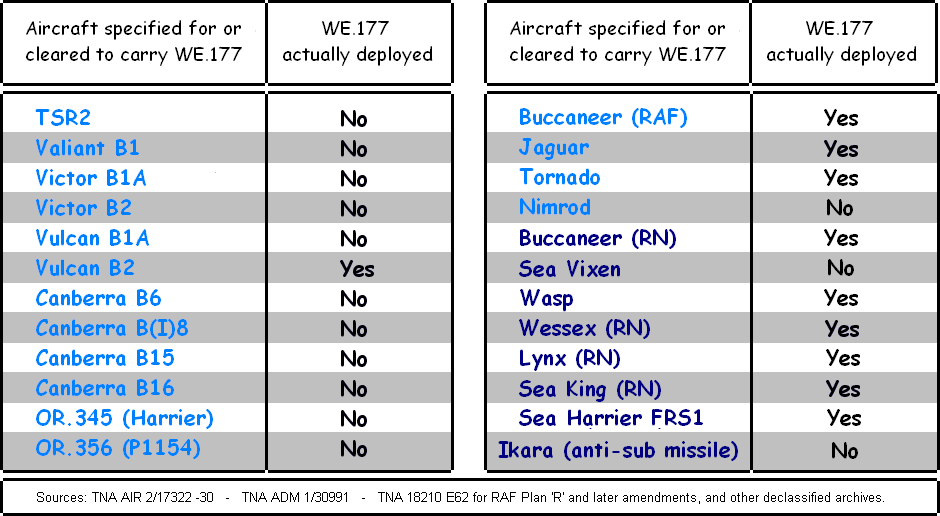
|
|
OR.1156 & OR.1178
OR.1156 pre-dated the Air Staff Operational Requirement for an Improved Kiloton Bomb, OR.1177,
(75) the first draft
being produced in January 1958
(76) at the instigation
of the Commander-in-Chief of RAF Coastal Command.
(77) Prior to that, an
Air Ministry Working Party set up to recommend future policy on airborne anti-submarine detection and weapons had concluded early in 1957
(78)
that only a nuclear depth bomb could provide certainty of killing the new generations of fast, silent nuclear-powered submarines being developed in the Soviet Union. The Working Party
recommended that a nuclear depth bomb be developed for all versions of Shackleton aircraft, at that time RAF Coastal Command's front-line long-range maritime patrol bomber. OR.1156 was
to be met initially by an adaptation of the Red Beard warhead,
(79)
and later proposals were considered using the Una warhead,
(80)
later renamed Ulysses.
(81)
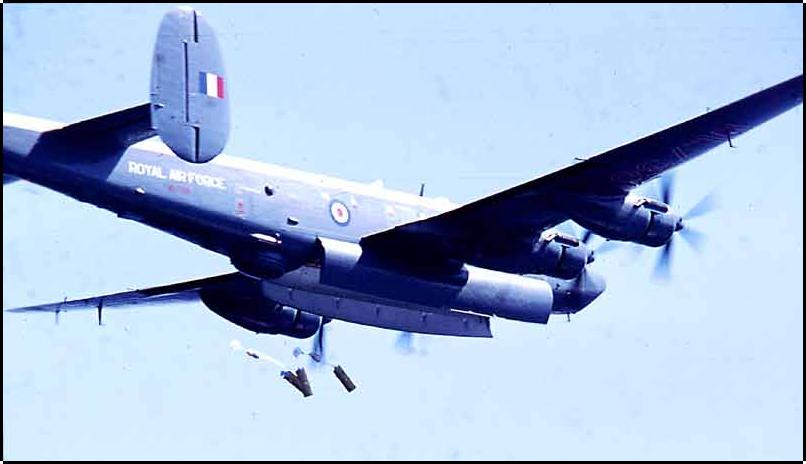 |
|
Although there is no hard evidence, and what follows here is speculation, it is entirely possible that the Ursula warhead was intended for the OR.1156 nuclear depth bomb project.
Although little is known of Ursula, it is known to be shorter and be of greater diameter than its contemporary, Ulysses.
(82)
Neither of these characteristics would be detrimental to the OR.1156 anti-submarine weapon, given the capacious bomb bay of the Shackleton or its successors, and Ursula would meet the
dimensions specified in the first draft of OR.1156.
(83)
Una was known to be a thermonuclear design based on Red Snow, the anglicised US W-28, using the Tony fission trigger, an anglicised US W-44.
(84)
Given Ursula's design ancestry in Una, and its design, dimensional and weight similarities to Una it is entirely possible that Ursula was the warhead of choice for OR.1156 at one point in time.
The first draft of OR.1156 specified a yield of 30-50 kt,
(85)
and it is now known that the Red Beard warhead never achieved those figures; and there were numerous handling, storage and temperature limitation environmental issues with the weapon.
(86)
Similar issues as those that resulted in OR.1177 for an Improved Kiloton Bomb. As an interim measure, yield requirements for OR.1156 were lowered to 5-10 kt in the period to 1965,
(87)
and 15 kt in the five year period to 1970.
(88)
The Red Beard warhead could have met those requirements, but with no possibility of an increase to meet the full requirement of 30-50 kt, and no doubt explains the search for an alternative
warhead in Una or Ursula.
 |
|
Ultimately, given the pressures on resources, the Coastal Command requirement became a joint Naval Staff/Air Staff requirement and renumbered OR.1178 before being
subsumed into OR.1177 and deployed in 1969 as WE.177A.
(89)
The Royal Navy deployed WE.177A in its intended role as a fixed-wing strike weapon and as a helicopter-borne anti-submarine weapon. However, neither RAF Coastal Command long-range
maritime patrol Shackletons or its successor, the Nimrod, ever deployed this weapon. There were plans to do so, but never implemented, the 79 WE.177A weapons planned for their use being
allocated elsewhere.
(90) From 1961
(91) Shackletons
were supplied with a stock of 36 US Navy Project 'N' weapons maintained for their use at RAF St Mawgan, Cornwall,
(92) and Sigonella
US NAS, Sicily.
(93) Shackletons
carried the Mk-101 Lulu NDB, and were able to carry two plus other weapons.
(94) Nimrods could
carry two B-57 NDBs, but were allocated only one per aircraft.
(95) Use of the
American weapons was restricted to the NATO area and temporary deployments of Coastal Command Shackletons and Nimrods to the Middle and Far East were without nuclear weapons.
(96) A primary
reason for wanting a UK-owned NDB for these aircraft was to free them from that and other restrictions on their operational flexibility. Nimrods based in Cyprus on NATO duties had to first fly
the 894 nm to Sicily to collect their weapons from American custody.
(97)
|
|
WE.177 design antecedents
In the early 1990's some writers asserted that the WE.177A design was based on the US B57 bomb,
(98)
which was of a similar size, weight, yield and purpose, and that misplaced and poorly researched speculation has been widely repeated elsewhere, as recently as 2013 in the Bulletin of
Atomic Scientists
(99)
The B57 was a dual-purpose weapon used as a strike weapon against ships and land targets, and also functioned as a NDB, and it used the W-44 Tsetse/Tony boosted fission warhead
rejected by the British for their RE.179 primary. It is also true that the British had access to its design and planned to manufacture the W-44 in the UK for various purposes.
(100)
However, since the early 1990's, many secret files have been declassified, and these make it clear that the claims about a copied US design
(101)
were wrong and merely ill-informed speculation. The original Naval Staff Requirement, GDA.10
(102)
incorporated into OR.1177 makes clear from the outset in 1960, that the Royal Navy required a
bomb with three yields of ½ kt, 2 kt and 10 kt,
(103)
that was lighter and smaller than the RAF requirement, and at a max weight of 550 lbs very similar to the US B57; and the B57 was indeed studied closely; and found deficient.
(104)
Declassified records released in 2008
(105) show that the
B57 was rejected as unsuitable. The Ordnance Board (the UK safety authority) was unimpressed with the shock-sensitivity of the PBX-9404 explosive used in the B57's W-44 warhead.
(106)
The Ordnance Board, RAE Farnborough and the Royal Navy required considerable redesign of several arming systems to comply with British safe practice, in particular the methods used to
control radioactive tritium, and make inadvertent operation of the tritium valve impossible, from fire or other causes.
(107)
The RAF and Royal Navy also required a hydrostatic system of detonation at a predetermined water depth. The B57 design relied for detonation on a timer
(108)
that was unable to determine depth, or, crucially for safe operation, if the weapon had grounded on a shallow sea floor. The B57 also required modification to permit all the delivery and flight
profiles required by the Royal Navy. Redesign was expected to be costly and time consuming as compared to developing a new weapon using the studies already done on OR.1177,
(109)
while a UK-designed warhead capsule to OR.1176 was already well advanced.
(110)
Some writers also made the assertion
(111) (again repeated
word-for-word as recently as November 2013 in the Bulletin of Atomic Scientists)
(112) that because
the British conducted so few full-scale nuclear tests, WE.177 was unlikely to be an indigenous design. That the British weapon, by a curious, unscientific, irrational extension of that
unsubstantiated speculative opinion, must be an American design (the closest being the B57).
(113)
Evidence-based research it was most definitely not. Norris and Kristensen ignored more recent research and locked into their US-centric viewpoint, failed to understand that the WE.177 fission
element was one of a 'family' of designs, deliberately similar, deliberately intended to produce a ' common design', usable with only minor changes, in a variety of applications from
Skybolt, Polaris, Blue Water and WE.177.
For a single basic design, a single series of only four full-scale underground nuclear tests was needed
(114)
and a fifth test, UGT Courser, failed due to faulty US-supplied ENI equipment at the NTS).
(115)
Many American devices were deployed with the US Armed Forces with a lesser test record than this.
(116)
Furthermore, in this period, there were other additional British [nuclear] 'effects' tests conducted in the United States. Effects tests were not of the actual weapon functioning, but of the
ability of other components of the missile, the RV and the warhead; and their 'hardness' (or resistance) to defences. Hardness could only be designed in by exposing RVs and warheads to
nuclear detonations and their high-energy X-ray emissions similar to those produced by exo-atmospheric ABM bursts. The nuclear devices detonated could be of any design or origin; or
detonated for any purpose other than effects testing; providing their yield was a known quantity. As it was after a detonation. British effects tests were 'piggy-backed' onto scheduled
American tests
(117)
(as US effects tests were also piggy-backed) to minimise expense and provide more numerous test opportunities for effects testing. Consequently, these UK effects tests did not appear
separately on tables of NTS testing, adding to an appearance of there being fewer British tests than the actualitié. There were also numerous non-nuclear 'scaled' tests in the UK. Hardly a small
testing programme for a single design of fission device.
In fairness to the original three authors writing so long ago, and with military secrecy being an important factor, the design origins of WE.177 and the UK Polaris ET.317 warheads were not so
apparent when these authors first published in 1994. However, in 2013, after an interval of nineteen years; and after numerous declassifications of archived documents, and numerous published
academic studies by well-respected researchers,
(118)
there really can be no excuse for such sloppy work and misplaced speculation; some of it in 2013 copied word-for-word from an outdated,
discredited publication of 1994.
Finally, referring the other assertion in the 1994 publication and repeated in the Bulletin of Atomic Scientists in 2013, that the British weapons could not be of British design because
(they allege wrongly) so few nuclear tests were conducted by the British, one only has to contemplate the words: "the Israeli bomb"; of which there were apparently no tests at all.
Speculation also fails to take into account the cultural and financial differences between the US and British nuclear programmes. The early US programme was over-reliant on full-scale testing
because of the extreme urgency attached to its very large programme. There are instances of poor design directly attributable to a poor theoretical understanding of the physics, and an
empirical design approach.
(119)
The fission primary of the W-28 being one example of design flaws attributable to an imperfect theoretical understanding.
(120)
On the other hand, the British, with fewer resources, and always short of cash, employed their meagre resources to better effect, with a better understanding of the theory that underpinned their efforts.
(121)
They also benefitted from the shared US test data, as the US benefitted from equally valuable British know-how. That shared know-how, coupled with British experience and greater emphasis on
understanding the theoretical underpinning was one factor that contributed to an American desire to complete the 1958 Bilateral, or Mutual Defence Agreement.
(122)
The US understood that as with British know-how on radar and the jet engine had helped them, they had much to gain from the British in this field, as the British also gained. It was a shared
experience, not a one-way street.
|
|
Construction
WE.176 and the WE.177A weapon it was originally intended for, differed in one principal respect from the earlier weapon it replaced. Red Beard like similar early British and US weapons had
a first generation spherical implosion device that featured a removable fissile core that could be stored separately from the high-explosive components, with the fissile core inserted into the
weapon at the last possible moment, either in-flight by mechanical loading devices (IFL) or on the ground immediately before take-off (LML - Last Minute Loading). These arrangements were thought to
enhance the safety of what were very complicated, yet primitive devices, that mishandled would have devastating consequences. Storing the fissile core separately from the HE, detonators and an
electrical power supply was merely an extension of the age-old good practice of storing fuzes or detonators well away from the main explosive charge. But primitive as the first generation nuclear
weapons were, they were still very complex devices, and Service personnel had little practical experience of performing delicate servicing and assembly operations on equipment so
complicated and so demanding of precision. The successor to Red Beard was expected to minimise these operational difficulties, and also produce a similar nuclear yield from a smaller and
lighter package. The methods needed to achieve this end, required greater precision in manufacture, all the neccessary equipment permanently installed in a self-contained package to be
serviced only by the manufacturer's specialist workers, and less involvement by Service personnel. Additionally, the Improved Kiloton Bomb had to meet the new tougher requirements of
transonic and supersonic flight, and new methods of delivery, including laydown, which could be described as a controlled crash-landing, where the deceleration from supersonic speeds whilst
still airborne could be as stressful as ground contact at high-speed.
Consequently, the replacement warhead was engineered rather differently to Red Beard. The first draft of the specification OR.1177 called for the weapon to be supplied, stored and
transported in several main sections (nose with radar elements, centrebody, tail, and warhead capsule). It had been hoped that the warhead capsule itself could be transferred between different
weapons as and when operations required. For example: it was envisaged that a warhead capsule might be transferred between a bomb and another delivery vehicle, eg. an air-defence
missile, an anti-submarine missile, or a submarine torpedo. This arrangement was quickly seen to be impractical if other operational requirements were to be met, and a self-contained
warhead enclosed in a shock-resistant capsule was installed in the fully assembled bomb casing at manufacture, and was issued to the Service in that state, installed in a non-air-conditioned
storage container. It required no servicing or assembly operations by the Service user other than periodic checks for gas leakage and routine checks of the electrical systems.
After a decision to reject the use of the US W-44 Tsetse primary originally proposed because of concerns about the shock-sensitivity of the PBX-9404 HE used, a UK-designed primary was
substituted. This was based on a design originating with a UK device named Super Octopus, that was later developed into the Cleo design. An enlarged Cleo was adopted for use in the
primary for the warhead for Skybolt, the thermonuclear bomb to OR.1177 (then to be much larger than WE.177A), and a primary for the Blue Water SSM for the Army. Skybolt had the greater
priority at this time, and the PAMPAS UGT detonated 01 March 1962 has been attributed to the Skybolt warhead development programme, although its use was always envisaged for these
other weapons. The Royal Navy GDA.10 requirement for a small bomb that led to WE.177A was not yet not approved.
TNA declassified files provide hard evidence that the Cleo device tested at Pampas UGT was probably not one-point-safe. It used a mechanical safety device consisting of a core filling of two
litres of five micron diameter glass balls that were to be ejected during the arming sequence. Prior to detonation the void was filled with pressurised tritium. There were concerns about the
consequences of ejecting these glass balls into the aircraft mechanisms, and concerns about the mechanical reliability of the ejection mechanisms. Similar arrangements in earlier weapons
had led to a weapon being in an unsafe condition in storage when the core filling escaped from the warhead onto the storage area floor. See here at
Violet Club footnote 43.
The TENDRAC UGT on 07 December 1962 was of an enlarged modified device, and a declassified PRO file refers to this device having a smaller fissile core than PAMPAS, and being
inherently one-point-safe. It also dispensed with the mechanical safety device, eliminating the doubts about the glass ball core filling, and easing the provision of a gas-tight fissile core.
Evacuation to vacuum could then be done in the factory at assembly. The plutonium hemispheres manufactured at Aldermaston were probably closed by welding, (although there is no direct
hard evidence for this) and seated on polymeric (plastic) cushions inside a gas-tight beryllium tamper, welded closed.
Although further changes were made, and further UGTs were done to optimise the device as a primary for Polaris after the cancellation of Skybolt and the Army's Blue Water SSM, the enlarged-Cleo device tested at TENDRAC was used as the primary for WE.177B, and alone as the fission warhead PT.176 for WE.177A, remaining essentially as it was when tested at
TENDRAC. Some changes may have been incorporated after the CORMORANT UGT two years later, and the so-called Economy Tests COURSER (a failure) and CHARCOAL. These later
tests were not originally mounted for warhead development, but were a programme of advanced reseach unconnected with Skybolt, WE.177 and Polaris, although some use of them was made
to optimise the Polaris warhead, especially in economising on fissile material, they may have been too late to influence major changes on the eve of WE.177B deployment. The principal
changes from the Skybolt proposal was a reduction in fissile material used in the W-59 Skybolt thermonuclear secondary to acheive a yield of approximately ½ MT for WE.177B (or as much as
possible given the restraints on casing size), and this change, and a similar later change for Polaris, did not directly impact on the design of the Pampas-Tendrac enlarged-Cleo design of a
primary device, which could remain essentially unchanged. Although weight reduction was possibly a prime concern for the Polaris version. There is no hard evidence either way.
The life-limiting factor was the radioactive tritium gas used in the warhead, which decays at a known rate, and was specified to be replaced at three-year intervals initially. All other components
were designed to match that expected three-year life, and the entire weapon was returned to the manufacturer at that interval, when all routine servicing was done. This practice has been the
norm for all subsequent nuclear warheads.
The armoured, shock-resistant warhead capsule contained an independent power supply and all the equipment needed for the warhead to function to detonation after a hard landing on the
ground or in water in what is termed a 'laydown' delivery. The warhead capsule was protected by the shock-absorbing qualities of the nose and tail, and the after part of the centre section. The
equipment housed in these sections was no longer required after laydown. The tail was said to 'slap-down' on landing, and in doing so absorbs some of the landing shocks, protecting the
armoured warhead capsule, itself secured inside a forged high-strength aluminium alloy centre section casing.
|
|
WE.177A
WE.177A weighed 282 kg (620 lb), with a selectable yield of 10 kT and ½ kT. This was a boosted fission weapon. The ½ kt yield was used only in the NDB role for detonation below
140 ft (43 m) in shallow coastal waters or in oceanic deep waters below 350 ft (107 m) to limit damage to nearby shipping. The full 10 kT yield was intended for use only below 350 ft (107 m) in
deep oceanic waters where no shipping was at risk
(123)
and the low yield was selected automatically where the water depth did not exceed 350 ft.
The full 10 kT yield was used by fixed wing aircraft for surface attack. It had airburst, ground burst or laydown options. Although this variant most closely matched the original GDA.10
naval requirement and was identified as the 'A' model, it was not the first to be deployed. Development was purposely delayed when the Skybolt ALBM was cancelled. Revised priority was then
given to a bomb intended to extend the life (in a strategic role) of the Vulcan bomber force. This stopgap weapon was WE.177B, also known as Weapon X, a thermonuclear
parachute-retarded free-fall bomb based on a lengthened WE.177A casing, using as a thermonuclear primary the intended warhead for WE.177A. This primary was known as KATIE in
WE.177B. and as KATIE A in WE.177A.
Twenty WE.177A bombs were transferred to the RAF from the Royal Navy when the large carriers were decommissioned, and the remaining 43 weapons that were assigned to the Navy's
helicopters were retired in 1992. These were also capable of use by Sea Harriers. It was known to the Armed Services as 'Bomb, Aircraft, HE 600 lb MC'. In this service jargon MC (Medium
Capacity) referred to a nuclear weapon in the kiloton range. The suffix HC (High Capacity) referred to a weapon in the megaton range, although there were some anomalies. The twenty
weapons transferred to the RAF were in fact still deployed on Buccanneer aircraft tasked for the maritime strike role, and assigned to SACLANT, as they were when carrier-borne.
WE.177A anti-submarine weapons were deployed afloat by the Royal Navy for use by embarked helicopters. They were never deployed by the RAF aboard their maritime anti-submarine
aircraft. RAF Nimrods based in the UK were equipped with US B-57 weapons drawn from NATO stocks maintained in the UK at RAF St Mawgan for RAF and Dutch Navy maritime aircraft.
(124)
Nimrod aircraft based in the Mediterranean and assigned to SACEUR were also equipped with US B-57 weapons maintained in a US Navy stockpile at Sigonella in Sicily. Although it was intended
to issue 72 WE.177A weapons plus 7 reserves, totalling 79
(125)
to all Nimrod squadrons and the 'shadow squadron' (an operational training unit in its peacetime role)
(126)
there were never enough WE.177A weapons in British stockpiles to permit implementation of those plans. Nimrods were configured to carry two WE.177A weapons, although the B-57 weapons
assigned from US stockpiles totalled only 36, sufficient for only one per aircraft. UK-based RAF Nimrods were assigned to SACLANT for use in the Atlantic area, and Cyprus and Malta-based
aircraft were assigned to SACEUR and in support of CENTO for use in the Mediterranean. Use of the American B-57 NDB was limited to the Atlantic and Mediterranean areas. Nimrod squadrons
were ocasionally rotated to Singapore without nuclear weapons, a limitation on operational flexibility that WE.177A NDBs would not have suffered.
|
Serial numbers of WE.177A weapons issued to Strike Command (STC) in the UK, Near East Air Force (NEAF) at RAF Akrotiri, Cyprus, and 43 to the Royal Navy for shipborne Anti Submarine Warfare (ASW). The STC weapons were assigned to NATO and were targetted in accordance with SACEUR's Strike Plan. They were also assigned targets under the UK's NRWP (National Retaliatory War Plan). The weapons assigned to NEAF were assigned targets in support of CENTO.
5017 5117 5204 5312 5469 5626 5775 5924
5018 5125 5209 5320 5480 5630 5790 5928
5032 5129 5214 5328 5486 5645 5796 5943
5036 5132 5222 5332 5491 5648 5798 5977
5050 5142 5244 5350 5492 5667 5800 5979
5058 5145 5245 5370 5500 5674 5828 5989
5070 5151 5247 5391 5510 5682 5831 5991
5077 5158 5261 5396 5514 5685 5837 5993
5079 5159 5269 5400 5525 5715 5852 5995
5084 5168 5276 5407 5544 5719 5859
5092 5174 5280 5421 5562 5726 5873
5098 5187 5290 5429 5583 5746 5883
5103 5196 5300 5432 5599 5749 5908
5110 5200 5309 5444 5605 5750 5910
These 107 serial numbers for WE.177A rounds are found in declassified archives, and tally exactly with rounds ordered. For the Royal Navy 63, and for the RAF 44.
Of these 107, 14 were converted to Type C rounds, although which of these serial numbers were converted is not known. Although serial numbers are listed here in ascending order, this is not necessarily the order of manufacture by date. The order of manufacture is not known.
There are anecdotal reports that serial numbers were changed when weapons emerged from the ROF after refurbishment. However there is no documentary evidence to support those reports. What documentary evidence survives from the 1969 and 1975 Type A refurbs and later refurbs of all types shows that serial numbers remained the same before and after refurbishment. The only known exemption is that of the Type A operational round S/N 5796 which was withdrawn and converted to a surveillance round and numbered S8A.
Refurbishment, (re-lifing) was scheduled at intervals of three years, determined by the aging of tritium necessary for the boosted fission thermonuclear trigger. The earliest Type A rounds were issued in 1969 and refurbs were scheduled for 1972, 1975, etc. The latest declassifications (Jan 2015) indicate that refurb intervals were extended first to 3.75 years and 4 years. (214) . The reasons for these extensions is not known, but suggests that the rate of decay of tritium had been overestimated, and that in-service experience suggested that refurb intervals could be extended, or that boosted yield could be compromised in return for savings in industrial effort. At the time in question industrial issues at AWRE were a problem and effort needed to be directed to Chevaline warhead production.
Data from:
TNA DEFE 58/101 E33, E37, E54, E58, E76, E94, E109, E130, declassified March 2007.
|
RAF dissatisfaction with WE.177A and plans for a successor NDB
As early as 1966, before either the RAF or the Royal Navy took delivery of the first of their WE.177A bombs,
(127) some RAF
staff officers were expressing dissatisfaction with its NDB performance, claiming that its kill ratio was 40% at best, that its sink rate was poor, and that its performance as an NDB was unduly
compromised by an engineering design that was skewed to meet the land strike function. They urged senior staff officers to begin planning for a smaller, slimmer, and better, successor NDB.
A weapon whose performance as an NDB would not be degraded by a build-standard necessary to survive laydown in a land-strike role. A process that is well-described as a controlled
crash-landing. A new NDB should have a fast sink rate, a kill ratio of at least 75%, and able to be used in shallow coastal waters (unlike the US B-57 NDB deployed on RAF Nimrod) and be in
service by the mid-1970s.
RAF staff officers claimed that warhead design had by 1966 advanced considerably,
(128) that advances
in miniaturization of electronics and other control mechanisms were such that a new weapon could be smaller and lighter with reliability so improved that the weight penalties of control systems
duplication could be much reduced. Referring to the WW2 improvements in kill-ratio that led to advances in attacking submerged submarines with smaller, ahead-firing weapons of the
Hedgehog type, with their smaller warheads fired in salvoes to detonate in a pattern, they pressed for development of a much smaller, lower-yield NDB to be launched in a salvo to explode in a
cluster pattern. Such a weapon, with yield measured in hundreds of tons rather than kilotons, would be deployable on the smallest surface vessels and aircraft and be more usable in limited war,
with fewer political constraints. RAF senior ranks were urged to start project and design studies quickly; although the outcome was that financial pressures prevailed, and WE.177A served on in
the ASW role with the Royal Navy until withdrawal in 1992.
|
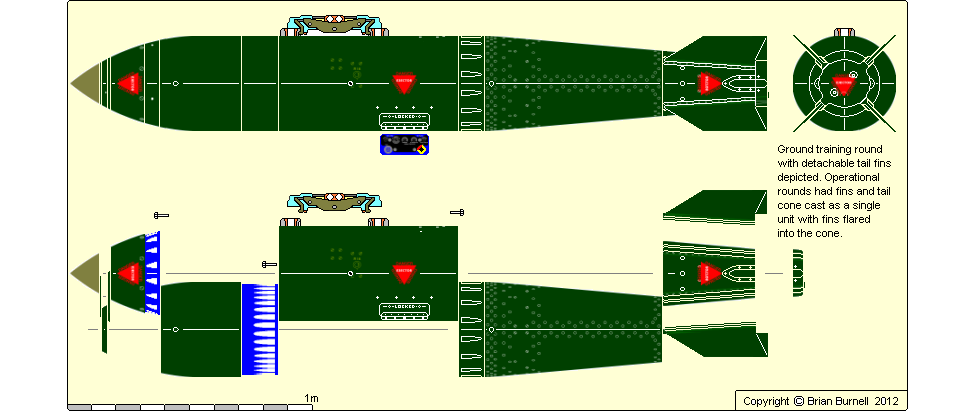
|
|
WE.177B
WE.177B weighed 457 kg (1'007.5 lb), with a single yield of 420 kt.
(129)
Although it weighed in excess of 1'000 lb it was known to the Armed Services as Bomb, Aircraft, HE 950 lb MC No.1.
WE.177B had a thermonuclear warhead, comprising two parts. The primary was KATIE referred to above, but without the variable yield facility or the NDB's hydrostatic fuse. KATIE was based
on a British design known as CLEO, earlier known as Super Octopus, intended as the thermonuclear primary for RE.179, a British warhead for the RAF version of the cancelled Skybolt
air-launched ballistic missile. The secondary (or fusion element) of RE.179 was based on the US W-59 warhead and was known by the British codename of SIMON. However, the W-59
primary used PBX-9404, a plastic-bonded-explosive, considered by the British to be unsafe. The US W-44 primary was replaced with a British primary developed from CLEO, that evolved into
KATIE, that did not use the shock-sensitive PBX-9404. When Skybolt was cancelled the fusion secondary of RE.179 was adapted with KATIE to become WE.177B (also referred to as
Weapon X) and in a smaller version, the British ET.317 warhead for the Royal Navy's Polaris A3T.
|
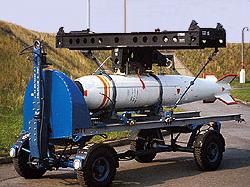 WE.177B and carrier, awaiting
aircraft loading at RAF Marham. Photo: Leitch.
|
WE.177B had airburst, impact, ground laydown and water laydown options. Roughly, 'laydown' can be taken to mean a ground burst or a sea surface burst with a time delay after a relatively soft
parachute retarded landing, enabling the bomber to escape the detonation. The nose and tail sections absorbed much of the energy, with the equipment in those sections being redundant after
touch-down. The warhead in the toughened centre section survived the crash-landing unscathed. Priority was given to the laydown option for the Vulcan bombers, and the first nine examples
deployed had no other option than laydown delivery. These nine weapons were recalled for early refurbishment when radar and other delayed equipment was retrofitted. The WE.177B
programme was completed by September 1967.
Skybolt strategic warheads ordered numbered 90
(130)
and at Skybolt cancellation this was the RAF requirement for WE.177B, although this quantity was reduced later. Numbers built are now certain with declassification of RAF Strike Command
papers in February 2013, and these reliable sources confirm the figure of 53 weapons.
(131) This number
was later reduced with the early withdrawal of one round, possibly after an accident. So, at the end of 1969, with RAF Strike Command relieved of the strategic strike role by the Royal Navy
Polaris force, there were 48 rounds issued to frontline aircraft in RAF Strike Command plus 4 operational spares used to maintain frontline strength while rounds were undergoing routine
maintenance. Vulcan aircraft of Strike Command then assumed a tactical bombing role while assigned to the Priority Strike Plan of SACEUR with 32 WE.177B weapons. A further 16 WE.177B
weapons were issued to the two Vulcan squadrons of NEAF (Near East Air Force) based at Akrotiri, Cyprus, to meet treaty commitments to CENTO. In total 48 frontline weapons plus 4
operational spares. With the conversion of the Victor bombers to fuel-tankers and retirement of the Vulcan bombers, WE.177B was carried by successor aircraft, including RAF Tornados and
Buccaneers. All WE.177B weapons were retired by August 1998.
|
Serial numbers of WE.177B weapons issued to Strike Command in the UK, and NEAF based at RAF Akrotiri, Cyprus, in December 1969 were as follows.
With a shortage of Type A weapons for NEAF to meet committments to CENTO, Type B high-yield weapons were substituted in NEAF until sufficient Type A weapons were delivered. This
diversion of Type B rounds to NEAF and retirement of Blue Steel by December 1969 left Strike Command without sufficient Type B weapons to meet a committment to provide 40 high-yield
weapons to SACEUR's Priority Strike Plan. Until the 16 NEAF Type B weapons could be replaced by newly-delivered WE.177A rounds, and 16 Type B rounds returned to Strike Command in
the UK, the 32 Type B operational rounds issued to Strike Command plus 4 spares were supplemented by Type A low-yield weapons as a short-term measure.
24 Strike Command Type B weapons were also expected to deploy to Singapore to meet treaty committments to provide 24 weapons for SEATO Plan 4, comprising RAF strikes in the Far
East in a limited nuclear war with China.
STC NEAF
5000 5315 5676 5816 5005 5465
5043 5341 5688 5856 5088 5483
5114 5380 5705 5879 5108 5568
5155 5417 5728 5894 5227 5608
5163 5436 5736 5955 5285 5693
5192 5517 5741 5968 5297 5840
5205 5553 5762 5972 5324 5881
5258 5585 5793 5986 5357 5925
5273 5621 5812 5990
36 rounds 16 rounds
(includes the 4 spares)
There are anecdotal reports that serial numbers were changed when weapons emerged from the ROF after refurbishment. However there is no documentary evidence to support those reports. What documentary evidence survives from the 1969 and 1975 Type A refurbs and later refurbs of all types shows that serial numbers remained the same before and after refurbishment. The only known exemption is that of the Type A operational round S/N 5796 which was withdrawn and converted to a surveillance round and numbered S8A.
Refurbishment, (re-lifing) was scheduled at intervals of three years, determined by the aging of tritium necessary for the boosted fission thermonuclear trigger. The earliest Type B rounds were issued in 1966 and refurbs were scheduled for 1969, 1972, 1975, etc. The latest declassifications (Jan 2015) indicate that refurb intervals were extended first to 3.75 years and 4 years. (215) . The reasons for these extensions is not known, but suggests that the rate of decay of tritium had been overestimated, and that in-service experience suggested that refurb intervals could be extended, or that boosted yield could be compromised in return for savings in industrial effort. At the time in question industrial issues at AWRE were a problem and effort needed to be directed to Chevaline warhead production.
Data from:
TNA DEFE 58/200 E15b p1 and E31 p2, declassified February 2013.
TNA DEFE 58/101 E75, E77, E95, E101, E102, E111, E112, E128, E129, declassified March 2007.
|
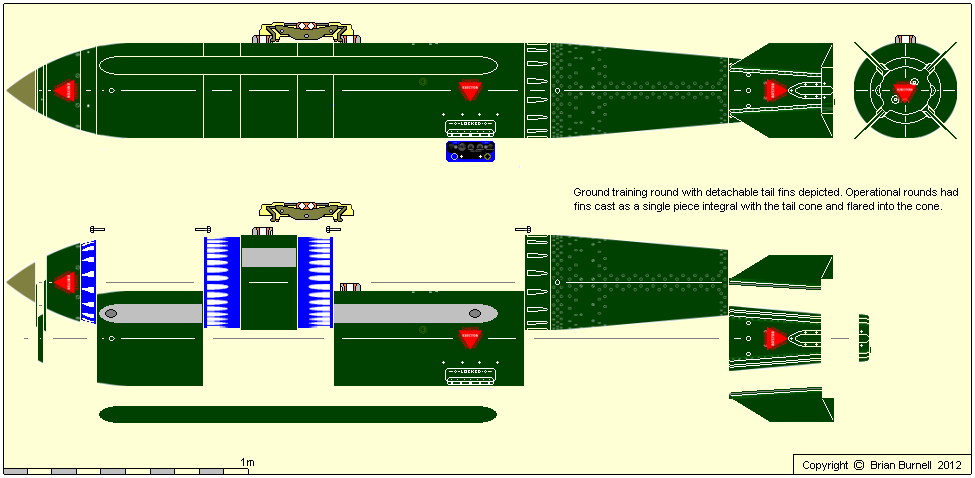
|
|
WE.177C
WE.177C weighed 457 kg (1'007.5 lb), with a single yield of 190 kt.
(132)
Initially, it was deployed only by RAF Germany in the tactical strike role, and used by Buccaneer, Jaguar and Tornado strike aircraft. It was developed to meet a NATO committment to arm RAF
Germany strike aircraft with weapons of a maximum 200 kt yield for use at the forward-edge-of-the-battlefield. An agreed NATO policy was to limit such weapons to 200 kt, and WE.177B (designed
for a strategic strike role) was too large at 420 kt, and WE.177A was too small at 10 kt. It is known from declassified archives that WE.177C was intended to replace the US supplied weapons
assigned to Canberra and Phantom tactical strike aircraft of RAFG when they were replaced by Buccaneer and Jaguar tactical strike aircraft. These US B-43 weapons were of 130 kt yield
(133)
and believed to be the Y4 variant.
(134)
Military doctrine in NATO was changing, and by the mid-1970s there was a requirement to replace the obsolete Honest John nuclear-armed missile deployed by the British and other
NATO armies. Honest John had a range of 35 km (22 miles)
(135)
and its replacement, the Lance missile rather more at 125 km (80 miles).
(136)
Lance had selectable yields between ½ kt and 50 kt.
(137)
Nuclear artillery with much smaller yields between 0.1 kt and 10 kt provided battlefield nuclear supporting fire up to 14 km (9 miles)
(138)
and aircraft were assigned the task of attacking more distant targets beyond the forward edge of the battlefield in enemy rear areas. A weapon with greater yield than Lance and WE.177A was
required for this task, and SACEUR wanted a higher yield than the 130 kt provided by the US weapons assigned to Canberra and Phantom aircraft. The Canberra was obsolete and the Phantom
was scheduled to be re-assigned to other duties with the withdrawal of their US weapons. The Canberras were replaced by Buccaneers, the F4 Phantoms were replaced by Jaguars and augmented
later with the Tornado. The Buccaneer aircraft were equipped to carry two WE.177A or WE.177B weapons
(139)
and no changes were needed to carry two WE.177C weapons, whereas to carry US weapons, expensive modifications were needed. British-owned replacements for these US weapons had
operational military advantages
(140)
(the weakest and slowest link in the chain-of-command was in the handover from US custody to operational users in the midst of resistance to a fierce enemy assault) and British-owned
weapons in British custody were at lower risk of being over-run before weapons were released from US custody; and were believed to also confer political benefits,
(141)
demonstrating to allies and potential enemies a determination by the British government to support Nato nuclear strategy, rather than rely wholly on the United States to supply dual-key weapons.
In the early 1970's, the British government was negotiating to join the European Union, and wished to reassure France in particular about reliance on US supplied weapons. These numerous
contributing factors were a part of the genesis of WE.177C.
WE.177C was deployed from the mid-1970's
(142)
to co-incide with the introduction into service of the Buccaneer and Jaguar aircraft, and before deployment of Chevaline had begun. The design history of both WE.177C and Chevaline are intertwined.
The fission primary of ET.317, the fission primary of the first Polaris warhead was codenamed Jennie. It was derived from the Super Octopus-Cleo-Katie lineage used in
WE.177A and WE.177B, and used in Polaris was believed vulnerable to Soviet ABMs and scrapped, although the similar Katie fission devices used in WE.177A and WE.177B were in
different operational environments where they were not vulnerable to ABM defences.
The fusion secondary of ET.317, codenamed Reggie, was derived from the W-59 - RE.179 secondary lineage, and named Simon in WE.177B. As used in Polaris A3T,
Reggie was a downsized version of Simon, and was salvaged and re-used in the Chevaline warhead with a newly designed super-hardened primary. However, there were three warheads on
each Polaris missile, but only two on its successor, Chevaline. The one-in-three spare Reggie secondaries were then salvaged and re-used as the secondaries for WE.177C, matched with a
'converted' Katie A as the primary.
(143)
The 'conversion' (MoD description) probably entailed removal of the variable yield equipment and hydrostatic fusing. This primary and secondary were then installed in a casing identical to the
WE.177B casing and ballasted to have similar weight and ballistic properties, intended to minimise development time and cost. However, another codename, Cirene, previously not
used, appeared in declassified files in connection with Simon, Reggie, and WE.177A weapons 'converted' to WE.177C format.
(144)
The function of Cirene is not known. However, a reasonable deduction is that the 'converted' warheads from WE.177A were re-named Cirene, a female name, as were Katie, Cleo, etc. All known
fission warheads appear at that time with female names, and all known secondaries appear with male names, so a reasonable deduction is that Cirene was a fission primary for WE.177C,
converted from Katie A.
This combination of a Katie A primary from WE.177A and a Reggie secondary salvaged from Polaris/ET.317 produced a yield of 190 kt in WE.177C. Almost identical to the 200 kt yield of the
ET.317 warhead of Polaris. Co-incidentally, the government of the day had decided after the 1966 General Election that they would build "no new nuclear weapons". With some examples of
WE.177C being partly composed of salvaged components, and the remainder built to an existing design requiring no further testing, astute collectors of Westminster politician's weasel words
will focus on the precise meaning of the word "new"
(145) .
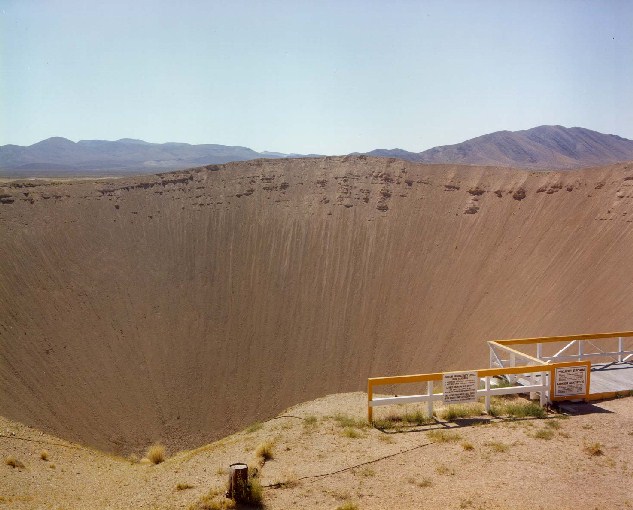 |
|
Known serial numbers of 51 WE.177C weapons issued to Strike Command (STC) in the UK, and RAF Germany (RAFG) are listed below.
8000 8095 8262 8399 8590 8697 8823 8939
8022 8126 8270 8417 8620 8710 8844 8966
8034 8171 8278 8458 8624 8714 8887
8041 8200 8289 8459 8628 8730 8900
8049 8203 8293 8470 8646 8753 8918
8054 8209 8333 8474 8663 8768 8923
8071 8234 8365 8551 8692 8781 8933
These included the serials of the Type C weapons due by Spring 1977 for refurbishment (re-lifing of the tritium booster gas) after three years of operational assignment. From this we can conclude that the first of these 51 weapons were issued in early 1974 because in January 1977 declassified files showed 39 weapons listed for re-lifing up to April 1978, and others were added from later listings.
No precise total production figures are yet known, although research by Dr John Walker of the Foreign Office Arms Control and Disarmament Unit and published in 2011 by RUSI*** puts the number at 125 Type C weapons produced, 14 of these being converted from Type A and 111 new-build.
There are anecdotal reports that serial numbers were changed when weapons emerged from the ROF after refurbishment. However there is no documentary evidence to support those reports. What documentary evidence survives from the 1969 and 1975 Type A refurbs and later refurbs of all types shows that serial numbers remained the same before and after refurbishment. The only known exemption is that of the Type A operational round S/N 5796 which was withdrawn and converted to a surveillance round and numbered S8A.
Refurbishment, (re-lifing) was scheduled at intervals of three years, determined by the aging of tritium necessary for the boosted fission thermonuclear trigger. The earliest Type C rounds were believed to be issued in 1974 with refurbs scheduled for 1977, 1980, 1983, 1986, 1989, 1992, 1995 and 1998. The final Type C rounds were withdrawn and dismantled by 1998.
The latest declassifications (Jan 2015) indicate that refurb intervals were extended first to 3.75 years and 4 years. (216) . The reasons for these extensions is not known, but suggests that the rate of decay of tritium had been overestimated, and that in-service experience suggested that refurb intervals could be extended, or that boosted yield could be compromised in return for savings in industrial effort. At the time in question industrial issues at AWRE were a problem and effort needed to be directed to Chevaline warhead production.
Data from:
TNA DEFE 58/101 E130, declassified March 2007, and TNA DEFE 72/202, declassified January 2015.
*** Dr John Walker, Foreign Office Arms Control and Disarmament Unit, British Nuclear Weapons Stockpiles, 1953-78. Published Oct 2011 in the Royal United Services Institute Journal.
|
WE.177C was retired by August 1998. Numbers are speculative, but based on hard evidence in declassified files, the number of spare secondaries after dismantling of Polaris war-ready
operational warheads, plus spares from the servicing and supply chain produces a figure of 63, and this is the likely initial quantity of WE.177C. It is known from declassified files that the Royal
Navy at this time had four boatloads of Polaris missiles and warheads, plus approximately 15% spares in the supply and servicing chain, totalling 74 tactical (operational war-ready) missiles.
(146)
with 222 warheads. The Navy then reduced their stockpile to three tactical outloads plus spares totalling approx 53 missiles and 159 warheads.
(147)
So approximately 63 warheads were surplus, and their secondaries were available for re-use in Chevaline (two per missile) and one in WE.177C; the fission primaries being dismantled and the
fissile material recycled into new primaries for Chevaline. Although the number of WE.177A primaries available for 'conversion' to WE.177C may have been a limiting factor. There is as yet, no
hard evidence. There is other evidence that RAF orders for WE.177A weapons for delivery after the RAF's initial order for 44 WE.177A weapons were converted into orders for WE.177C. RAF
Plan R figures shown in the table below show that total RAF orders would be for 157 WE.177C weapons; although RAF planning could, and did, change at frequent intervals.
Other calculations derived from declassified records of the numbers of weapons assigned to the known numbers of aircraft, plus spares, produce similar overall numbers of weapons. It is known
that RAF Germany Buccaneer aircraft assigned to SACEUR were each configured to carry two WE.177C weapons.
(148)
Jaguar aircraft were configured to carry only one. Tornado aircraft were similarly configured. Overall, considering all three variants of WE.177, there were fewer weapons than aircraft, because RAF
staff officers calculated that some aircraft would be lost in the conventional phase of the air war before tactical nuclear weapon release was authorised. Planners sought to hold back enough aircraft
from the conventional air war phase to ensure that their stock of nuclear weapons could be delivered by those survivors.
(149)
For that reason, Jaguar aircraft were assigned fewer nuclear weapons (6 weapons per 10 aircraft) because based on their planned usage, RAF planners believed that the Jaguar squadrons would
suffer higher attrition in a conventional air war.
(150)
|
|
Carriage
Although Victor B2 bombers were intended to carry WE.177B until Polaris became operational, the successful trials of low-level launches of Blue Steel made that unnecessary, and WE.177B
was never deployed on the Victor bomber.
Type A, B and C weapons were carried by RAF strike aircraft comprising the Vulcan, Buccaneer, Jaguar, Tornado, and also the Royal Navy's Sea Harrier FRS.1. Seven Vulcan squadrons
were operational with WE.177 in 1970 and 1971, and six squadrons from 1972-81. Seven squadrons of Jaguars were declared operational with WE.177 between 1977-80, and six squadrons
for a longer period. Five RAF Buccaneer squadrons plus one Royal Navy squadron were declared operational with WE.177 from 1975-78, and 1980, with a lesser number for a longer period.
Ten Tornado squadrons equipped with various versions of WE.177 were operational from 1986-91, with a lesser number for a longer period. Squadron numbers varied with the production of
weapons and the phasing in and out of aircraft types, building from six squadrons in 1966 to a high point of nineteen squadrons in 1977-78. Although photographs exist of RAF ground-attack
Harriers carrying WE.177, and clearance was required for the Harrier by OR.1177, there is no evidence that any RAF Harrier squadron was deployed with this weapon.
Squadrons equipped and declared operational with WE.177 were numbered:
6,
9,
12,
14,
15,
16,
17,
20,
27,
31,
35,
44,
45,
50,
54,
101,
208,
216,
617,
800 NAS (Naval Air Squadron),
809 NAS (Naval Air Squadron),
226 OCU (RAF shadow squadron),
237 OCU (RAF shadow squadron),
The two shadow units were dual-role training units (Operational Conversion Units) that reverted to operational duties, assigned to SACEUR in a European tactical nuclear war. One was a
Buccaneer unit, one was a Jaguar unit. More precise data with squadron identities and basing can be seen using the links below. The Royal Navy's helicopter squadrons are omitted since
basing of single helicopters embarked on numerous small escort ships is difficult to collate reliably.
1966 Vulcan @ Waddington, Cottesmore.
1967 Vulcan @ Waddington, Cottesmore.
1968 Vulcan @ Waddington, Cottesmore.
1969 Vulcan @ Waddington, Akrotiri.
1970 Vulcan, Buccaneer @ Waddington, Akrotiri, Scampton, Honington, HMS Eagle.
1971 Vulcan, Buccaneer @ Waddington, Akrotiri, Scampton, Honington, Laarbruch,
HMS Ark Royal, HMS Eagle.
1972 Vulcan, Buccaneer @ Waddington, Akrotiri, Scampton, Honington, Laarbruch,
HMS Ark Royal, HMS Eagle.
1973 Vulcan, Buccaneer @ Waddington, Akrotiri, Scampton, Honington, Laarbruch,
HMS Ark Royal.
1974 Vulcan, Buccaneer @ Waddington, Akrotiri, Scampton, Honington, Laarbruch,
HMS Ark R.
1975 Vulcan, Bucc, Jaguar @ Waddington, Scampton, Honington, Laarbruch, Lossiemouth, Coltishall, HMS Ark R.
1976 Vulcan, Bucc, Jaguar @ Waddington, Scampton, Honington, Laarbruch, Lossiemouth, Coltishall, Bruggen, Ark R.
1977 Vulcan, Bucc, Jaguar @ Waddington, Scampton, Honington, Laarbruch, Lossiemouth, Coltishall, Bruggen, Ark R.
1978 Vulcan, Bucc, Jaguar @ Waddington, Scampton, Honington, Laarbruch, Lossiemouth, Coltishall, Bruggen, Ark R
1979 Vulcan, Bucc, Jaguar @ Waddington, Scampton, Honington, Laarbruch, Lossiemouth, Coltishall, Bruggen.
1980 Vulcan, Bucc, Jaguar @ Waddington, Scampton, Honington, Laarbruch, Lossiemouth, Coltishall, Bruggen.
1981 Vulcan, Bucc, Jaguar @ Waddington, Scampton, Honington, Laarbruch, Lossiemouth, Coltishall, Bruggen.
1982 Vulcan, Bucc, Jaguar @ Waddington, Honington, Laarbruch, Lossiemouth, Coltishall, Bruggen.
1983 Buccaneer, Jaguar, Tornado @ Honington, Laarbruch, Lossiemouth, Coltishall, Bruggen, Marham.
1984 Buccaneer, Jaguar, Tornado @ Honington, Laarbruch, Lossiemouth, Coltishall, Bruggen, Marham.
1985 Buccaneer, Jaguar, Tornado @ Honington, Laarbruch, Lossiemouth, Coltishall, Bruggen, Marham.
1986 Buccaneer, Jaguar, Tornado @ Honington, Laarbruch, Lossiemouth, Coltishall, Bruggen, Marham.
1987-91 Buccaneer, Jaguar, Tornado @ Honington, Laarbruch, Lossiemouth, Coltishall, Bruggen, Marham.
1992 Buccaneer, Jaguar, Tornado @ Honington, Laarbruch, Lossiemouth, Coltishall, Bruggen, Marham.
1993 Buccaneer, Jaguar, Tornado @ Honington, Lossiemouth, Coltishall, Bruggen, Marham.
1994 Buccaneer, Jaguar, Tornado @ Lossiemouth, Coltishall, Bruggen, Marham.
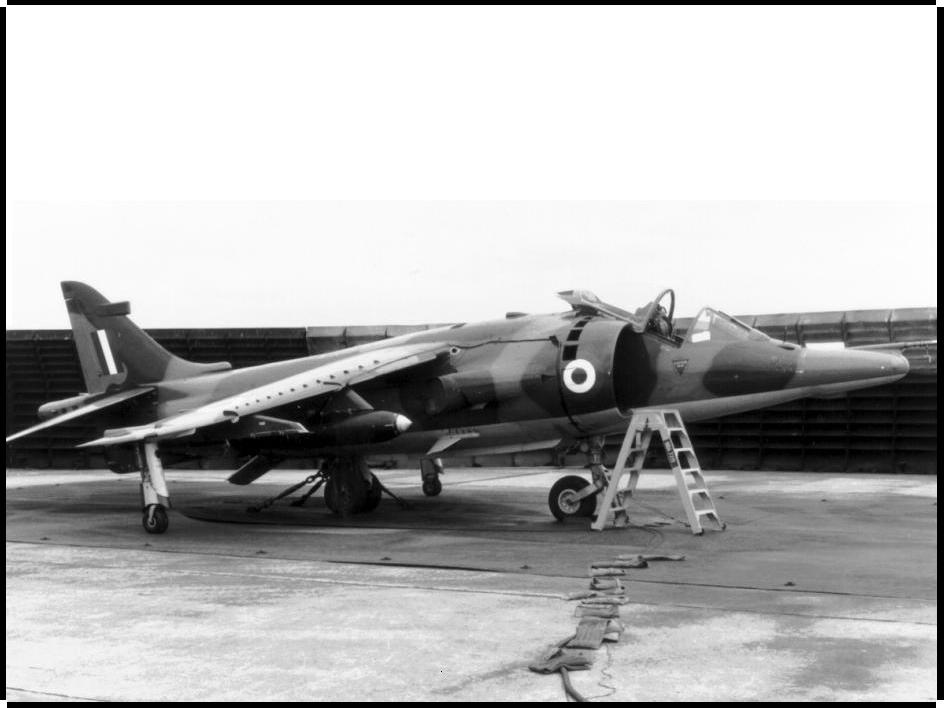 |
|
|
Royal Navy Sea Harrier FRS Mk.1 strike aircraft carried WE.177A slung beneath the starboard wing, and carrier-borne Royal Navy and RAF shore-based Buccaneer strike aircraft carried two
WE.177A weapons internally. Although never issued with WE.177B weapons, the Buccaneers were equipped to carry them and WE.177C, although there is no hard evidence that WE.177C
was issued to RAF Buccaneer squadrons. In the anti-submarine role, Royal Navy Wasp, Wessex, Lynx and Sea King embarked helicopters were configured to deliver WE.177A. The Wasp,
and Lynx helicopters were embarked on frigates and destroyers, with the larger Wessex and Sea Kings aboard carriers. Significant numbers were stored aboard RFA fleet supply ships which
could also operate the larger helicopters.
|
|
Delivery
All versions of WE.177 had air-burst capability, as evidenced by the white translucent window in the nose of the bomb, which housed a radar altimeter, and all versions had a back-up
ground-burst-on-impact capability as insurance against failure to detonate the airburst. All versions had a selectable ground-burst capability when a ground-burst was required. A laydown
capability was also available (a soft landing followed by a time delayed ground burst). In addition, a laydown capability in water was provided to attack sea surface targets. For this, a soft
landing followed by parachute detachment at splashdown facilitated sinking, followed by a short time delay and an underwater burst.
In the anti-submarine role WE.177A functioned as a depth bomb. For delivery by helicopter, the drogue gun was removed and the parachutes were activated by a lanyard. The parachutes
detached at slashdown to assist rapid sinking. The nose section, the rear centrebody section and the tail flooded with seawater. Only the pressurized warhead and arming unit section remained
watertight. Sink rate was approximately 20 feet per second. The two NDB yields were necessary because even in deep oceanic water the full yield of 10kt would sometimes risk damaging
nearby friendly shipping, and a reduced yield was also required for use in shallow coastal waters. Detonation was by duplicated hydrostatic fuzes, unlike the US B-57 NDB which used a preset
timing device. Although never deployed on Nimrod maritime aircraft, it was intended that low-level release from these aircraft (and the proposed Brequet Atlantic interim maritime aircraft) would
be at low speeds and heights of approx 150 knots and 1'000 ft. In these conditions, the drogue gun was to be removed and replaced by a lanyard and an auxiliary parachute pack derived from
the US Mk-44 air-launched torpedo.
|
|